30 March 2014

In the Wake of Myriad, Gunpowder is Not Patent-Eligible: USPTO

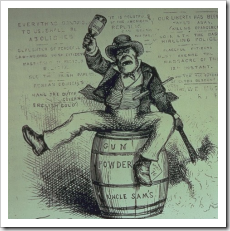
Powder KegThe US Patent and Trademark Office (USPTO) has concluded that recent decisions of the US Supreme Court relating to patents for genes and for diagnostic methods mean that mixtures of ‘naturally-occurring materials’ are not patent-eligible – at least, not unless one or more of the components has been ‘changed’ in some way from its natural state.

The USPTO has published an extensive (93-slide) presentation used for examiner training [PDF, 972KB] on the Supreme Court’s interpretation of section 101 of the US patent statute in Mayo Collaborative Services v Prometheus Laboratories, Inc. (2012) and Ass’n for Molecular Pathology v Myriad Genetics, Inc. (2013).  In an example to be found on slide no. 55, examiners are told that ‘gunpowder’ would not be eligible for patenting (even if it was not already known) because as ‘a mixture of three naturally occurring materials: potassium nitrate, sulfur and charcoal’ it is ‘not markedly different’ from naturally-occurring materials, ‘because none of the components have been changed.’

This will no doubt come as a surprise to many people, who would not have held any real doubts that gunpowder was ‘invented’ by the Chinese, around the 9th century C.E.  Indeed, as the quite well-researched Wikipedia entry on the History of Gunpowder explains, it took a few centuries, and a number of educational accidents, to refine the proportions of gunpowder’s constituent parts to produce maximum explosive effect.

While there is no question that effective gunpowder can be made by combining materials that occur in nature, the resulting combination is not (fortunately) naturally-occurring!  There is, to my knowledge at least, nowhere in the natural world at which dangerously flammable reserves of potassium nitrate, sulphur and charcoal can be found just lying around in wait of a serendipitous lightning strike!  (Interestingly, however, there is evidence that 17 nuclear fission reactors once formed and operated naturally for around a million years in what is now Gabon, western Africa.)

Conventional wisdom would have it that, in the case of a combination like gunpowder, the prospective invention lies in bringing the components together to create something useful.  If the combination is not previously known, and not obvious, then it should be patentable.  Apparently, the USPTO no longer believes in this conventional wisdom!

29 March 2014

IP Australia to Accept International Applications Online via ePCT

WIPO logoFrom 14 April 2014 it will be possible to file international applications under the Patent Cooperation Treaty (PCT), designating IP Australia as the Receiving Office, via the World Intellectual Property Organization (WIPO) ePCT online filing service.

Currently, electronic filing of PCT applications with IP Australia is possible using the PCT-SAFE system.  This requires documents and filing forms to be prepared using a dedicated software package installed on the user’s PC.  The software creates a file that is then uploaded to IP Australia’s website to lodge the application.  The PCT-SAFE software includes useful features, such as the ability to store applicant details for future re-use in subsequent applications, but all of the stored data is confined to the computer system on which the software is installed (although there are export/import functions provided so that this data can be moved).

WIPO’s ePCT system takes all of the PCT-SAFE functionality, and more, online so that it is accessible from anywhere a web browser can be found (subject to possession of a WIPO digital certificate, of which more below). 

The ePCT system also retains applicant and inventor details (names, addresses, nationality etc) so that they do not need to be re-entered every time they are needed.  It allows partially complete applications to be saved.  Once an application has been filed, it remains on the user’s list of applications, and can easily be accessed to obtain up-to-date status information, and to submit further documentation for processing, such as changes of applicant, inventor or agent names or addresses.  The creator or owner of an application filed via ePCT can assign roles to other users, so that various access rights can be made available to different people, e.g. members of an IP management team.

IP Australia has stated that ePCT will be its preferred channel for filing of PCT applications and associated requests, from 14 April 2014.  Clients who are currently using PCT-SAFE or more traditional (i.e. paper) filing methods will want to look at switching over to ePCT as soon as possible.

23 March 2014

Should Pharmaceutical Patent Term Extensions Be Shorter?

Expensive PillsLast month, the Federal Minister for Industry, Ian Macfarlane, stated that the government had no intention of releasing the final report of the Pharmaceutical Patents Review.  Last week, following the submission of at least one request under the Freedom of Information Act (although I understand there were others), the report was made available on IP Australia’s website.

The release of the report is described as being in response to ‘stakeholder interest’, which is true enough!  It is accompanied by the following government statement:

The Pharmaceutical Patent Review was commissioned by the previous government and conducted by an independent panel. The review panel provided its final report to the previous government in May 2013, which did not release the report.

The government notes that the report is one of a number of reviews of the pharmaceutical system conducted during the term of the previous government. The government has no plans to respond to the report at this stage but may take information in the report into account when considering future policy. The views expressed and recommendations made in the report are those of the review panel and do not necessarily reflect government policy.

In other words, ‘we did not commission it, the people who did commission it did not release it, we were not going to release it until we were forced to, and we are going to ignore it anyway!’

The report is some 234 pages in length, and I have no intention of trying to cover everything in it, particularly considering that it is unlikely to influence government policy.  However, one of the key issues addressed by the review – whether the current system for extending the term of certain pharmaceutical patents is appropriate – is certainly worthy of further discussion.  All members of the review panel recommended a reduction in the duration of extended patents.

22 March 2014

New IP Law Reform Bill Hits Australian Parliament

Law booksOn Wednesday, 19 March 2014, the Intellectual Property Laws Amendment Bill 2014 was introduced into the Australian House of Representatives.

If passed (as seems likely), the bill will: implement Australia’s obligations under the TRIPS Protocol; provide for cheaper litigation options under the Plant Breeder’s Act; provide for single patent application and examination processes for Australia and New Zealand, and for a single trans-Tasman patent attorney regime; and implement a number of administrative changes and corrections in the Patents, Trade Marks and Designs Acts.

I last wrote about this bill back in January, when IP Australia released an exposure draft, calling for public comment.  No submissions in response to the call appear to have been published.  In any event, the version of the bill introduced into parliament last week is almost identical to the exposure draft.  I have prepared a marked-up copy showing the differences between the final version of the bill, and the exposure draft.  (My earlier document showing the changes between the 2013 version of the bill and the exposure draft is also still available.)

The one substantive change between the exposure draft and the final bill is that a proposal to repeal section 185 of the Patents Act 1990 has been abandoned.  If you are not familiar with section 185, you are not alone.  I do not think I have ever previously had cause to look at it, mainly because it applies only to officers and employees of IP Australia, and is therefore not a provision to which a patent attorney would normally need to refer. 

Basically, section 185 prohibits employees of IP Australia from doing certain things which have a clear potential to give rise to a conflict of interest, and which generally would therefore be contrary to the terms of their employment in the public service in any event.  It is not clear to me why the decision to repeal the section has been reversed, however it could be political expediency – someone may have felt that a proposal coming out of IP Australia to repeal an offence that could only be committed by its own employees could perhaps be regarded unfavourably.

16 March 2014

Australian Federal Court Considers Patent Attorney Privilege

Australian Mud Company Pty Ltd v Coretell Pty Ltd [2014] FCA 200 (13 March 2014)

Legal ParaphenaliaIt was only last month that I wrote about the changes to ‘patent attorney privilege’ introduced by last year’s Raising the Bar law reforms, and now we have the first decision of the Federal Court of Australia to consider the new provisions.

Just to recap quickly, the ‘privilege’ I am referring to is the legal professional privilege which protects communications between legal professionals and their clients, along with related records and documents, from compulsory disclosure by order of a court, or under a provision of statutory law.  Patent attorneys are not lawyers, and communications between patent attorneys and clients are therefore not automatically protected under common law, or by relevant provisions of the Evidence Act 1995.  Instead, express provision is made for patent attorney privilege in section 200 of the Patents Act 1990.

Interestingly, although I have speculated that the enhanced patent attorney privilege may apply only to communications, records and documents made on or after 15 April 2013, it appears to have been accepted by the parties to the dispute in this case, and by the court, that the current provisions apply to communications that took place between patent attorney and client back in 2004.  However, I do not think that this can be regarded as settled law, considering that a judge of the same court previously expressed doubts as to the retroactive effect of an earlier change to the law in relation to patent attorney privilege (Wundowie Foundry Pty Ltd and Clarewood Pty Ltd v Milson Foundry Ltd and David Wallace [1993] FCA 422).

More importantly, for patent attorneys and their clients, the court has confirmed that the current patent attorney privilege provisions protect a broad range of communications, records and documents made for the ‘dominant purpose’ of providing patent attorney services, including technical documents and communications made in the course of preparing a patent application.  Furthermore, the court found that neither public use of an invention, nor the ‘lodgement and subsequent publication of a patent application’ results in a waiver of privilege.

Copyright © 2014
Creative Commons License
The Patentology Blog by Dr Mark A Summerfield is licensed under a Creative Commons Attribution-NonCommercial-ShareAlike 3.0 Australia License.