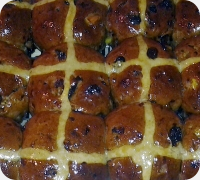
 I am sometimes asked – as I am sure most patent attorneys are – whether it is possible to patent a recipe. This provides a sufficient connection to the subject matter of this blog to allow me, as a special ‘Easter report’, to post my recipe for hot cross buns, which is surely not patentable. But first, for those who are actually interested, I shall explain how recipes are treated under the patent laws.
To put it simply, the answer to the question above is, in the vast majority of cases, ‘no’.
Gene Quinn over at his IP Watchdog blog wrote a nice piece on this topic back in February, explaining why most recipes are not patentable in the US (see The Law of Recipes: Are Recipes Patentable?). In that country, the primary barrier to patenting of recipes is obviousness, i.e. lack of inventive step.
While a new recipe for baking a cake, or making a cocktail, might be technically ‘new’ (i.e. pass the novelty test) because the particular combination and/or quantities of ingredients have never before been published, it will almost certainly be a variation on one or more existing recipes. Under the US law of obviousness, you cannot invent something patentable just by trying various different combinations of known elements in a recipe until you have something that you swear is better than mum’s (or mom’s) version!
RECIPES AND AUSTRALIAN PATENT LAW
In Australia, there is a more fundamental problem than inventiveness. Section 50 of the Patents Act 1990 expressly states that:(1) The Commissioner may refuse to accept a request and specification relating to a standard patent, or to grant a standard patent:
…
(b) on the ground that the specification claims as an invention:
(i) a substance that is capable of being used as food or medicine (whether for human beings or animals and whether for internal or external use) and is a mere mixture of known ingredients; or
(ii) a process producing such a substance by mere admixture.
Section 2.9.7 of the Australian Patent Examiner’s Manual provides some additional guidance on how this exclusion is interpreted:
The term "capable of being used as a food" includes mixtures which may require cooking or other preparation before they are edible. Mixtures falling within this term may include ingredients which, of themselves, are not foodstuffs, e.g. baking powder, colouring matter or other additives, so long as the mixture as a whole is capable of being used as a food.
"Mixtures" may embrace not only powders or granules, either loosely or in compacted form (e.g. a tablet or pill), but also mixtures of liquids or gases and includes also suspensions and solutions.
So, in general, you cannot have a patent in Australia for processes involving mixing and/or cooking known ingredients to produce edible results. In other words, a recipe is not typically patentable.
An exception will arise, however, when there is something distinctly new and unexpected about the results achieved. As the Manual goes on to say:
By "mere mixture of known ingredients" is meant a mixture exhibiting only the aggregate of the known properties of the ingredients. Not only must the ingredients be known, but the property which makes the ingredients useful for the purpose of the invention must also be known.
If the result achieved by the invention is more than might be expected from a mere mixture (i.e. synergism), the invention is patentable.
Notably, this is exactly the same sort of thing that would also usually qualify an invention as non-obvious in the US. For example, the use of a particular ingredient in a particular quantity might surprisingly increase the shelf-life of the end product, or it might result in more efficient absorption of nutritional ingredients by the body, or achieve some other such functional benefit.
So, while the statutory provisions in the two countries may be different, the end result is much the same: unless you developed it in a lab, rather than a kitchen, you probably cannot have a patent for your invention!
So, with the obligatory patent discussion out of the way, here is my recipe for hot cross buns.
PATENTOLOGY’S UNPATENTED HOT CROSS BUNS
The recipe has been developed using a bread machine for the initial mixing, kneading and rising stages. I certainly recommend this, because it takes a lot of the hard work out of the process, and produces a more consistent result. And I am pretty lazy when it comes to such things (I use the same ‘cheat’ for pizza dough). If you are the kind of person who is accustomed to doing your own kneading by hand, you should also be able to adapt the recipe to suit.My early efforts followed a recipe in the bread machine manual pretty closely. But this involved powdered milk, to which I am ideologically opposed! So I hunted around the internet looking at various recipes (they all vary), and noting some of the common features, and after a little trial and error came up with a working hybrid which includes, contains or comprises (pardon the patentese) real milk and a whole egg.
One thing that I have done intentionally is to ensure that all of the ingredients are measured by weight (approximate equivalent volume measures are also supplied). You can literally put the bread machine pan onto a digital scale, and just add the ingredients in the order listed, which minimises the amount of cleaning up to be done at the end.
I make no apologies for the mixed peel. You can replace this with alternative dried fruit (chopped dried apricots might work) if it is not your thing, but I take no responsibility for the results!
DOUGH
Using fresh yeast
The recipe seems to work better with fresh live yeast. This is sold in good delicatessens, and comes in a compressed ‘block’ of a crumbly consistency.If you can get fresh yeast, and would like to give it a try, it is pretty simple. The rule of thumb is that the required weight of fresh yeast is about three times the equivalent active dry yeast.
So crumble up about 21 g of yeast (the closest I can get with my scale is the nearest 5 g, but this does not seem to be a problem) and dissolve it in 40 g (2 tbsp) of tepid water (not hot – body temperature is ideal). Make sure it is well mixed – you do not want clumps of yeast in the dough!
You need to reduce the milk by the same amount, i.e. to 300 g. Then pour the yeast/water blend over the other ingredients immediately before activating the machine.
- milk 340 g (340 ml)
- 1 beaten egg
- oil (e.g. grapeseed or a mild olive oil) 30 g (2 tbsp)
- salt 10 g (2 tsp)
- brown sugar 50 g (3 tbsp)
- bread flour (strong baker’s flour, 12% protein) 600 g (4 metric cups)
- Ground mixed spice 15 g (1 tbsp)
- dry yeast 7 g (typically one sachet, approx. 2¼ tsp)
At around 22 minutes in to the kneading cycles (my machine provides a helpful ‘beep’) add the fruit:
- sultanas 190 g
- mixed peel 40 g
SHAPING
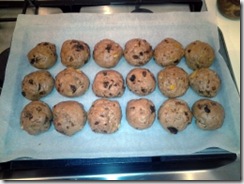 When dough is ready, divide into the desired number of pieces and shape into rounds. The recipe makes 12 large buns, 18 medium buns (roughly the size of commercial buns) or 24 small buns. I find the dough to be tacky, but not overly sticky, so it can be worked without using additional flour to prevent sticking.
Arrange rounds on a baking tray/sheet, either lightly greased or (preferably) on a sheet of baking paper. Then cover loosely with plastic/cling wrap, and place in a warm location to rise for about 20-30 minutes, or longer if desired. The distance between rounds should be 1-2 cm, depending on the size of the buns – they should roughly double in size, and just come into contact with each other at closest points, which allows crosses to be applied as a ‘grid’ without spillage!
Now wait again…
CROSSES AND BAKING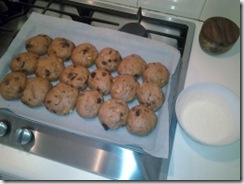
For crosses, mix:
- water 3 tbsp
- plain flour 3 tbsp
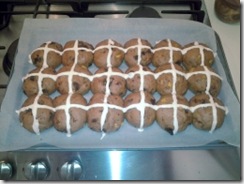 Apply the batter to the buns in a grid pattern, using an icing syringe or piping bag or (at a pinch) using a plastic bag (eg a freezer bag) with a corner cut off. You may need to experiment to get the desired width and consistency of crosses! The quantity is not critical, so just add water or flour, as required, if batter is too runny or too thick. With experience, you will not need to measure – just spoon some flour into a bowl, add water and blend, adjusting ingredients as required.
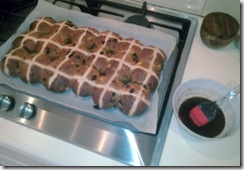 Preheat your oven to around 180-190 C (these are fan-forced temperatures – 10-20 C higher temperature may be required for non-forced ovens). Bake buns for 15-20 minutes. Keep an eye on the buns for the last few minutes, too ensure that they do not become too brown!
Remove buns from the oven and transfer to a wire rack to cool slightly. When applying glaze, you can place the wire rack over the baking paper and baking tray/sheet to catch the drips and make cleaning up easier.
GLAZING
For the glaze, blend:- icing sugar, sifted ½ cup
- ground allspice and/or mixed spice ½ - 1 teaspoon (to taste)
- ground cinnamon ¼ - ½ teaspoon (to taste)
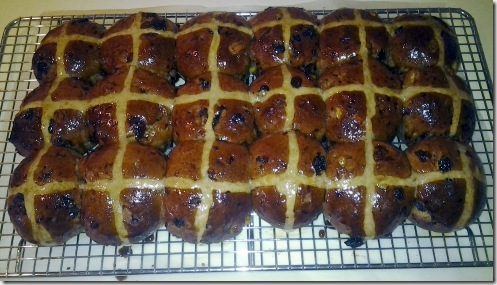
Serve fresh while still warm, or cool and store in an airtight container to be served cold, or reheated when required. Do not refrigerate (unless you want hot cross cannonballs)!
REHEATING
Preferred reheating methods vary. You can microwave, or heat on a tray or wrapped in foil in the oven. Whatever method you use for store-bought buns should work for these. My preferred method is as follows:- Wrap buns to be reheated snugly in a ‘tray’ made from aluminium foil, so that bases and sides are covered, but tops remain exposed.
- Preheat oven to around 180 C.
- Heat wrapped buns in oven for about 15 minutes, or until heated and browned to your liking.
SERVING
I like to serve buns with a good-quality French salted cultured butter (e.g. Lescure or Beurre D’Isigny). Of course there are plenty of cheaper products, but after going to all this trouble to make the buns, why settle for anything but the best?!Happy Easter, everyone!
Tags: Australia, Patent law, Personal, Recipes




5 comments:
If you had felt an urgent need for a patent, I think you could have got a process claim. Your steps of using a bread-making machine, and adding ingredients directly to the weighing pan, would probably give you novelty and avoid the 'mere admixture' rejection. Inventive step is nearly always arguable. However, I feel sure you advised yourself that there was no point in a patent, because it would be impossible to enforce!
This is a good point, Tim, and one which is also brought out in the IP Watchdog article referenced at the top of my article. While recipes per se are not patentable, a novel and advantageous way of performing a step in implementing a recipe may support a valid process claim.
The difficulty with arguing inventive step in this case is that the breadmaker actually has specific programs, and instructions, for making dough without completing the baking process. This leaves only the direct addition of ingredients as a possible basis for inventiveness. I suppose one might argue that this is counter-intuitive, because all recipes in the breadmaker instruction manual specify most ingredients by volume, rather than weight.
But as you say, enforcement would be an issue. In this case, there is nothing which would distinguish the finished product of my method from buns made using the same combination of ingredients without use of the breadmaker.
Clearly my method saves labour. I devised it because I am a lazy cook, and I hate washing up! In a commercial context, of course, a labour-saving process may provide competitive advantage by reducing the cost and/or increasing the volume of production. But since applying for a patent requires disclosure of the process, and enforcement is then potentially problematic, this is a classic example where maintaining the process as a trade secret may be a better course of action.
Mark, your discussion refers to patents. What about copyright and trade marking? I have been reading that, back in 2003, Kellogg's tried to trade mark the recipe for Chocolate Crackles. They own the trademark for the name, but it appears they were unsuccessful in gaining a trade mark over the recipe, although I can't find any actual evidence of this. It caused a lot of outrage at the time, with dire predictions of mothers' club cake stalls being liable to be sued. Margaret Fulton even weighed into the debate, which looked to me like a bit of a media beat up. Could a recipe be subject to copyright or trade mark protection?
Hi Jan
I usually stick to patents on this blog, but what the heck...!
You rightly inferred that the Chocolate Crackle 'controversy' was largely a beat-up. To my knowledge, Kellogg's never tried to claim ownership of the recipe, or to stop people from making Chocolate Crackles. All they did was to apply to register CHOCOLATE CRACKLES as a trade mark. They were, in fact, successful -- it is Australian trade mark no. 927235 -- and yet I am unaware of them having since sued any mothers, fathers or children for making, or even selling, cocoa and Copha slathered Rice Bubbles!
The fact is that Kellogg's invented the name Chocolate Crackles when they first started promoting the recipe as a way of selling more Rice Bubbles. However, they are not remotely interested in preventing individuals from making Chocolate Crackles, selling Chocolate Crackles, or calling them Chocolate Crackles. What they want to do is to prevent competitors from using the name Chocolate Crackles in association with competing products such as Rice Crispies. As with any registered trade mark, what Kellogg's has is the exclusive right to use the term CHOCOLATE CRACKLES, in the course of trade, in relation to the goods specified in their registration.
Their goal is to try to ensure that when people think about makiing Chocolate Crackles, they think about using Rice Bubbles, and not an alternative product.
As for copyright, there's a good article here on the Fortnightly Review of IP and Media Law. Amongst other things, it says:
A recipe in its written form is likely to be protected by copyright. However, to infringe the copyright, you would probably have to copy and reproduce the recipe verbatim. This is because there is no copyright in a list of ingredients. Nor is there copyright in ideas. There is also no copyright in the expression of a method of preparation unless it qualifies as a literary work i.e. it has to be more than just a list of steps.
The issue with the CHOCOLATE CRACKLESTM recipe is that the 'genuine article' includes the KELLOGG'STM ingredient RICE BUBBLESTM. Reproducing that recipe in a commercial context might infringe those trade marks. Modifying it to name an alternative (or generic) product, but still calling it CHOCOLATE CRACKLES, in a commercial context, probably also infringes that trade mark.
But nobody can stop anyone from simply making the product most commonly known as 'Chocolate Crackles' from whatever combination of vegetable fat, cocoa, sugar and popped rice product they choose. Nor has Kellogg's ever attempted to do so.
Mark
Thanks Mark. Common sense prevails - at least in this instance.
Post a Comment