Showing posts with label Law reform. Show all posts

03 May 2024

Have Australia’s ‘Raising the Bar’ Law Reforms Suppressed Patent Oppositions?

BalanceAustralia has a pre-grant patent opposition system.  That is to say, once an application has passed examination and been accepted for potential grant as a patent, there is a period (of three months) during which anybody may oppose the grant.  The subsequent opposition proceedings – if they run their full course – consist of a series of evidentiary stages, legal submissions, and an oral hearing, following which the hearing officer (a delegate of the Commissioner of Patents) issues a written decision on the outcome of the opposition.  In the final reckoning, the patent application may emerge unscathed, it may be refused, or it may end up being granted subject to narrowing amendments. 

The patent opposition system recognises that the examination process is imperfect.  Examiners have limited time, resources and technical expertise.  Therefore, they may not always find the closest and most relevant prior art, or spot every technical and legal issue that might be identified by a motivated competitor to the patent applicant, equipped with a team of technical and legal experts.  Furthermore, opposed applications are presumably those that are of greatest concern to competitors, enabling the system to weed out invalid claims that have the greatest potential to unfairly stifle competition.

In the years prior to 2016, the number of oppositions filed each year was fairly consistently between 100 and 120.  In recent years, however, it has commonly been between 40 and 60.  In other words, there are now only about half the number of patent oppositions being filed than was the case just a decade ago.  So, if oppositions play an important role in the Australian patent system – and the policy rationale for having them asserts that they do – is it possible that they are now less effective than they once were?  And, if so, then why?

In this article, I will present data on all patent oppositions filed between 2008 and 2023.  I will demonstrate that the decline in patent oppositions appears to be associated with the commencement of the Raising the Bar (‘RtB’) IP law reforms in 2013.  Among other things, the RtB reforms introduced more stringent standards of patentability, particularly in relation to inventive step and the level of disclosure required to support broader patent claims.  The reforms also changed the standard of proof to be applied during examination and opposition proceedings.  I will show that in the post-RtB era, opposition proceedings have more frequently progressed through to a final decision, and that opponents have had somewhat greater success in completely eliminating opposed applications.  However, the overwhelming majority of opposed applications still result in granted patent rights, and in nearly half of all cases the opponent has been wholly unsuccessful and the patent has been granted with the originally accepted claims.

While the data cannot directly reveal the reasons for the significant reduction in opposition filings, I tentatively argue that the change in the standard of proof applied in patent oppositions may have had the unintended consequence of suppressing patent oppositions, and reducing the effectiveness of the opposition system.

17 November 2021

Raising the Bar Has Not Reduced the Patent Acceptance Rate in Australia

High JumpData on patent acceptances into 2021 confirms that the Intellectual Property Laws Amendment (Raising the Bar) Act 2012 (‘RtB Act’), which came into effect on 15 April 2013, has had a minimal impact on the rate of patent application acceptance in Australia – and to the extent that an effect is present, it does not run in the direction that might be expected!  Here, I define ‘rate of acceptance’ as the proportion of examined applications that go on to be accepted for grant.  Between 2009 and 2013, the rate at which applications subject to the former (i.e. pre-RtB) provisions were accepted rose from 69% to 72%.  In comparison, the acceptance rate of post-RtB applications has stabilised at around 75% in each year between 2017 and 2021.

Some people may have anticipated that, in raising the standard of inventive step and introducing stricter requirements for enablement and support of claims, the RtB reforms would result in fewer applications being accepted.  I was not one of those people, and I expect that neither were most other patent attorneys.  Those of us who work on behalf of patent applicants are well-aware that, firstly, most of those applicants are seeking patent protection in other jurisdictions that have high standards of patentability, and are not wasting time and money on equivalent Australian applications for inventions that do not meet those standards.  And, secondly, encountering a higher bar to acceptance does not necessarily mean abandoning the application altogether; often it may simply mean settling for a more limited scope of protection.

Perhaps more surprisingly, however, raising standards of patentability has not resulted in applicants making more rounds of amendment to their applications in order to achieve acceptance.  In fact, if anything applications examined under the post-RtB provisions have been, on average, subject to fewer amendments in examination than pre-RtB applications.

Interestingly, in the transition between the two legal regimes, the earliest applications to be examined under the provisions of the RtB Act had acceptance rates in excess of 90%, while acceptance rates of the last applications to be examined under the former provisions fell to below 50%.  These effects are most likely attributable to the respective applicants’ strategies in pursuing early examination of post-RtB applications, and in persisting to the bitter end with some pre-RtB applications.

Another interesting observation is that expedited examination has become increasingly popular in the years since the RtB reforms commenced, rising from just under 6% of all cases in 2014/15 to over 8% in 2020/21.  In particular, expedited examination under the Global Patent Prosecution Highway (GPPH) program rose from just 2.7% of cases in 2013/14 to 5.1% in 2019/20.  In fact, GPPH requests were the majority of all expedited examination requests in every post-RtB year except for the first (2013/14).

Finally, the most recent data confirms (once again) that the duration of patent prosecution (i.e. from examination request through to acceptance, in successful cases) has reduced significantly – from a median of over 600 days, to a little more than 400 days – since commencement of the RtB reforms.  This has been due, in almost exactly equal parts, to the tighter time constraints imposed on applicants, and to reductions in Patent Office delays in commencing examination after a request has been filed.

27 February 2020

Countdown to the End of the Innovation Patent: Abolition Legislation Signed into Law

Like sands through the hourglassOn 26 February 2020, the Intellectual Property Laws Amendment (Productivity Commission Response Part 2 and Other Measures) Bill 2019 received Royal Assent (i.e. was signed into law by the Governor General of Australia), becoming Act No. 9 of 2020.  I reported passing of this Bill in the Senate, with amendments, in November last year, noting that its passage through the House of Representatives (which eventually occurred on 5 February 2020) was a mere formality.  The full text of the Bill, as passed, can be found on the Parliament of Australia website, and should soon be available as the Intellectual Property Laws Amendment (Productivity Commission Response Part 2 and Other Measures) Act 2020 on the Federal Register of Legislation.

The main feature of the Act, about which I have written a number of times over the past few years, with varying degrees of ambivalence, is the abolition of Australia’s second-tier innovation patent system.  I briefly reviewed the history of the innovation patent’s downfall when reporting passage of the Bill through the Senate, and will not rehash this here.  The key point to note, however, is that the legislation provides for an 18 month window, commencing on the date of Royal Assent, before the phase-out of the innovation patent begins.  The following timeline has therefore now been established:
  1. 26 February 2020 – Act receives Royal Assent;
  2. 26 August 2021 – no longer possible to file new innovation patent applications, other than divisional applications based on applications filed on or before 25 August 2021; and
  3. 25 August 2029 – final expiry date of all innovation patents (i.e. eight years after the last possible filing date of 25 August 2021).
The Bill originally provided a 12-month sunset period, however this was extended to 18 months by amendments in the Senate proposed by the Labor opposition, along with provisions requiring that a statutory review be undertaken to assess the impact on Australian small to medium enterprises of abolishing the innovation patent system, and make recommendations to facilitate access to standard patent protection for small business in Australia.  The review must commence within three months (i.e. by 26 May 2020), and provide a written report to the Minister for Industry, Science and Technology (currently the Hon Karen Andrews MP) within 12 months of commencement (i.e. no later than 26 May 2021).

To assist people with keeping track of the time remaining to file new innovation patents, I have added a countdown timer to the sidebar of this blog.  (You’re welcome!)  Notably, because 2020 is a leap year, and the Act received Royal Assent prior to 29 February and during daylight savings time, everyone has 25 hours more than would otherwise have been the case to file their final innovation patent applications!

While abolition of the innovation patent is, for most people, the big ticket item in the Act, it introduces a few other changes to Australia’s IP laws.  Read on for a brief summary of these.

05 November 2019

Australian Senate Condemns the Innovation Patent, but Grants an Extra Six Months on Death Row

Sad GravestoneOn 16 October 2019 the Intellectual Property Laws Amendment (Productivity Commission Response Part 2 and Other Measures) Bill 2019 was passed by the Australian Senate. Among other purposes, this bill includes long-anticipated provisions to phase out Australia’s second-tier patent right, the innovation patent – despite concerted last-ditch efforts by opponents of the move to persuade non-government senators, in particular, to vote against the legislation. This lobbying did not fall entirely upon deaf ears, with Centre Alliance Senator Rex Patrick speaking passionately on behalf of Australian companies that wanted to see the innovation patent retained and unsuccessfully moving an amendment removing the phase-out provisions from the bill.

In the end, however, the Labor opposition voted with the government, thus ensuring passage of the bill, albeit on condition that the legislation be amended to provide for a statutory review to be undertaken to assess the impact on Australian small to medium enterprises of abolishing the innovation patent system, and make recommendations to facilitate access to standard patent protection for small business in Australia. The review is required to commence within three months of the legislation coming into effect, and must be completed within 12 months.

To allow time for the review, the period before the phase-out begins is to be extended from 12 to 18 months. During this period, it will remain possible to file new innovation patent applications. Once the phase-out commences, however, new innovation patents will only be available where they are based on existing applications filed prior to the phase-out date, e.g. as divisional applications or via conversion of pending standard patent applications.

To become law, the bill must still pass through the House of Representatives. However, its passage there is certain, since the government has a majority. The House will sit for the final time in 2019 between 25 November and 5 December, and I anticipate that the bill will pass during this period, and then be sent on to the Governor General for ‘Royal Assent’ (i.e. to be signed into law) before the end of the year. On this timetable, the statutory review will have to commence no later than March 2020, and be completed no later than March 2021. The phase-out will then begin by June 2021.

31 October 2018

Changes to Australia’s Law on Inventive Step Put On-Hold Following Consultation on Draft Legislation

PauseBack in July, I reported the commencement of a process of consultation on an Exposure Draft of legislation – the proposed Intellectual Property Laws Amendment Bill (Productivity Commission Response Part 2 and Other Measures) Bill 2018 – intended to introduce a number of further reforms to Australia’s intellectual property laws, including abolition of the innovation patent, introducing an ‘objects clause’ into the Patents Act 1990, and (again) raising the standard of inventive step.  The consultation period concluded on 31 August 2018, and IP Australia received 18 non-confidential submissions (including one from me [PDF, 155kB]).  It has now published a response to those submissions [PDF 188kB].  Additionally (assuming that my own experience is representative) individual responses have been prepared and sent to each party that made a submission, which has become a commendable feature of recent consultations by IP Australia.  Full details of the draft legislation, and consultation process, can be found on IP Australia’s web site.

As many readers will be aware, the majority of the provisions in the draft legislation are intended to implement recommendations arising from the Productivity Commission’s (PC) enquiry into Australia’s Intellectual Property Arrangements, that have been accepted by the government. 

Following consultation, IP Australia intends to proceed with the following reforms, substantially as proposed in the draft legislation:
  1. abolition of the innovation patent system;
  2. introduction of an ‘objects clause’ into the Australian Patents Act (for anyone who does not already know, an objects clause is a provision that outlines the underlying purposes of the legislation, which can be used to resolve uncertainty and ambiguity); and
  3. amendments to Crown use and compulsory licensing provisions (subject to a number of technical amendments identified in submissions).
None of this comes as a great surprise.  Given that the government accepted the PC’s recommendations in each of these areas, IP Australia has an obligation to progress the implementing legislation.  Any action to block these reforms must now take place at the parliamentary level.  The changes to Crown use and compulsory licensing in fact received broad support from stakeholders.  On the other hand, many submissions continued to oppose the abolition of the innovation patent system, and the inclusion of an ‘objects clause’, notwithstanding that challenging the decisions already made by the government was beyond the scope of the consultation process.  As would be expected, therefore, such submissions fell on deaf ears.  Indeed, one can almost detect a note of irritation in IP Australia’s reply that it ‘notes that the decision to abolish the innovation patent system was taken by the Government, and that this consultation was directed towards the implementation of that decision.’

In a less predictable twist, however, IP Australia has found a range of concerns expressed in submissions relating to the draft amendments to inventive step provisions to be ‘persuasive’.  In particular, it has been persuaded ‘that the proposed changes to the legislation and the accompanying EM [Explanatory Memorandum] will not achieve the intended outcome of sufficiently raising the threshold for inventive step, as the wording is not sufficiently different and that the courts may not have sufficient regard to the EM when considering the proposed inventive step changes.’

As a result, the inventive step reforms have been placed on-hold pending further consideration:

IP Australia has advised the Government of the outcome of this consultation process. The Government has decided to postpone changes to inventive step to ensure there is sufficient time to formulate and consult further on options to ensure legislative changes have the intended effect.

11 September 2018

Computerised Decision-Making – Coming Soon to an IP Office Near You?

Malevolent robotThe Intellectual Property Laws Amendment (Productivity Commission Response Part 1 and Other Measures) Act 2018 (the ‘PC Part 1 Act’) received Royal Assent, and thus passed into law, on 24 August 2018.  Following an initial consultation, which confirmed (in case any confirmation was required) that the proposal to abolish the innovation patent system remained controversial, it had an easy passage through the two houses of the Australian Parliament after the corresponding provisions were dropped from the Bill at the eleventh hour.  (These same provisions have since been incorporated into the draft of the Intellectual Property Laws Amendment Bill (Productivity Commission Response Part 2 and Other Measures) Bill 2018.) 

The PC Part 1 Act implements a number of less-contentious recommendations made by the Productivity Commission in its 2016 Report into its inquiry into Australia’s intellectual property arrangements, including clarifications on the legality of parallel imports, reducing the initial period before a registered trade mark may be challenged on grounds of ‘non-use’, and reducing reporting obligations relating to pharmaceutical patents with an extended term.  The Act also implements a number of measures that have been on IP Australia’s policy agenda for a while, most of which are intended to streamline and align the administration of the Australian IP system and make ‘technical amendments’ to correct or clarify IP legislation.

Included among the ‘streamlining’ measures are provisions to enable the Commissioner of Patents, and the Registrars of Trade Marks, Designs, and Plant Breeder’s Rights ‘to arrange for a computer program under their control to make decisions, exercise powers, and comply with obligations under the legislation’, i.e. to permit computerised decision-making.  When this idea was originally proposed in a public consultation process conducted in June-July of 2015, it was described as the ‘expanded use of automated systems’, and would have required the Regulations to prescribe specific decisions that may be automated.  The small number (three) of submissions received on this proposal were generally positive, but all noted the important role of the Regulations in controlling, and/or keeping the public informed, of the types of decisions that might be computerised.

However, three years is an eternity when it comes to progress of digital technologies, and with advances in machine learning and other techniques, the range of decisions that might presently, or in the near future, be wholly or partly automated has expanded greatly since the initial consultation in 2015.  The provisions that have actually been enacted (and which came into effect immediately upon receiving Royal Assent, i.e. on 24 August 2018) include no requirement for Regulations to be made permitting the automation of particular decisions.  Going forward, therefore, any decision, or related action, under the Patents, Trade Marks, Designs, or Plant Breeder’s Rights Acts may be automated using a computer program, if/when the relevant Commissioner or Registrar considers it appropriate.  The legislation has been drafted such that this may include both procedural actions (e.g. allowing an extension of time when no objections have been raised) and substantive actions (e.g. preparing an issuing examination reports).

While it might seem unlikely that computers will be examining patent applications any time soon, a submission made by IP Australia to the World Intellectual Property Organization (WIPO) prior to a meeting of international IP Offices held in May 2018 indicates that fully or partially automated trade mark examination – at least at the stage of an initial report – may be much closer to reality.

In any event, the necessary legislative permission is now in-place to enable any part of IP Australia’s decision-making processes to be automated, and an increase in the removal of human beings from the day-to-day execution of routine tasks that perhaps do not require high levels of adaptability and/or creativity is most likely now inevitable.  Fortunately, the legislation includes provisions that will make it easy for a computerised decision to be ‘overruled’ by a human decision-maker.  Furthermore, both computer and human decisions may be appealed to the Administrative Appeals Tribunal.

To find out more about how this will all work – and what IP Australia is up to in automating trade mark examination – please read on.

24 July 2018

Reprieve for the Innovation Patent Short-Lived, as New IP Laws Amendment Bill Exposed for Comment

MaybeMy speculation that the last-minute removal from the Intellectual Property Laws Amendment (Productivity Commission Response Part 1 and Other Measures) Bill 2018 of provisions to phase out the innovation patent system had more to do with political expediency than any change-of-heart over abolishing the system appears to have been well-founded.  Despite an announcement at the time that ‘the Government has decided to undertake further industry consultation targeted at better understanding the needs of innovative SMEs before the phase out of the innovation patent occurs’, and the fact that a consultation to learn more about the needs of innovative SMEs remains open until 3 August 2018, amendments to substantially prevent the grant of new innovation patents have re-emerged in an exposure draft of the Intellectual Property Laws Amendment Bill (Productivity Commission Response Part 2 and Other Measures) Bill 2018.  The provisions are unchanged from the earlier draft, and would simply ensure that no innovation patent application having an effective filing date on or after commencement could pass the formalities examination and be validly granted, and that no innovation patent claim having a priority date on or after the date of commencement could be validly certified.

The new draft legislation, published on IP Australia’s web site on 23 July 2018, also includes provisions intended to:
  1. amend the inventive step requirements for Australian patents;
  2. introduce an objects clause into the Patents Act 1990;
  3. amend Crown use provisions of the patents and designs legislation;
  4. amend compulsory licensing provisions in the Patents Act; and
  5. implement measures to streamline processes within the Patents and Trade Marks Acts and make technical improvements to the legislation.
Further details of the main patent-related provisions are discussed below.

In addition to the earlier consultation on the provisions for phasing out the innovation patent, IP Australia has also previously consulted on options for implementation of the inventive step changes, objects clause, Crown use and compulsory licensing provisions. However, this draft legislation is the first time that specific legislative provisions have been published for comment.

The exposure draft is open for public comment until 31 August 2018.  Instructions for making submissions can be found on the consultation web page.

26 June 2018

Federal Court Offers Little Insight on How Far the Bar Has Been Raised on the Standard of Disclosure in Patent Specifications

Clearing the BarLast week I wrote about a recent Australian Federal Court decision on patent-eligibility of a computer-implemented invention, Encompass Corporation Pty Ltd v InfoTrack Pty Ltd [2018] FCA 421.  There is, however, a further aspect to this decision that may turn out to be of greater significance because, in addition to attacking Encompass’ patents on subject matter and novelty grounds, InfoTrack also sought to have the patents invalidated on the basis that the disclosure in the specification was deficient under the requirements of section 40 of the Patents Act 1990.  I believe that this is the first time that the current provisions, since commencement of the Intellectual Property Laws Amendment (Raising the Bar) Act 2012, have received substantive judicial consideration.  Furthermore, given that the decision has been appealed by Encompass (case no. NSD734/2018), and a Notice of Contention filed by InfoTrack, it seems highly likely that the post-Raising the Bar provisions of section 40 will soon be reviewed by a Full Bench of the Federal Court of Australia.  If so, then we may find out just how far the bar has actually been raised on the disclosure requirements.

The former version of section 40 required, among other things, that a patent specification ‘describe the invention fully’, and that the patent claims defining the invention must be ‘fairly based on the matter described in the specification’.  Over time, the courts interpreted these provisions as, in most cases, requiring only that the description should enable a person of ordinary skill in the relevant field to implement something falling within the scope of the claims without further invention, and should provide a ‘real and reasonably clear disclosure’ of the invention that is broadly consistent (or, at least, not inconsistent) with what is claimed.  In practice, this was a pretty low bar that generally allowed applicants to make relatively broad claims despite possibly having disclosed only a single, specific, implementation of an invention.

By comparison, the current version of section 40 requires that a patent specification ‘disclose the invention in a manner which is clear enough and complete enough for the invention to be performed by a person skilled in the relevant art’, and that the claims must be ‘supported by matter disclosed in the specification’.  The intended effect of these changes is, firstly, to require that the description provide sufficient information to enable the skilled person to perform the invention across the full scope of the claims and, secondly, that the scope of the claims should not be broader than is justified by the extent of the disclosure and the contribution made by the invention.  While these intentions are not necessarily apparent from the wording of the provisions, the idea is that they are implied through the use of similar terminology to that used in other jurisdictions (particularly Europe and the UK), as indicated in the Explanatory Memorandum that accompanied the Raising the Bar legislation.

If the changes to the law achieve their intended effects, then the standard of disclosure required, and the concurrence of the relationship between the description and claims, should be substantially enhanced.  I would have to say, however, that there is little in the first instance decision in Encompass v InfoTrack to indicate just how far the bar has been raised.  This appears, at least in part, to be a result of the way the case was argued, which led the court to give greater attention to what the new provisions are not, rather than to what they are.  In any event, it is to be hoped that consideration by the Full Court will be more enlightening.

11 June 2018

Evidence Shows that 2013 Australian Patent Law Reforms Have Had No Long-Term Effect on Application Acceptance Rates

HeaderOn 15 April 2013, the majority of provisions in the Intellectual Property Laws Amendment (Raising the Bar) Act 2012 came into effect.  Among other things, these reforms were designed to lift the inventive step standard, and to impose more-stringent requirements on the disclosure in a patent specification.  As a consequence of this, you would think that some inventions that would have been patentable prior to commencement of the reforms would be unpatentable under the new standard, and that some patent specifications that would have passed muster previously could fail to meet the higher standards for disclosure.  And, if so, then it might logically follow that the proportion of applications that successfully pass examination (i.e. are accepted for grant) would be lower under the new law than under the old.

Yet, as logical as that reasoning may seem, just recently I published an analysis indicating that acceptance rates across almost all examination technology sections at the Australian Patent Office were, in fact, consistently increasing on an annual basis between 2014 and 2016.  That result is surely worthy of a closer look!

A more-detailed analysis of Australian patent examination data covering a period of over three years either side of the Raising the Bar reforms, from 2010 up until the end of 2017, indeed confirms that a naïve assumption that lifting standards should reduce acceptance rates is incorrect.  In fact, acceptance rates had been rising for a number of years prior to commencement of the reforms, and initially this trend continued under the supposedly higher standards.  And although there was subsequently a brief decline in acceptance rates, this has been followed by a period during which acceptances have once again been on the rise.  Indeed, right now it appears as though the proportion of applications that are accepted for grant following examination is around 80%, which is almost exactly where it stood immediately prior to commencement of Raising the Bar.

10 April 2018

With Second-Tier Patent Rights in Retreat in Australia, Are They Making an ‘Advancement’ in New Zealand?

Dr Parmjeet ParmarWhile the second-tier innovation patent may be out-of-favour with the Australian government (a late stay of execution notwithstanding), there is at least one New Zealand parliamentarian who is bold enough to stand up for the rights of incremental innovators.  Dr Parmjeet Parmar is a list member for the opposition National Party in New Zealand, who has drafted and submitted a private member’s bill titled the Patents (Advancement Patents) Amendment Bill.  The bill proposes the introduction of a new second-tier patent right which has many similarities with – and a few differences from – the Australian innovation patent, and Dr Parmar suggests that it would fill a gap in the availability of intellectual property rights in New Zealand that was widened by the enactment of the Patents Act 2013.

Generally speaking, the proposed ‘advancement patent’ would – like the innovation patent – provide for a shorter-term patent right, permit fewer claims, and feature a bifurcated system of registration and optional examination and enforceability.  Some of the major differences from the innovation patent would be:
  1. terminology, i.e. ‘advancement’ rather than ‘innovation’, and ‘advancement step’ rather than ‘innovative step’;
  2. maximum term, i.e. up to ten years, rather than eight years; and
  3. lifecycle, i.e. an ‘advancement patent’ would be considered ‘provisional’ initially, and only have the status of ‘granted’ following examination/certification.
Reading Dr Parmar’s maiden speech in the New Zealand parliament, it is not hard to see where she finds her enthusiasm for innovators and innovation.  Born, raised and originally educated in India, she moved to be with her husband in New Zealand where she completed a PhD in biological sciences at the University of Auckland.  She subsequently worked in both academic and commercial science and research, before establishing a business manufacturing natural health products.  Clearly this is a level of hands-on experience with research, innovation, business and entrepreneurialism to which few – if any – of the politicians, bureaucrats and economists currently gunning for the Australian innovation patent can lay claim.

Many people will be surprised to see this new bill introduced in New Zealand at the same time that Australia is looking to abolish the innovation patent.  A common theme in the long gestation of the New Zealand Patents Act 2013 and the recent review of Australia’s IP arrangements by the Productivity Commission was the view, held particularly by certain economists, that for net importers of intellectual property and technology, such as Australia and New Zealand, intellectual property rights tend to be owned predominantly by foreign entities, and that it is therefore not in our interests to grant such rights improvidently, or too easily.

My own analysis of innovation patent data over a nine-year period showed that while the target community of Australian small and medium enterprises (SMEs) were indeed, by filing numbers alone, the dominant users of the system, too many of these were ‘self-filers’, who generally gain no value from their patents, while many of the largest individual users of the system are foreign entities that filed innovation patents for strategic reasons (e.g. Apple, Inc), or merely to take advantage of economic incentives in their own home countries (e.g. many Chinese companies).  While probably not enough to justify abolition – rather than improvement – of the innovation patent, this is not a great look, and is hardly a glowing endorsement of the domestic benefits of a second-tier patent system.

Considering these current concerns with the innovation patent, I decided to take the opportunity to reach out to Dr Parmar and ask her about her motivations for drafting her bill, and why she believes that a New Zealand ‘advancement patent’ would fare better than the Australian innovation patent.  She was kind enough to take the time out of her busy schedule to answer my emailed questions, and I am pleased to be able to present her views in her own words.

30 March 2018

A ‘Death Row Reprieve’ for Innovation Patents as IP Laws Amendment Legislation Reaches Parliament

5 minutes to midnightOn 28 March 2018, the Intellectual Property Laws Amendment (Productivity Commission Response Part 1 and Other Measures) Bill 2018 was introduced to the Australian House of Representatives.  Schedule 1 of the Bill, along with associated regulations, will implement various recommendations arising from the Productivity Commission’s inquiry into Australia’s intellectual property arrangements, namely: clarifying the circumstances in which the parallel importation of trade marked goods does not infringe a registered trade mark; expanding the scope of ‘essentially derived variety’ declarations in the Plant Breeder’s Rights Act; reducing the grace period for filing non-use applications under the Trade Marks Act; and eliminating requirements for patentees to provide certain data relating to pharmaceutical patents with an extended term.

Notably absent from the bill as introduced to parliament, however, are provisions for phasing out Australia’s second tier patent system, the innovation patent.  As recently as early March, IP Australia published its response to submissions on the proposed phase-out, rejecting continuing calls for the innovation patent system to be retained in some form, and indicating its intention to proceed with the transition process set out in the exposure draft of the legislation.  But if a week is a long time in politics, three weeks is a veritable eternity, and IP Australia has now announced that ‘the Government has decided to undertake further industry consultation targeted at better understanding the needs of innovative SMEs before the phase out of the innovation patent occurs.’

19 March 2018

Is Australia Headed for a ‘Technology’ Test for Patent-Eligibility?

Which wayLast week I reported on IP Australia’s response to submissions made in its consultation on the Exposure Draft Intellectual Property Laws Amendment Bill 2017 and Regulations.  Now, hot on the heels of that development, IP Australia has also published the submissions it received in its other ongoing consultation process, commenced in September 2017, along with its corresponding further response.  This consultation also relates largely to implementing recommendations made by the Productivity Commission, and accepted by the Australian Government, including: amending inventive step requirements; introducing an objects clause into the Patents Act 1990; amending the provisions for Crown use of patents (and designs); and amending the provisions for compulsory licensing of patents.  In this case, however, proposed legislation has yet to be drafted, and the initial consultation has been directed to obtaining feedback from stakeholders on a number of potential implementation options for each recommendation.

A total of 18 non-confidential submissions were received in response to IP Australia’s consultation papers.  Once again, a number of these submissions argued against changes in the law, notwithstanding that the Government has already decided to implement the various Productivity Commission recommendations, and doing nothing is therefore not an option that is open to IP Australia.  Fifteen non-confidential submissions provided comments on the options for amending the inventive step requirements, of which 14 did not support making any changes.  Fourteen non-confidential submissions were received in relation to introducing an objects clause, of which just six submissions were in favour, and eight did not support the change.

There was less stakeholder interest in Crown use and compulsory licensing, however among those that did make submissions on these issues there was somewhat greater support for change.  Of seven non-confidential submissions relating to Crown use, five supported amending the law.  In relation to compulsory licensing provisions, three out of eight non-confidential submissions supported change.

Crown use and compulsory licensing provisions have rarely been invoked in Australia (and no compulsory licence has ever been granted).  Furthermore, the proposed amendments are unlikely to result in any increase in the use of these provisions.  The relative lack of interest in these areas is therefore not very surprising.

However, the proposed changes to the inventive step requirements, and the preferred wording of the objects clause, could have the more profound effect of introducing a ‘technology’ requirement into Australian patent law, creating tension with previous statements of the Full Bench of the Federal Court of Australia rejecting the proposition that patentable inventions be required to fall within an ‘area of science and technology’.

12 March 2018

Continuing Opposition to Abolition of the Innovation Patent Falls On Deaf Ears at IP Australia

Hard of hearingIP Australia has published its response to submissions made in its consultation on the Exposure Draft Intellectual Property Laws Amendment Bill 2017 and Regulations.  The period for comment on the proposed legislation closed on 4 December 2017.  The draft legislation contains measures to implement aspects of the Government’s response to the Productivity Commission’s inquiry into Australia’s intellectual property arrangements, along with amendments to strengthen plant breeder’s rights (PBR) enforcement, streamline official processes, and make technical improvements to the legislation.

While the majority of Productivity Commission recommendations addressed by the draft legislation relate to PBRs and trade marks, the most significant patent-related provisions are those implementing the abolition of the innovation patent system.  The proposed approach would see a fairly gentle transition, with applicants given a year’s notice within which innovation patents would still be granted under the current system, followed by eight years during which all existing innovation patents would gradually cease or expire, and restrictions would be imposed on new applications and the certification of innovation patent claims.

When the draft legislation was published, I argued that the proposed transition could be viewed as too gentle, considering the Productivity Commission’s relatively strong objections to the strategic use of divisional innovation patents, and the uncertainty caused by uncertified claims.  This was, however, very much a contingent view – i.e. given that the innovation patent system is to be abolished based upon the Productivity Commission’s recommendation, the abolition should be implemented in a way that most-effectively addresses the Commission’s reasons for making that recommendation. 

In fact, I would prefer to see the innovation patent system given a second chance, in an improved form.  However, since the Government has accepted the Productivity Commission’s recommendation, and the consultation was directed to its implementation, rather than being a further opportunity to canvas objections to this decision, I did not make a submission.  This did not, however, prevent a number of others from taking the opportunity to once again express their opposition to abolishing the innovation patent system.

Unsurprisingly, these repeated objections fell on deaf ears, with IP Australia focussing in its response on the few submissions that actually addressed the merits of the proposed legislation.  On this basis, it appears at this stage that – absent a last-minute reprieve at the parliamentary level – the process of abolishing the innovation patent system is likely to proceed in substantially the manner set out in the draft legislation.

12 November 2017

Compelling Applicants to Identify ‘Technical Features’ of Inventions Claimed in Australian Patent Applications

Technical featuresAs I have reported previously, a consultation process in currently underway in relation to a number of recommendations accepted by the Australian Government following the Productivity Commission’s Report on its Inquiry into Australia’s Intellectual Property Arrangements (‘PC Report’)IP Australia has issued a number of consultation papers, and written submissions from interested stakeholders are due by this Friday, 17 November 2017.

The primary concern of the economists making up the PC committee that conducted the IP inquiry, with regard to patents in particular, is that rights are granted too readily in Australia, resulting in an excessive number of ‘low-value’ patents being granted.  When the PC economists refer to ‘low-value’, what they mean is that the innovations protected by the patents have low social or additional value.  The Report explains these characteristics in the following terms (see pages 200-1 of the Report):
  1. innovations are of greater social value where they result in new goods, services, or production methods that improve the allocation of society’s limited resources, particularly where those innovations advance human knowledge and create knowledge spillovers into other areas of the economy;
  2. innovations are additional where they would not have been developed or commercialised (or development would have been delayed) absent patent protection – noting that (at least according to some economic theories of the patent system) patents for innovations that are not ‘additional’ impose net costs on the community even if the innovation is socially valuable.
As a result of these concerns, the PC wants Australian patents to be harder to obtain (or, in the case of innovation patents, impossible to obtain).  The primary mechanism proposed by the PC for achieving this objective is to raise the standard of inventive step, possibly by imposing conditions that are unique among the world’s patent systems, such that the requirements in Australia are at least as high as, and preferably higher than, those existing in other jurisdictions.

To this end, the PC has recommended that applicants for patents in Australia should have to identify the technical features of the invention in the patent claims.  It has conceived of this as a new obligation, over and above existing legal requirements for patent claims in Australia, having a goal of improving the information available to examiners for identifying relevant prior art and assessing inventive step.  Furthermore, the PC believes – and IP Australia appears to have accepted – that this is an existing additional requirement under European patent law, and that it will impose a minimal burden upon most applicants.

In my view, however, the PC’s proposal is fundamentally misconceived.  In saying this, I mean no disrespect to the Commissioners.  They were handed an impossible task by the Government – given just 12 months to understand, review, and recommend reforms to Australia’s IP arrangements across the whole gamut of relevant rights, including patents, copyright, trade marks, registered designs, plant breeder’s rights, and circuit layout rights.  Consider, however, that after focussing primarily on patent law and practice continuously for over 15 years of my working life, I still find inventive step to be a difficult and constantly shifting topic.  When looked at from this perspective, the PC did a remarkable job.  But it would be wrong to think that all of its pronouncements are authoritative and beyond reproach.

IP Australia has offered three alternative proposals for implementing the PC’s recommendation, one of which requires change to substantive legal requirements for patent validity, while the other two would primarily involve changes in examination practice.  Unfortunately, because the recommendation itself is flawed, I do not consider any of these proposals to be acceptable.  Legislative change would create uncertainty and have possible unintended consequences, whereas changes in practice without the backing of legislation would be liable to challenge as being inconsistent with existing law.

05 November 2017

New Online Register Exposes IP Australia’s Policy Concerns

Online engagementA few weeks ago, following the release of the Government’s response to the Productivity Commission inquiry into Australia’s intellectual property arrangements, IP Australia published a beta version of its ‘policy issues register’ online.  Publication of the register is an initiative by IP Australia under the Open Government National Action Plan, and is intended to enhance public participation in government decision-making.

While many interested stakeholders in the Australian IP system would be aware of active enquiries, consultations, and legislative reform – such as the ongoing consultations into various matters, including raising the standard of inventive step under the Australian patent law, and on the proposed draft Intellectual Property Laws Amendment (Productivity Commission Response Part 1 and Other Measures) Bill and Regulations 2017 – up until now there has been little insight available into other issues and concerns that may have been occupying the policy wonks at IP Australia.

This is changed by the new online register, which is a list of issues that IP Australia is considering or working on for policy action or legislative amendment.  The issues may relate to any of the IP rights administered by IP Australia, i.e. patents, trade marks, designs and plant breeder’s rights (but, notably, not copyright, which falls within the responsibilities of the Department of Communications and the Arts). 

Issues listed in the register may come to the attention of IP Australia as a result of:
  1. government priorities;
  2. recommendations from IP related reviews;
  3. stakeholder suggestions;
  4. international developments; or
  5. internal proposals.
The current beta release of the online policy issues register will run until 16 March 2018, after which IP Australia plans to conduct a review in response to any input from the public.  In the meantime, it is possible to provide feedback on each individual issue via an accompanying form, to submit new policy issues for consideration, and to submit comments on the beta policy issues register itself.

Below, I highlight just a few of the patent-related areas in which IP Australia’s ongoing policy concerns are revealed by the online register.

29 October 2017

The Impending Extinction of the Australian Innovation Patent

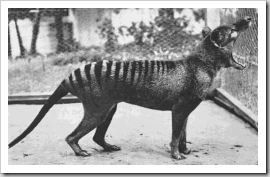
Last ThylacineThe photograph accompanying this article is of ‘Benjamin’, the last known thylacine (commonly known as the Tasmanian tiger), which died in captivity in the Hobart zoo, most likely as a result of neglect, on 7 September 1936.  Benjamin had been captured in 1933, three years after the last thylacine known to have been shot in the wild was killed by a farmer.  Indeed, a major contributor to the thylacine’s extinction was its inconvenience to farmers.  As the largest carnivorous marsupial of modern times, the thylacine was blamed for the slaughter of livestock, and between 1888 and 1909 the Tasmanian government paid £1 per head for dead adult animals and ten shillings for pups – which was a lot of money at the time.

The innovation patent is another unique Australian creature that is about to become extinct at the hand of government policy.  Unfortunately for the innovation patent, it has become a great inconvenience to economists, within IP Australia and at the Productivity Commission, who believe that the system, and in particular the low threshold for the innovative step, contributes to low value patents, which they blame for the imposition of unacceptable costs on the community.  IP Australia has now published draft legislation and rules (the Intellectual Property Laws Amendment (Productivity Commission Response Part 1 and Other Measures) Bill and Regulations 2017) including measures to implement aspects of the Government’s response to the Productivity Commission’s inquiry into Australia’s Intellectual Property arrangements.  These measures include the abolition of the innovation patent which will, if the draft legislation becomes law in its current form, go out like the thylacine, not with a bang but a whimper, dwindling slowly away over eight years after the last shot has been fired against it. 

Of course I am aware that the extinction of an entire species is a tragedy of criminal proportions, and that comparison with the mere repeal of a second-tier patent system is hyperbole of the highest order.  But I am using this rhetorical device to highlight the analogous manner in which government policy is driven in each case by a single perspective on the problem at hand.  Both the thylacine bounty and the abolition of the innovation patent are the result of governments acting on input provided by particular interest groups, i.e. farmers and economists respectively.  Just as the 19th century was a different time, when there would have been little public interest in, or opposition to, the culling of a unique native animal to protect farmers’ livelihoods (and the food supply), there is today very little interest from the broader community in challenging economists’ views on what is best for Australia’s innovation and intellectual property systems.

Economic modelling has become one of the primary drivers of so-called evidence-based policy-making, despite the fact that very few people (including most, if not all, politicians) could claim to understand the economists’ models, assumptions, or the statistical methods used to produce their ‘evidence’.  In fact, economic models rarely make reliable predictions, even when they fit past data well.  Just this past week, the deputy governor of the Reserve Bank of Australia has conceded that the Bank can only ever predict even the most basic economic indicators within a wide margin of error and that, ‘not surprisingly, forecast misses are more common than not’.  If the country’s top central bankers cannot predict headline figures like economic output and inflation with any precision, what prospects do economists have of predicting the long-term impact of different options within the Australian patent system on national innovation and productivity?

Sadly, we will never know if there was a solution better than ‘termination with extreme prejudice’ to the problems posed by either the thylacine or the innovation patent.  But, once we accept that the innovation patent must and will die, IP Australia’s current proposal seems like a soft option.  I say that if we are going to abolish the innovation patent, it should be done as swiftly and decisively as possible!

11 September 2017

Australian Government Commences Consultation on Proposed Patent Law Reforms

OptionsThe Australian Government recently issued its response to the Productivity Commission’s final report on its Inquiry into Australia’s Intellectual Property Arrangements, indicating support for a number of the Commission’s recommendations.  IP Australia has now published a set of consultation papers discussing proposed implementation of the Government’s response to a number of recommendations in the report, as well as a 2013 report by the Commission on Compulsory Licensing of Patents.  Four of the five consultation papers that have been released relate to patents, and address: amending inventive step requirements; introducing an objects clause into the Patents Act 1990; amending the provisions for Crown use of patents (and designs); and amending the provisions for compulsory licensing of patents.  (Additionally, a fifth paper addresses introducing divisional applications for international trade marks.)

Written submissions in response to questions presented in the consultation papers are due by Friday 17 November 2017, and should be sent via email in Word, RTF, or PDF format to consultation@ipaustralia.gov.au.

It is presently intended that legislative amendments relating to the issues discussed in the consultation papers be included in a Bill for introduction to Parliament in 2018.  Prior to this, it is expected that there will be further consultation on an Exposure Draft of the proposed amendments.

IP Australia will conduct further consultation on other measures covered by the Government’s response to the Productivity Commission’s report – including  phasing out of the innovation patent system – later in 2017, with a view to introducing corresponding further amendments in a Bill as soon as possible.

28 August 2017

Vale Innovation Patent – Australian Government Responds to Productivity Commission IP Report

Sad sackThe Australian Government has issued its response to the Productivity Commission’s final report on its Inquiry into Australia’s Intellectual Property Arrangements, indicating its support for a number of the Commission’s recommendations.  In the area of patents in particular, the Government intends to implement recommendations to further amend the law in relation to inventive step, introduce an ‘objects clause’ into the Patents Act 1990 and ‘phase out’ (i.e. abolish) Australia’s contentious second-tier right, the innovation patent.  It has also indicated its support for a proposal that ‘IP Australia should reform its patent filing processes to require applicants to identify the technical features of the invention in the set of claims’, although it is unclear at this stage exactly what form the implementation of the recommendation will take.

The Government has largely rejected recommendations of the Productivity Commission to set patent fees to promote broader intellectual property policy objectives (as opposed to the current objective of recovering the costs of running the Patent Office), and to restrict the availability of extensions of term for patents relating to pharmaceutical products.  It has, however, indicated support ‘in principle’ for the introduction of a system for transparent reporting and monitoring of settlements between originator and generic pharmaceutical companies to detect potential ‘pay for delay’ agreements, modelled on the US system.

As I will discuss further in this article, the demise of the innovation patent has been on the cards for some time, and is now all but inevitable.  Adding an objects clause to the Patents Act may be little more than window-dressing.  Much will depend on how it is worded (and the Productivity Commission’s proposal will not be popular), and then how much weight it is given by the courts (which might, I would suggest, be very little).  Further enhancing the inventive step standard, which the Productivity Commission has suggested should be based upon the European model, is not hugely controversial, in my opinion. 

As I shall endeavour to explain, however, if there is to be a fight over any of the proposed reforms it is most likely to be over the requirement to identify ‘technical features’ in patent claims.  In combination with raising the inventive step standard to the highest possible level, I believe that this recommendation reflects the Productivity Commission’s general antipathy to the idea that the patent system provides any net economic benefit to Australia, and its belief that patents should therefore be as difficult to obtain as is practicable.  But the potential consequences of a new, and unique, requirement for Australian patent claims could be far-reaching, and detrimental to Australian innovators.

06 August 2017

The Meteoric Rise and Spectacular Fall of Damages for Unjustified Threats of Patent Infringement

Unjustified Violent ThreatOn 19 August 2016, a single judge of the Federal Court of Australia issued a ruling awarding damages of A$1,506,859 against the Australian Mud Company Pty Ltd for making unjustified threats of patent infringement proceedings against Coretell Pty Ltd: Australian Mud Company Pty Ltd v Coretell Pty Ltd (No 7) [2016] FCA 991.  Less than a year later, however, a different judge has ‘reluctantly’ dismissed a claim for damages allegedly arising from threats of infringement proceedings made to the public at large via a trade publication: Mizzi Family Holdings Pty Ltd v Morellini (No 3) [2017] FCA 870.  This follows a decision in March of this year, by a Full Bench of the Federal Court on appeal, overturning the Australian Mud damages award.

I first wrote about the Mizzi Family Holdings litigation back in January 2014, following the initial findings in December 2013 of a single judge of the Federal Court that the respondent, Daryl Morellini, had not infringed an innovation patent for a ‘cane billet planter’ owned by Mizzi, and that all prior threats of infringement proceedings were therefore unjustified.

The first relevant threat in the Mizzi case had not been made directly to Morellini, but rather had been directed to the cane growing industry more generally through the combination of an advertisement and an article that appeared in the Canegrowers Magazine of 5 April 2010.  The advertisement had been placed by Mizzi, and included a notice of its patent application.  The article was authored by one Mr Terry Hurlock of Invention Pathways Pty Ltd, who had worked in conjunction with Mizzi’s patent attorneys, and was entitled ‘Infringement Danger’.  This juxtaposition of the advertisement identifying the patent application with the article warning about the potential consequences of infringement was found by the court to constitute ‘unjustifiable threats’, in the circumstance that the patent was not actually infringed.  A second threat was said to have been made in June 2011, after another cane grower, one Mr Girgenti, used Morellini’s planter, and Mizzi made a verbal allegation of infringement and demanded the payment of a royalty.

The initial decision in the Mizzi case was followed by a second judgment of the primary judge, on questions of costs and declaratory relief in relation to the unjustified threats (Mizzi Family Holdings Pty Ltd v Morellini (No 2) [2014] FCA 807), an appeal to a Full Bench of the Federal Court, decided in February 2016 (Morellini v Mizzi Family Holdings Pty Ltd [2016] FCAFC 13), and now the most recent decision on damages related to the threats.  Through all of this, the fundamental original finding of the primary judge – that the patent was not infringed – has remained undisturbed.

The major difficulty for Morellini in demonstrating damage was the requirement, emphasised by the Full Court in Australian Mud, to establish causation between the threats themselves and the damages claimed.  The court found (at [20]) that:

There is no direct evidence that anybody declined to deal with Mr Morellini as a result of the threats. It seems that even before the newspaper article on 5 April 2010, there was a degree of reluctance concerning any such dealings. That reluctance cannot have been attributable to the threats. Mr Morellini has not demonstrated that any adverse effect resulted from either of the threats. The newspaper article may well have been widely read within the sugar industry, but there is no reason to believe that the incident involving Mr Girgenti was a matter of common knowledge. Some people in the industry may have heard of it. In either case such knowledge may have reinforced previous perceptions, but that is largely speculative.

As we shall see, unjustified threats provisions were originally enacted to curb anticompetitive, abusive, coercive, or extortionate use of the patent system.  Yet here in Australia we have two recent cases of patentees acting apparently from a good-faith belief that their patents were valid and infringed, and with an arguable case to this effect at first instance and on appeal before a Full Court, in which the prosecution of unjustified threats claims clearly resulted in proceedings becoming significantly more protracted, complex, and costly, than they might otherwise have been.  For a brief period, we hit a high water mark for unjustified threats with a judge awarding over one and a half million dollars in damages, before this was sensibly and firmly reversed on appeal.  Ultimately, neither accused infringer received any award of damages.

How and why did this happen?  What is wrong with the Australian law in relation to unjustified threats that a Federal Court judge could make an astronomical seven-figure award of damages, when the correct sum was zero?  Or that the parties in long-running infringement proceedings would devote such resources to an argument that ultimately brought no benefit to any of them, under provisions that were not originally intended to apply in such circumstances?  And what can be done to fix this situation?

04 April 2017

Justice Stephen Burley Pulls Excess Teeth from Australia’s Innovation Patent

ToothThe innovation patent is Australia’s ‘second tier’ patent right.  It is granted without substantive examination (but must be examined and certified before it can be enforced), has a maximum term of only eight years, and requires a lower level of inventiveness than a standard patent in order to be valid.  Despite this, however, a certified innovation patent gives its owner all of the same rights and remedies against infringers – including injunctions and financial compensation – as a standard patent.  And in one respect innovation patents have appeared, since September 2011, to offer a distinct advantage over standard patents in that damages have been held to accrue not just back to the date of certification, or the date of grant, but all the way back to the original effective filing date.  In the case of divisional applications, this could be many years before the actual filing and grant dates of the innovation patent.  (For more information, see Britax Childcare Pty Ltd v Infa-Secure Pty Ltd [No 3] [2012] FCA 1019, and my earlier article Innovation Patents Reach Back in Time for Infringement.)

Innovation patents are currently under attack from a number of quarters, and it is no secret that a number of authorities would like to see the system abolished altogether.  I have repeatedly argued, however, that the main criticisms of the system could be dealt with through some judicious modifications to strike a better balance between reduced patentability standards, patent term, rights of patentees, and rights of competitors and the wider public.  (See, for example, IP Australia Has the Innovation Patent In Its Sights, Again!, Five Easy Ways to Fix the Innovation Patent System, The Productivity Commission on Patents – It’s All About ‘Value’ and ‘Quality’, and Users and Abusers of the Australian Innovation Patent System.)

The strategic use of divisional innovation patents to ‘tailor’ claims targeting a competitor’s activity, and then claim compensation back to the original filing date of the parent application, was highlighted by the Australian Government’s Productivity Commission in its final report on its Inquiry into Australia’s Intellectual Property Arrangements.  In a chapter concluding with a recommendation that the innovation patent system be abolished, it presented the following diagram illustrating the discrepancy between the period during which divisional innovation patent claims are public (i.e. when infringers may be on-notice of liability) and the period over which compensation can be claimed (Figure 8.4, p 255).
PC IP Arrangements Report Figure 8.4
However, in a decision issued on 3 April 2017 and authored by Justice Stephen Burley (with whom Justices Nicholas and Jagot expressly concurred, rather than simply issuing a joint judgment), a Full Bench of the Federal Court of Australia has overruled Britax: Coretell Pty Ltd v Australian Mud Company Pty Ltd [2017] FCAFC 54. 

Accordingly, as the law now stands compensation for infringement of a divisional innovation patent cannot be claimed back to the original date of the parent application.  The correct position, according to the Full Court, is that compensation for infringement of an innovation patent (divisional or otherwise) is available only from the date of grant – which is also the date of publication – of the innovation patent.

Copyright © 2014
Creative Commons License
The Patentology Blog by Dr Mark A Summerfield is licensed under a Creative Commons Attribution-NonCommercial-ShareAlike 3.0 Australia License.