
Showing posts with label Politics. Show all posts

03 June 2026

Funding Quantum Hardware, Forsaking Research Talent: The Deepening Crisis in Australian Science

Image generated by Google Gemini based on author prompt.It has been just over two years since the Australian and Queensland governments announced their near-billion-dollar joint venture to fund PsiQuantum. Back in April 2024, policymakers excitedly pitched the construction of a utility-scale quantum computer at Brisbane Airport as an ‘anchor’ for the next industrial revolution. I did not write about it then.  Like many, I assumed the inevitable collision with technical and logistical reality would happen quietly, behind closed doors, perhaps eventually leading to a scaled-back scope or an extended timeline.

But here we are in mid-2026, and the wheels are visibly wobbling.  Last month, the much-touted Brisbane Airport site was unceremoniously abandoned in favour of a council-owned site at Moreton Bay Central.  Yet, despite pivoting to an empty lot at a former paper mill, it appears that neither the company nor the government has publicly walked back their foundational commitment to have the site operational by the end of 2027.  Promising to build the world's first million-qubit, fault-tolerant computer from the ground up in just 18 months is, to put it mildly, an ambitious logistical – and technical –  undertaking!

More importantly, I am writing about this now because we should not continue to ignore the sheer opportunity cost of this mega-project.  While the government plays venture capitalist with a single, highly speculative hardware gamble, the reality is that Australian science may be reaching a breaking point.

According to the Australian Bureau of Statistics (ABS), Australia’s Gross Expenditure on R&D (GERD) was a mere 1.69% of GDP in 2023-24.  This leaves us languishing far behind the OECD average, estimated at 2.93% in 2023, and significantly outpaced by peer economies that treat foundational research as critical infrastructure rather than a discretionary expense.

We are, quite literally, starving the ecosystem.

There is a profound irony at the heart of the PsiQuantum deal.  The company is headquartered in Silicon Valley, but its co-founders are products of the Australian university system.  They are the quintessential example of the ‘brain drain’ – talented innovators who left Australia when the domestic funding ecosystem failed to support their ambition.  This leaves us spending nearly a billion dollars of taxpayer money to effectively buy back our own exported talent at a massive premium.

Yet, in doing so, we are contributing to the collapse of the very STEM pipeline required to produce the next generation of innovators.  How does a government justify a near-billion-dollar bet on a speculative hardware project while simultaneously starving the foundation?  The answer, as is so often the case in technology policy, lies in a deliberate semantic conflation.  By using the word ‘quantum’ as a monolithic buzzword, policymakers have successfully blurred the lines between practical, deployable technologies and a long-term engineering marathon.

Let's dive in and look at the data.

28 August 2018

‘Innovation’ Drops From the Agenda as Yet Another Sitting Australian Prime Minister Given the Boot

Et tu BruteLast week, Australia got a new Prime Minister, with former Treasurer Scott Morrison replacing former lawyer, investment banker, tech investor, and republican Malcolm Turnbull.  However, lest any foreigners, hermits, or future historians who have perhaps stumbled upon this article in the National Library’s Pandora Archive, assume that this is a sign of a robust democracy recognising the will of the people, I should point out that it was not as a result of a general election, but of internal sniping and fighting within a governing party.  As many readers will be aware, this is now ‘normal’ in Australia – the last elected Prime Minister to actually lead their party to a subsequent election was John Howard in 2007.  Since then, we have had just three further elections, but five changes of Prime Minister.

In September 2015, when Turnbull deposed Tony Abbott as Prime Minister of Australia, a wave of positive sentiment swept through Australia’s innovation community – among which I count the many entrepreneurs, scientists, researchers, technologists, investors, and associated professional services providers (including patent attorneys) whom I encountered at various meetings, events, and seminars during those heady early days of the Turnbull Government.  The reason for this was partly because many of those people viewed Malcolm Turnbull as a kindred spirit, with personal, hands-on experience as an investor in technology businesses, and a generally progressive and positive attitude towards science, technology, and innovation.  Additionally, Turnbull’s first major policy announcement was of an investment of A$1.1 billion over four years in a ‘national innovation and science agenda’, in which he called for an ‘ideas boom’ to replace the ‘mining boom’ (and, more generally, Australia’s reliance on primary industry for exports), and declared his desire to see a cultural shift to embrace risk-taking, and destigmatise failure.

Ah… halcyon days!

Over less than three years, however, most of that initial positive energy has dissipated, to be replaced with disillusionment and disappointment, as talk of innovation at the top levels of government petered out to little more than a whisper.  And now, with the change in ‘leadership’ (I use the word advisedly), it seems that ‘innovation’ is completely off the agenda.  In particular, in announcing his new Cabinet, Prime Minister Scott Morrison has ditched the word entirely, with Karen Andrews being appointed Minister for Industry, Science and Technology (which presumably means that the Department formerly known as Industry, Innovation and Science is to be similarly renamed), and former Minister for Jobs and Innovation, Michaelia Cash, now appointed as Minister for Small and Family Business, Skills and Vocational Education.

So how did this happen?  How did ‘innovation’ go from a A$1.1 billion policy imperative to being a dirty word in government in under three years?

17 July 2018

Australia Again Fares Woefully in Capitalising on Innovation in WIPO’s Annual Index

Anger and frustrationLast week, the World Intellectual Property Organization (WIPO) published its Global Innovation Index 2018 (GII) report, as it has done every year since 2011.  Jointly authored with Cornell University and the INSEAD Business School in France, the GII is intended to provide ‘a detailed quantitative tool that helps global decision makers better understand how to stimulate the innovative activity that drives economic and human development.’  It ranks 126 economies based on 80 indicators, ranging from intellectual property filing rates to mobile-application creation, education spending, and scientific and technical publications.

In 2018, Australia ranks 20th overall, which is a gain of three places since 2017.  The countries that were ahead of Australia and that have slipped behind in 2018 are New Zealand (now 22nd, down from 21st), Austria (down from 20th to 21st), and Iceland (crashing down from 13th in 2017 to 23rd in 2018).

Yet, while Australia has risen slightly in the overall rankings, it continues to languish in a pathetic 76th place, i.e. in exactly the same position as last year, in a measure that I regard as particularly telling – the ‘innovation efficiency ratio’, which indicates how much innovation ‘output’ the country is getting in return for its innovation ‘inputs’.  Australia’s efficiency ratio is just 58%, which compares to the median of 61%, and is way below the values for those countries that are most effective at converting innovation inputs into outputs, such as Switzerland (96%), Luxembourg (94%), China (92%), the Netherlands (91%), and Ukraine (90%).  Yes, you read that correctly – Ukraine is the fifth highest performing economy on innovation efficiency because, while it ranks just 43rd overall in the GII, and a rather poor 75th on innovation inputs, its effectiveness in converting those inputs places it at number 35 in the output ranking.

29 January 2017

The Patent History of Australia’s Most Litigation-Prone (Former) Senator

From the Australian Parliament websiteI read a column today recommending that Australians ride out the Trump presidency by having a laugh at America’s expense – ‘we must’, the author extols us, ‘make sport of her in this high season of her weirdness, this peak of her fever, this pomp of her lunacy.’  Who knows, maybe this is good advice.  But it does have one major failing: right now Australian politics is itself hardly a bastion of seriousness and sanity.  And of all the buffoons and bloviators propelled into parliamentary prominence by last year’s farcical federal election, there is arguably none more compellingly attention-catching that ex-One Nation Western Australian senator (or, quite probably, ex-senator, unless you are asking him) Rodney Norman Culleton – a man whose submissions at a Federal Court bankruptcy hearing have been described by the Chief Justice of the court as ‘unfocused’ and ‘bombastic’.

It would be impossible to compress the continuous carnival that is Rod Culleton’s political career into an entire article, let alone a single paragraph.  But for the benefit of my international readers, I will do my best.  Culleton was propelled into the Senate at the election of 2 July 2016, grabbing the 11th (of 12) Western Australian seats despite receiving only 0.52% of the primary vote – of which the bulk (0.5%) was for One Nation as a party, rather than for Culleton personally – thanks to a byzantine cascade of preferences.  He succeeded despite (or because of) new voting rules that were intended to prevent minor candidates from getting elected off the back of byzantine cascades of preferences.  Even so, the legitimacy of his candidacy fell under a cloud, on account of the fact that he had been convicted of theft.  The conviction was subsequently quashed, but this does not alter the fact that at the time of voting he would have been barred from being elected under s 44(ii) of the Constitution.  With the High Court still considering that particular conundrum, Culleton then resigned from the One Nation party (the source of 96% of his primary vote), before being declared bankrupt by the Federal Court (just in time for Christmas), disqualifying him from remaining in parliament under s 44(iii) of the Constitution.  The bankruptcy orders were stayed, to give him time to appeal, but in the meantime his Senate seat was officially declared vacant.  Not that Culleton is fazed by such trivial setbacks – the official parliamentary website may have him listed as ‘Former Senator Rod Culleton (Independent)’, but the man himself has shown a marked preference for the ‘alternative fact’ that he is ‘still a senator’.  Through all of this, Culleton has become renowned for his ability make absolutely no sense whatsoever, and to become involved in physical altercations at the most inopportune moments.

And that is all in under six months.  So, aside from the fact that you would have to laugh, otherwise you would cry for the demise of Australian democracy, you might be wondering what any of this has got to do with the usual subject matter of this blog.  Well, as the former senator’s parliamentary web page states, Culleton’s qualifications and occupation before entering Federal Parliament include ‘business entrepreneur in farming, manufacturing, inventor and transport/logistics’, while his sole listed publication is ‘”Storage Bin”, 2015202345, Australian Divisional Patents, IP Australia, 2004’.  This connection came to my attention when I read that Culleton has accused former Wesfarmers director Dick Lester, who brought the proceedings to have Culleton declared bankrupt, of ‘abusing the bankruptcy process to get hold of Culleton’s Australian Keg Company patent in lieu of payment “to obtain what he wouldn’t otherwise have got”.’

Indeed, not only is Culleton an inventor, but one of his patents has even been successfully enforced after the infringer attempted to sue the Australian Keg Company for making unjustified threats of patent infringement.  I wrote briefly about that decision here, back in January 2014.  This is of some interest, because of course the overwhelming majority of patents are never litigated.  Yet Culleton appears to be a man drawn to the courts as inexorably as a moth to a flame!

17 July 2016

A Single Trans-Tasman Patent Application and Examination Process? NZ Committee Says ‘No’!

Single EnvelopeA joint Australia-New Zealand proposal for a unified patent application and examination process – once hailed by both governments as a boon for local innovators and a ‘world first’ in patent cooperation – appears likely to be dead-in-the-water, following a scathing report issued last week by the New Zealand Parliament’s Commerce Committee.

The idea behind the proposed single application process (SAP), and single examination process (SEP), was simple – to allow applicants wanting to obtain patents in both Australia and New Zealand to file one common application which would be subject to search and examination by an examiner either at IP Australia or at the Intellectual Property Office of New Zealand (IPONZ).  It was not proposed that the patent laws in the two countries would be merged, but rather that examiners would be trained to apply the laws of both countries, resulting in two separate patents being granted.

Despite various hold-ups (see below for more details), it had appeared that the New Zealand government remained keen on the SAP/SEP proposals, with implementing legislation being included in the Patents (Trans-Tasman Patent Attorneys and Other Matters) Amendment Bill, which was introduced into parliament on 3 November 2015.  However, this aspect of the legislation has been roundly rejected by the Commerce Committee, which is comprised of members from both sides of politics. 

The majority of the Committee (including members from the governing National Party) concluded that the purported benefits of the SAP and SEP mechanisms either do not exist, or are outweighed by the costs.  The opposition Labour Party Committee members have gone further still, in a separate ‘minority view’, calling the legislation ‘badly drafted’, and a waste of taxpayers’ money, while describing themselves as ‘bemused at the dexterity required by the Government to justify a complete reversal of its original position.’

The New Zealand Parliament is not bound to accept the Commerce Committee’s recommendation that the SAP and SEP provisions be deleted from the legislation when it comes up for further debate.  However, it looks very much as if any remaining supporters of the initiative will find themselves in the minority when the time arrives for a vote to be taken.

At the same time, however, the Commerce Committee has not recommended any substantive changes to provisions intended to introduce a joint Australia-New Zealand regulatory regime for patent attorneys, which will make New Zealand attorneys subject to essentially the same regulations and disciplinary proceedings as already apply to Australian attorneys.

28 February 2016

Aussie Turns on Aussie as US Congress Shines Light on Allegations of Skulduggery at WIPO

Smoking GunOn Wednesday 24 February 2016 a number of US Congressional subcommittees held a joint hearing on ‘Establishing Accountability at the World Intellectual Property Organization: Illicit Technology Transfers, Whistleblowing, and Reform’.  Three witnesses appeared at the hearing: Mr James Pooley, who is a US citizen and the former Deputy Director for Innovation and Technology at the World Intellectual Property Organization (WIPO); Ms Miranda Brown, who holds dual Australian/British citizenship (as do I), and is the former Strategic Adviser to WIPO Director General (DG) Mr Francis Gurry (also an Australian); and Dr Matthew Parish, an international lawyer of US origin, now practising in Geneva, who appeared in his capacity as legal counsel to the sole union representing the interests of WIPO employees, the Staff Council.

The testimony of the three witnesses is incendiary and damning of Gurry, and makes for fascinating, if uneasy, reading. 

Pooley reprises his earlier allegations regarding Gurry’s ‘secret’ programs to ship ‘high-end computers and other electronic gear to North Korea and Iran’, his ‘secret’ plans to open WIPO satellite offices in China and Russia, and his intimidation of, and retaliation against, whistleblowers within WIPO.  Pooley also implicates Australian officials – most notably the then-Ambassador to the US, Kim Beazley – in blocking Congressional efforts to put forward a US candidate to challenge Gurry’s re-appointment to a second term as WIPO DG in 2013.

14 December 2014

The EPO – Dysfunctional or Just a Misunderstanding?

Locking HornsIn recent times, strange and disturbing things appear to have been afoot within the European Patent Organization.  While the goings-on within the EPO have been reported by other IP blogs, by some specialist IP media outlets and (to a much lesser degree) in the general media, I have so far chosen quite deliberately not to comment.

The primary reason for my silence on the issue has been the very great difficulty in getting at anything even vaguely resembling the ‘truth’ about what is actually causing the ructions at the EPO.  One thing that people have often said to me about this blog (and of which I am quite proud) is how well-researched the articles often are, and how much time it must take me to write them.  I can safely say that the ongoing disputes at the EPO would constitute the most heavily researched article I have never written!  This article does not even try to account for all of the material I have read in trying (and failing) to get a handle on what is going on at the EPO.

Which is not to say that I do not care.  I care very much.  And the reason I care very much is simple – if the EPO becomes dysfunctional and ineffective, it is the applicants for European patents who ultimately suffer.  Those applicants include some of my clients, the clients of dozens of other Australian patent attorneys and, perhaps, numerous other Australian applicants who are more directly represented before the EPO.  And, of course, applicants from all around the world.

So what is going on at the EPO?  Is it dysfunctional?  Is there, as some are alleging, ‘corruption’ at the top?  Or, as I am coming to suspect, is all of the recent negative publicity largely the result of a messy and increasingly vitriolic labour dispute?  (Which is, of course, not to say that all of the above are mutually exclusive.)

30 November 2014

‘Pro Bono’ Patent Assistance Program Makes No Sense

Asking for HandoutIn September 2011, the America Invents Act (‘AIA’) was signed into law in the United States.  The most significant legal reform implemented by this legislation was the switch from the long-standing US ‘first to invent’ priority system to a ‘first (inventor) to file’ system similar to that which exists throughout the rest of the world.  The AIA also introduced other legal and procedural changes, such as new mechanisms for third parties to challenge patents and applications, and the provision of a ‘fast track’ process enabling applicants to accelerate examination for a fee.

Aside from these changes to the patent laws and procedures themselves, the AIA package included further measures aimed at enhancing US innovation and competitiveness.  One such measure, set out in section 32 of the AIA, requires the USPTO to ‘work with and support intellectual property law associations across the country in the establishment of pro bono programs designed to assist financially under-resourced independent inventors and small businesses.’

The USPTO duly established its Patent Pro Bono Program, to provide free legal assistance to under-resourced inventors and small businesses interested in securing patent protection for their inventions.  As USPTO Deputy Director (and current Acting Director) Michelle K Lee explained in a recent blog post, the program also supports a White House executive action aiming to expand pro bono patent assistance to all 50 states.  Currently, patent pro bono assistance is available in Alaska, Arizona, California, Colorado, the District of Columbia, Hawaii, Idaho, Louisiana, Maryland, Massachusetts, Minnesota, Montana, Nevada, New York, North Carolina, Ohio, Oregon, South Carolina, Texas, Virginia, and Washington.

This all seems very admirable.  However, a recent article on waybetterpatents.com questions the effectiveness of the program, suggesting that the requirements that must be satisfied in order to qualify for pro bono patent assistance are set too high, and that those who might benefit most from the program are unlikely to qualify.

To my mind, however, the flaw in the Patent Pro Bono Program is far more fundamental than overly-restrictive qualifying requirements.  With all due respect to the efforts of the USPTO, and the well-meaning attorneys who are offering their services for free, I do not believe that providing free assistance to secure patent protection makes any sense at all.  In fact, it could even be harmful – to the patent system, and to small business and innovators more generally.

02 November 2014

WIPO Director General Under Official Investigation for Misconduct

Francis GurryWorld Intellectual Property Review (WIPR) reported last week that the World Intellectual Property Organisation (WIPO) is now under formal investigation over allegations dating back to 2008 that Director General, Francis Gurry, ‘ordered a series of burglaries of workers’ offices in order to obtain samples of their DNA.’

I have written about these allegations on two previous occasions.  The first was back in December 2013, in response to articles written by Gene Quinn, on his estimable IP Watchdog blog (which is currently celebrating an incredible – in Internet terms – 15 years of continuous operation).  The second was in April of this year, following revelations that then Deputy Director General James Pooley had filed a ‘Report of Misconduct’ with WIPO, and with the US Mission in Geneva. 

On both occasions I expressed my suspicion that the resurfacing of the accusations against Gurry was at least partly motivated by US anger at WIPO’s involvement, under his direction, in UN assistance programs to North Korea and Iran, and building of closer ties with China and Russia.  At the time, Gurry was seeking reappointment as Director General for a second six-year term.  His reappointment was confirmed by the General Assembly on 8 May 2014.

Not that this was the first time Gurry had been the target of an effort to undermine his candidacy for the top job at WIPO.  His first term began controversially, with Brazil threatening at one stage to challenge his election on the basis that it was not legitimate.  What was allegedly behind this challenge was a concern that Gurry would be too ‘pro-developed-world’ – a fear that turned out to be unfounded – though the fact that it was Brazil’s own candidate who lost out by a single vote was no doubt a factor!  Ironically, it is Gurry’s pro-developing-world agenda that appears to have made him so unpopular with US politicians.

13 September 2014

Why Science Is Not An Industry (and Our Petals Are Precious)

Science and despairAustralia currently has no minister (or department) for science.  One of the first acts of Prime Minister Tony Abbott when his government was elected last year was to name a cabinet in which, for the first time since 1931, there was no minister with the word ‘science’ anywhere in his title (I use the masculine pronoun intentionally, because one of the other characteristics of the current cabinet is that it includes only one woman in a total of 19 members).

In October 2013, Abbott defended this decision in front of an audience of scientists, saying:

It’s been remarked upon, ladies and gentlemen, that we don’t have a minister for science as such in the new government. I know there are some in this room who might have been momentarily dismayed by that, but let me tell you, neither does the United States have a Secretary for Science, and no nation on earth has been as successful at innovating as the United States and I’d say to all of you, please, judge us by our performance, not by our titles; judge us by our performance, not by our titles.

The difference, in case it is not obvious enough, is that the US has never had a Secretary for Science, whereas Abbott made a conscious decision, after 82 years of there having been a science portfolio in every Australian government, to erase the word from his ministry.  Where the previous government had a Department of Innovation, Industry, Science and Research, the current government has a Department of Industry, headed by Minister Ian Macfarlane

Supposedly, responsibility for science continues to lie with the Minister for Industry.  However, it seems that Macfarlane is starting to get a bit tetchy with people who think, just because he does not have the word ‘science’ in his title, that he is not, in all but name, the Minister for Science.  And when I say ‘people’, I mean ‘scientists’.  And when  I say ‘scientists’, I mean (according to Macfarlane) ‘precious petals’.  Because last week Australia’s Minister for Industry, the Honourable Ian Macfarlane, MP, said:

I’m just not going to accept that crap [criticism of the lack of a science minister].  It really does annoy me, because there is no one, no one, more passionate about science than I am. I am the grandson and son of a scientist, and I give science more than their share of my time, and just because I’m not the minister for energy, do I hear the whinge from [the energy sector]? No.

But I hear it constantly from some of the precious petals, can I say, some of the precious petals in the science fraternity, and if you can’t guess, I won’t accept it.

Of course, this angered a few scientists, although I think they should wear the label with pride, because they are precious, in the nicest sense of the word!  And responding to name-calling is a distraction from the real issue, which is this government’s rather poor record, to date, on Australian science.

17 May 2014

Government Eviscerates Australian Science & Innovation Funding

Piggy BankLast Tuesday evening, Treasurer Joe Hockey handed down the first budget to be delivered by the current Australian Government.  We were warned that it would be tough, and that the Government needed to find billions of dollars in savings in order to bring the budget back into surplus over the next few years.  But I had hoped, nonetheless, that it would at least ensure the country’s ongoing investment in key science, innovation, technology and commercialisation programs, to build the expertise, skills and industries that will be most important globally throughout the coming years and decades.

Unfortunately, it seems that one of the Federal Government’s strategies in its 2014 budget is to mortgage the country’s long-term future to produce a better balance sheet in the near-term.

In my view, the Liberal/National Party Coalition Government is selling out Australian science, technology, innovation and creativity.  We will surely come to regret the loss of opportunities, over the coming years, for this country to develop and grow intellectual capital and technological skills.

The LNP government has cut more than A$450 million from key science agencies, including:
  1. A$111.4 million from the CSIRO;
  2. A$74.9 million from the Australian Research Council;
  3. A$80 million from the Cooperative Research Centres program;
  4. A$7.8 million from the Australian Institute of Marine Science;
  5. A$120 million from the Defence Science and Technology Organisation;
  6. A$27.6 million from the Australian Nuclear Science and Technology Organisation; and
  7. A$36 million from Geoscience Australia.
What good news there is for science and innovation in the budget – e.g. a new Medical Research Future Fund, and an Entrepreneurs’ Infrastructure Programme – is more than offset by cuts elsewhere.  What this budget lacks is any kind of coherent long-term vision for the kind of capabilities, industries, skills, knowledge – the intellectual capital and infrastructure – that will make up the Australian economy in five years and beyond, once the painful short-term cuts to expenditure have done their work.

12 April 2014

US Still Seething Over WIPO ‘Computers for Commies’ Deal?

IBM PC 5150Fox News has reported that World Intellectual Property Organization (WIPO) Deputy Director General Jim Pooley has filed a ‘Report of Misconduct’ with the legislative branches of WIPO, and with the US Mission in Geneva.  Pooley, who is the most senior US official at WIPO, has reportedly accused Director General Francis Gurry (an Australian national) of ‘serious misconduct’ and ‘violations of national and international law’.

The allegations made by Mr Pooley are not new, and relate primarily to Mr Gurry’s supposed involvement in a ‘scheme to illegally acquire DNA samples of WIPO employees’ as part of an investigation by Swiss authorities into anonymous letters he had received prior to his election as Director General.  I have written before about these allegations, back in December 2013, at which time Gurry was nominating against three other candidates for a second six-year term as WIPO Director General.  Several members of the US Congress – including both Republicans and Democrats – had written to Secretary of State John Kerry, urging the Obama Administration to support an alternative candidate for Director General in light of the growing ‘scandals’ engulfing Gurry.

At the time, I speculated that the main problem US politicians had with Gurry was not the conduct of a criminal investigation that took place five years earlier, but his more recent involvement in a WIPO program to ship ‘high-end computers’ and other electronic equipment to North Korea and Iran, along with ‘secret agreements’ to open satellite offices of WIPO in Russia and China.  But, as I also said in my earlier article, WIPO is not an arm of the US government, and it is not WIPO’s mission to enforce US foreign policy or to further US interests in the world.

22 March 2014

New IP Law Reform Bill Hits Australian Parliament

Law booksOn Wednesday, 19 March 2014, the Intellectual Property Laws Amendment Bill 2014 was introduced into the Australian House of Representatives.

If passed (as seems likely), the bill will: implement Australia’s obligations under the TRIPS Protocol; provide for cheaper litigation options under the Plant Breeder’s Act; provide for single patent application and examination processes for Australia and New Zealand, and for a single trans-Tasman patent attorney regime; and implement a number of administrative changes and corrections in the Patents, Trade Marks and Designs Acts.

I last wrote about this bill back in January, when IP Australia released an exposure draft, calling for public comment.  No submissions in response to the call appear to have been published.  In any event, the version of the bill introduced into parliament last week is almost identical to the exposure draft.  I have prepared a marked-up copy showing the differences between the final version of the bill, and the exposure draft.  (My earlier document showing the changes between the 2013 version of the bill and the exposure draft is also still available.)

The one substantive change between the exposure draft and the final bill is that a proposal to repeal section 185 of the Patents Act 1990 has been abandoned.  If you are not familiar with section 185, you are not alone.  I do not think I have ever previously had cause to look at it, mainly because it applies only to officers and employees of IP Australia, and is therefore not a provision to which a patent attorney would normally need to refer. 

Basically, section 185 prohibits employees of IP Australia from doing certain things which have a clear potential to give rise to a conflict of interest, and which generally would therefore be contrary to the terms of their employment in the public service in any event.  It is not clear to me why the decision to repeal the section has been reversed, however it could be political expediency – someone may have felt that a proposal coming out of IP Australia to repeal an offence that could only be committed by its own employees could perhaps be regarded unfavourably.

22 February 2014

The Politics of Patents

VotingI find it interesting that while intellectual property can certainly be a divisive topic, unlike many other areas of public policy it does not tend to divide people along party-political lines.
We have seen a number of recent high-profile examples of this characteristic.  The Raising the Bar patent reforms in Australia had broad bipartisan support, being criticised in parliament only by arch-conservative senator Bill Heffernan, and independent senator Nick Xenophon.  Over in the US, both the America Invents Act and the recent Goodlatte Innovation Act (which has yet to pass through the Senate) were supported and opposed in the House of Representatives by a selection of Democrats and Republicans. 

There is no question, also, that campaigns for IP law reform can make for very strange bedfellows.  A particularly striking example of this is the 2012 push in the Australian parliament to ban the patenting of genes, which brought together the aforementioned Senator Heffernan with Western Australian Labor MP Melissa Parke.

It is possible that the reason for this is that IP laws have impacts across a very broad range of policy areas, including industry, innovation, manufacturing, education, science, research, healthcare and international relations, to name but a few.  Perhaps people do not form views on IP per se, but rather upon the role it plays in the areas about which they are most passionate.

19 January 2014

IP Australia Consults (This Time) On Further IP Law Amendments

Consultation
[Update: This post was updated on 21 January 2014 in response to a clarification that I received from IP Australia.  The intention of the bill remains that Australia would extend the benefits of the TRIPS compulsory licensing provisions, for manufacture and export of generic pharmaceuticals to least developed countries, beyond the minimum requirements, so as to encompass non-WTO member countries.]

IP Australia has released an ‘exposure draft’ of a proposed Intellectual Property Amendment Bill 2014, and is inviting interested parties to make written submissions on the draft bill and associated draft explanatory memorandum by 7 February 2014.

The draft bill is a revised version of the Intellectual Property Laws Amendment Bill 2013, which narrowly missed out on being passed in the Senate (after having made it through the House of Representatives) when a Federal Election was called on 4 August 2013.  Among other things, the draft bill includes new provisions required for the implementation of a single patent application and examination process for Australia and New Zealand, amendments to enable the implementation of a single regulatory regime for patent and trade marks attorneys in Australia and New Zealand, and some further minor amendments to repeal unnecessary document retention provisions, and correct some oversights in the Intellectual Property Laws Amendment (Raising the Bar) Act 2012.

Unlike the earlier Raising the Bar reforms, which passed through both houses of parliament in 2012 with bipartisan support, the 2013 bill passed only by a narrow majority in the House of Representatives, with the then opposition (now government) conservative Liberal National Party (LNP) coalition voicing strong objections to two aspects of the legislation, namely:
  1. amendments to the Crown use provisions of the Act, to implement recommendations made in the Productivity Commission Inquiry Report into Compulsory Licensing of Patents; and
  2. introduction of new compulsory licensing provisions, implementing Australia’s obligations under the TRIPS Protocol to enable pharmaceutical manufacturers to apply to the Federal Court for a compulsory licence to manufacture generic versions of patented medicines to export to developing countries, based on draft legislation which was released for consultation in August 2012.
At the time I wrote (quite rightly, as it turns out):

Once the election is over, and a government has been formed, I would expect to see at least some of the provisions of the Intellectual Property Laws Amendment Bill reintroduced to parliament.

Now that the Raising the Bar reforms are all in operation, correcting the known issues and oversights in that earlier legislation should be a reasonably high priority.  And unless the next government wants to abandon the Trans-Tasman Single Economic Market program, it seems likely that the single filing and examination process and the single regulatory regime reforms will be reintroduced sooner rather than later.

It may, however, be back to the drawing board for the Crown use and TRIPS compulsory licensing provisions.

The new 2014 exposure draft retains all of the Raising the Bar corrections and Single Economic Market (SEM) reforms with only minor amendments, deletes the Crown Use amendments, and makes some substantive changes to the TRIPS provisions.  I have prepared a marked-up copy showing the differences between the 2013 Bill which passed in the House of Representatives, and the current exposure draft.

08 December 2013

The Gurry Controversy – WIPO Is Not an Arm of the US Government!

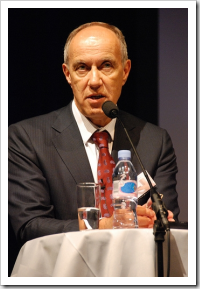
Francis Gurry (Source - Wikimedia Commons)I am a fan of Gene Quinn’s IP Watchdog blog (which, incidentally, you can vote for in this year’s ABA Blawg 100 listings, where it has been named in the ‘Hall of Fame’).  One of the things I appreciate about Gene’s approach to blogging is that he is not afraid to speak his mind, particularly on controversial issues.  And while I often agree with what he has to say, sometimes I do not.  This is one of those occasions.

In two recent IP Watchdog articles, Gene has gone on the attack against World Intellectual Property Organization (WIPO) Director General Francis Gurry (see DNA Scandal Raises Pressure on WIPO Director General and WIPO Watch: Is there a conspiracy against Francis Gurry?)  Now, Gurry is an Australian, but it is not my intention here to engage in some kind of US versus Australia slanging match.  I am more interested in the issues that have motivated such strong views on IP Watchdog, independently of Francis Gurry’s nationality.

The recent articles have been occasioned by the fact that Gurry’s current term as Director General expires in 2014.  Along with three other candidates – Mr Geoffrey Onyeama (Nigeria), Mr Jüri Seilenthal (Estonia), and Mr Alfredo Suescum (Panama) – he has renominated to continue in the role for a further six years.  There are, however, some people – principally, as far as I can determine, in the US – who do not consider Gurry to be a suitable candidate.

What Did Francis Gurry (Allegedly) Do?

There are three allegations that are being levelled against Gurry:
  1. that he ‘secretly’ ran a program to ship ‘high-end computers’ and other electronic equipment to North Korea and Iran;
  2. that he made ‘secret agreements’ to open satellite offices of WIPO in Russia and China; and
  3. that he was involved in a ‘scheme to illegally acquire DNA samples of WIPO employees’ as part of an investigation by Swiss authorities into anonymous letters he had received prior to his election as Director General.

19 August 2013

Election Stalls Further Patent Law Reform in Australia

Ballot BoxOn 4 August 2013, Australia’s Prime Minister, @KRuddMP (a.k.a. Kevin Rudd) announced that the country would go to the polls to elect a new Federal Government on 7 September 2013.  When that happened, the current government went into ‘caretaker mode’ (meaning that it cannot make any significant decisions without consulting the opposition), and all existing parliamentary business was suspended.

One consequence of this is that all legislation which has been introduced, but not yet passed in both houses of parliament, has lapsed, and will need to start the process all over again in the next parliament.  This is particularly unfortunate news for the Intellectual Property Laws Amendment Bill 2013, which was introduced in the House of Representatives on 30 May 2013, passed without amendment on 25 June 2013, and moved rapidly to the Senate, where it received its first and second readings (again without amendment) on 28 June 2013.  I can only suppose that had the Senate sat for even one more day before the election was called, the Bill would have passed.

The Bill was a bit of a grab-bag of both substantial and trivial amendments to the Patents Act 1990, along with a few minor amendments to the Trade Marks Act 1995, the Designs Act 2003, and the Plant Breeders Rights Act 1994.  The amendments affecting the Patents Act included:
  1. amendments to the Crown use provisions of the Act, to implement recommendations made in the Productivity Commission Inquiry Report into Compulsory Licensing of Patents;
  2. introduction of new compulsory licensing provisions, implementing Australia’s obligations under the TRIPS Protocol to enable pharmaceutical manufacturers to apply to the Federal Court for a compulsory licence to manufacture generic versions of patented medicines to export to developing countries, based on draft legislation which was released for consultation in August 2012;
  3. new provisions required for the implementation of a single patent application and examination process for Australia and New Zealand;
  4. amendments to enable the implementation of a single regulatory regime for patent and trade marks attorneys in Australia and New Zealand; and
  5. some further minor amendments to repeal unnecessary document retention provisions, and correct some oversights in the Intellectual Property Laws Amendment (Raising the Bar) Act 2012.
To complicate matters further, the first two of these reforms (i.e. Crown use and the TRIPS compulsory licensing implementation) did not receive bipartisan support in the House of Representatives, being described by the opposition Member for Indi, Mrs Sophie Mirabella, as being ‘fine’ in basic intent, but poorly conceived and drafted, and ‘simply not ready for introduction into the parliament’.

09 May 2013

New Zealand Resolves ‘Software Patent’ Impasse

Computer gearsIf you read what has been written in the media today (e.g. in The New Zealand Herald, Forbes, The Register, and ZDNet, to name just a few who have jumped on the bandwagon) you might think that New Zealand has just outlawed ‘software patents.’
If so, then you would probably be, strictly speaking, mistaken.  As I shall explain, it is quite likely that a wide variety of computer-implemented inventions will continue to be patentable in New Zealand, assuming the Patents Bill passes in the proposed form.  However, it is also true that many of the types of ‘software patents’ which cause the greatest concern to advocates of free and open source software (FOSS) will be excluded under the proposed provisions, just as they are in Europe.

However, it appears that the amendment put forward by aptly-named Commerce Minister Craig Foss in a new Supplementary Order Paper (SOP) is the result of an extended process of consultation behind the scenes, which has resulted in it receiving broad-based support across the New Zealand IT industry, and political opponents of the previous version of the provision (including Labour MP Clare Curran, who rather hyperbolically refers to the addition of what amounts to a clarification as ‘a humiliating back down’ by the Government).

As I have explained previously, the New Zealand Government had adopted a ‘European-style’ approach to software patents, excluding computer programs from patentability, but ‘only to the extent that a patent or an application relates to a computer program as such’.  Those two little words – ‘as such’ – which also appear in the European Patent Convention, and corresponding national laws, were the cause of great consternation among opponents of software patents, such as the New Zealand Open Source Society (NZOSS) accusing Minister Foss of throwing Kiwi software developers ‘under a bus’ (yes, hyperbole does seem to be par for the course over in New Zealand).

But even though the two evil words remain in the latest SOP, NZOSS is now back on speaking terms with Mr Foss, proclaiming itself ‘gratified by the government's willingness to work with the software industry to reach this stage’.

More importantly, the fact that the New Zealand Government has managed to find an acceptable compromise means that the Patents Bill should now be able to proceed through the remainder of its passage into law.  I can only agree wholeheartedly with NZOSS that this update to the creaky old Patents Act 1953 is long overdue.

13 December 2012

Unitary European Patent ‘A Huge Step Forward for SMEs’

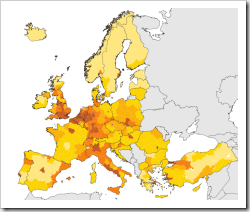
EU Population Density. Image: Wikimedia Commons.On Tuesday, 11 December 2012, Members of the European Parliament (MEPs) backed plans for a 'pan-European' patent – commonly called the ‘unitary patent’ – which will cover 25 of the 27 member states of the European Union (EU). The unitary patent will be enforceable across all participating countries via a single court action.

German MEP Klaus-Heiner Lehne reportedly described the decision as ‘a huge step forward for SMEs’, on the basis that the unitary patent will make the overall process of obtaining and enforcing European patents more affordable.

Under the current system, it is possible to apply for a patent through a central examination process in the European Patent Office (EPO), however the resulting patent must be brought into force (in a process known as ‘validation’) in each individual country required by the patentee.  The European Commission has indicated that a unitary patent could cost as little as €4,725 (referring, presumably, to the official fees only, and not the attorney costs involved in obtaining a defensible patent).  Under the current system, it would cost around €36,000 in official fees to obtain patent rights validated in every member state of the European Patent Convention (EPC).

20 October 2012

Surplus Stupidity Puts Australia’s Future at Risk

LEGO Mr FreezeAustralian politicians would gouge out their own eyes, and cut off their own arms, if they thought it would get them re-elected.  Of course it will not – that would just be stupid.  Almost as stupid as, say, jeopardising Australian research and innovation activities in pursuit of a symbolic budget surplus.  So, of course, that would never happen either, would it?

Except that it did happen, and it is still happening.

Last month there were a few, relatively low key, reports that the Australian government had frozen payouts of a broad range of research and commercialisation grants.  The unannounced freeze apparently commenced on 30 August 2012, with the affected programs including those operated by the Australian Research Council (ARC), the National Health and Medical Research Council (NHMRC), Commercialisation Australia and the Clean Technology Investment Program.

Australian Life Scientist reported the halt in payments, quoting a spokesperson for the Industry and Innovation Minister Greg Combet who stated that the freeze was a ‘normal part of the Budget process’.  However, such freezes have not occurred regularly in previous years.

It appears that the freeze may have been Mr Combet’s immediate response to a directive issued to all cabinet ministers at the end of August that they must review all grants not yet made or contracted in order to curb expenditure.  Obviously such reviews take time, so a halt in payments – at least temporarily – would be an inevitable consequence of such a directive.

Having not announced that there is a freeze on innovation funding, the government has also, not surprisingly, failed to given any indication of when it might end.  However, there were some signs of a thaw the in the past week, with A$652 million in long-awaited funding for medical research finally being allocated by the NHMRC.  While this is clearly good news for those in the medical research sector, the declaration by Australian Life Scientist that ‘the freeze is over’ may yet prove premature.

Copyright © 2014
Creative Commons License
The Patentology Blog by Dr Mark A Summerfield is licensed under a Creative Commons Attribution-NonCommercial-ShareAlike 3.0 Australia License.