In what might well be the final word on the scope and effect of so-called ‘Swiss type’ claims in Australia – at least for the foreseeable future – an enlarged panel of five judges of the Federal Court has clarified what is required for infringement of this form of claim: Mylan Health Pty Ltd v Sun Pharma ANZ Pty Ltd [2020] FCAFC 116. A Swiss type claim (the terminology used by the Court in this case, although they are also known as ‘Swiss-style’ or simply ‘Swiss’ claims) is generally of the form: ‘Use of [compound X] for the manufacture of a medicament for treatment of [condition Y].’ Such claims invoke a kind of legal fiction, in that according to the normal rules of interpretation the scope of the claim encompasses any and every method of making a medicament of any kind that includes the compound X as an active ingredient, subject only to this being suitable for treating the new condition. Interpreted in this way, a Swiss type claim would never be valid in the usual case that medicines containing compound X already exist for the purpose of treating one or more different conditions. We have collectively agreed, however, that as a matter of law a Swiss type claim is to be construed as if reciting the new therapeutic purpose (i.e. ‘treatment of condition Y’) imposes a distinct limitation on the scope of the claim sufficient to impart novelty to the invention.
In the Mylan case, a representative Swiss type claim – namely claim 1 of Australian patent no. 2006313711 – was:
Use of fenofibrate or a derivative thereof for the manufacture of a medicament for the prevention and/or treatment of retinopathy, in particular diabetic retinopathy.
A corresponding claim for a method of treatment is claim 7 of the same patent:
A method for the prevention and/or treatment of retinopathy, the method comprising administration of fenofibrate or a derivative thereof to a patient in need thereof.
While both types of claims are allowable in Australia (as discussed further below), a key distinction between them is the identity of a direct infringer. A Swiss type claim is directed to the manufacture of a product, and thus may be directly infringed by the manufacturer – normally the party that a patentee would want to restrain. Method of treatment claims, on the other hand, are directly infringed in the course of treatment, i.e. by a physician and/or patient, who are typically not the desired targets of infringement action. A patentee must therefore generally rely on indirect or contributory infringement provisions in order to pursue a manufacturer or supplier on the basis of a method of treatment claim.
In this case, the Court found that both the Swiss type claims and the method of treatment claims were invalid for lack of novelty and/or inventive step in view of various prior art disclosures. Thus there could be no infringement in any event. However, the Court nonetheless considered important questions of the interpretation and requirements for infringement of Swiss type claims. In particular, the Court determined that ‘infringement of a Swiss type claim is concerned with what the allegedly infringing manufacturer has done, not what it intended to do.’
 It is the function of a patent claim to define the scope of the invention protected by the patent. Infringement occurs when an accused system, article, or process is covered by the particular terminology used in a patent claim. Many inventions are combinations, e.g. a system, article, or process made up of two or more elements, components, or steps that work together to provide some new and useful function or result. Claims directed to such inventions must therefore recite the relevant combination.
 On 1 February 2016,
  Imagine that you have applied for a patent on an improved iron ore wagon. During examination, you wanted to distinguish your invention from pre-existing ore wagons. You therefore explained that your wagon has ‘an internal ridge’ that reinforces the side wall, and is ‘integrally formed within the side wall’, and you amended your claim to include this ‘integrally formed’ language.
  Last week
  A common idiom employed in patent claims is to define an element of the invention in terms of its function. For example, a claim might recite an apparatus including a part ‘A’, and part ‘B’, and ‘means for fastening the part A to the part B’.
  While the above is often regarded, cynically, as a self-serving proverb promulgated by the legal profession, for better or worse it is almost always true. There may be no other profession for which lay people are more inclined to persuade themselves that they do not require the services of an expert with years of training and experience behind them. After all, virtually nobody would dispute the same sentiment if the word ‘lawyer’ were replaced with ‘surgeon’, ‘engineer’, ‘architect’ or ‘pilot’!
 A reader of this blog recently asked me about the ‘preamble’ to a patent claim, and in particular whether statements made in the preamble are limiting under Australian law, and whether the position is different under US law. In other words, can a claim with the same wording nonetheless mean different things in different jurisdictions?
 The High Court of Australia has turned down an opportunity to review the standard of ‘innovative step’ under the
  Up until now I have had an informal, unwritten policy of not critiquing other blogs. After all, I know as well as anyone just how much hard work goes into maintaining a blog, coming up with ideas for articles, and finding the time and energy to actually write them. Anybody who does that deserves a certain degree of respect, even if I happen to disagree with everything they say! After all, everyone is entitled to their opinion.
 According to a recent decision of the Federal Court of Australia, innovation patents may, in some common circumstances, be infringed before they have even been filed!
 Earlier this year Justice Middleton, in the Federal Court of Australia, broke new ground in this country by holding a hearing, and issuing a decision, purely on the issue of claim construction as a preliminary matter in patent infringement proceedings (see
  A Full Bench of the Federal Court of Australia has unanimously upheld a July 2011 decision of Justice Jagot barring the introduction of generic alternatives to Sanofi-Aventis’ ARAVA and ARABLOC products. At first instance, the court found that a ‘second medical use’ patent directed to the use of the active ingredient leflunomide for the treatment of psoriasis effectively extends an existing monopoly on marketing of the drug for treatment of rheumatoid and psoriatic arthritis until 2014. Sanofi’s original patent on leflunomide expired in 2004.
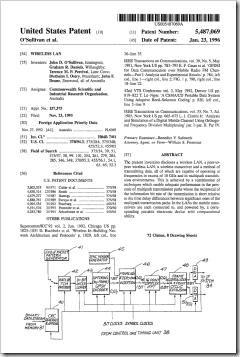 In all of the debate over the past week around the CSIRO wireless LAN patent, there has been very little information – and much misinformation – about what the patent actually covers.


