Showing posts with label Smartphone wars. Show all posts

07 August 2014

Apple v Samsung Ends, Not With a Bang But a Whimper

Duelling TabletsAs is being widely reported this morning, Apple and Samsung have agreed to settle all of their ongoing patent disputes outside of the US. This means that the Australian proceedings, which have occupied, by my estimate, over 150 days of court time, and the attention of two Federal Court judges, will now be terminated, presumably without judgment.

The only thing that is surprising about this is just how freakin' long it took!

I hate to say I told you so (actually, I don't), but I kind of did tell you so, way back at the beginning of August 2011, when Apple first commenced its Australian litigation against Samsung. I made four predictions on day one, and was more right than wrong in everything but the time frame. In my defence, the duration and scope of the case was completely unprecedented, and the assumption that Apple and Samsung would reach a rational commercial resolution failed to take into account the intransigence and emotional investment of the late Steve Jobs.

Here, briefly, are those four predictions, and an assessment of how they stack up against the outcome.

18 May 2014

Apple/Google End ‘Thermonuclear’ War – But What of Samsung?

Nuclear - Wrong WayApple and Google have announced in a joint statement that they have ‘agreed to dismiss all the current lawsuits that exist directly between the two companies’ and ‘to work together in some areas of patent reform.’

The statement goes on to say that ‘[t]he agreement does not include a cross license.’

The settlement is symbolically significant.  It has been widely accepted, since the commencement of Apple’s various patent lawsuits against Android-based handset makers back in 2010, that the ‘true’ target of all this litigation was Google, as the provider of the Android operating system.  This was confirmed in Walter Isaacson’s authorised biography of Steve Jobs, which revealed the late Apple CEO’s strong animosity towards Google, including his infamous vow to ‘go thermonuclear war’ to ‘destroy Android’.

At the time, however, Apple faced a challenge in striking directly against Google, which did not actually manufacture and sell any Android-based products of its own.  Rather than pursue some complex (and potentially unsuccessful) indirect infringement theory against Google itself, Apple chose to attack Android by suing manufacturers, such as HTC, Motorola and Samsung, which it saw as responsible for direct infringement of its patents.

Now, more than four years after Apple’s ‘first strike’ against Taiwanese smartphone maker HTC, it is very clear that Android has not been, and will not be, ‘destroyed’ by patent litigation.  On the contrary, in Q1 2014, 81% of smartphones shipped were Android-based, while just 16% ran Apple’s iOS.  Tit-for-tat lawsuits have ultimately resulted in little more than a growing series of stalemates, the most recent of which was a ruling in the dispute between Apple and Samsung in California earlier this month which is widely regarded as inconsequential to both parties.

18 November 2013

What’s Up Down Under With Apple and Samsung?

Smart devicesLast week, the Federal Court of Australia quietly published a further interim judgment in the ongoing litigation between Apple and Samsung.  Samsung Electronics Co. Limited v Apple Inc. [2013] FCA 1142 was officially decided in 4 November 2013, however publication was delayed to give the parties an opportunity to review the judgment and request that any confidential information be redacted. 

The new judgment is, I am afraid, not very exciting reading, particularly for the lay-person.  It is a decision on the rather dry subject of whether or not Samsung should be allowed to submit further evidence relating to ongoing negotiations conducted with Apple since the commencement of the litigation.  Any content in the judgment which would have made for interesting reading – such as, for example, the terms of proposed licensing arrangements between Apple and Samsung – has been blacked out.

The answer that the court gave to Samsung, incidentally, is ‘no’.  Samsung has already filed an application for leave to appeal the decision, and a hearing on this application will take place on 21 November 2013.

However, this seems as good an opportunity as any to review the history of the Australian Apple/Samsung litigation, and provide an update on its current status. 

As matters stand right now, it does not seem likely that any judgments will be handed down on substantive issues, such as whether Samsung or Apple infringe any of each other’s patents, or whether those patents are valid, until at least the first half of 2014.  In one of the ongoing matters (to which the latest interim decision relates) there are hearing dates set down for a further 41 days, extending into April next year.  Any judgments that are issued will almost certainly be appealed by at least one of the parties, meaning that any final determination in any of the cases is unlikely until at least the second half of 2014, and possibly not until 2015.

It is worth bearing in mind that all of these cases relate to products which are already superseded.  Indeed, some of the allegedly infringing products – such as Samsung’s original Galaxy Tab 10.1, and Apple’s iPhone 3GS – are now two or more generations old.  And, contrary to what you may read in some sections of the media, no ruling in these cases will extend to newer products merely because they appear to include similar features.  A patentee always bears the burden of proving that infringement is occurring.  A court will not ‘infer’ infringement based on a different product, no matter how similar the two may appear.

Which leaves me wondering still, as I have done before, what exactly is the purpose of all this litigation – in Australia and elsewhere – and why do Apple and Samsung seem unable to reach any kind of workable settlement?

09 August 2013

Are ITC Exclusion Orders a Pre-Globalisation Anachronism?

US ITCEarlier this week I spoke to reporter Yun-Hee Kim via Skype, for the WSJ Live Asia Today program, about the decision of the Obama Administration to veto the US International Trade Commission (ITC) exclusion order issued against a number of older Apple devices.  The products in question had earlier been found to infringe a Samsung patent which is essential to implementation of the 3G international wireless communications standards.

I have embedded the video report at the end of this article, or you can view it on the WSJ Live web site.

In issuing an exclusion order, the ITC had done nothing particularly unusual.  As I will explain further below, it does not really have any other powers it can exercise against infringers.  Furthermore, it is part of the standard process that all proposed orders made by the ITC are subject to review, and possible veto, by the President of the United States within a period of 60 days.

To my mind, there are three aspects of this case that have contributed to the exceptional level of interest it has generated.  Together, they suggest that it might be time to reconsider the role of the ITC in ‘protecting’ the US market from imports of patent-infringing products, which increasingly looks like a relic from a simpler time in which companies, and industries, were either ‘domestic’ or ‘foreign’, rather than global.

30 June 2013

A ‘Patent Troll’ Down-Under? Why Vringo Has Sued ZTE Australia

“It is a truth universally acknowledged, that a patent troll in possession of a good portfolio must be in want of a victim.”
– Jane Austen, Pride and Prejudice and Patent Trolls

Troll attacks AustraliaI am on the record, on this blog and elsewhere, as being of the opinion that Australia is not a jurisdiction in which the ‘patent troll’ business model can work effectively.  I have expressed the view, in particular, that the US litigation system, and related patent laws, make that country an almost uniquely happy hunting ground for patent trolls.

So, you might expect that I would have been surprised to learn that US-based non-practising entity (NPE) Vringo Infrastructure Inc has commenced patent infringement proceedings in the Federal Court of Australia against the local subsidiary of Chinese telecommunications equipment manufacturer ZTE Corporation.

I confess I was a little surprised, until I remembered who Vringo is, and where I had seen the company’s name before, and realised that this lawsuit is not typical ‘troll’ activity, but is more likely part of a global patent licensing strategy conducted at least partly for the benefit of the very much practising entity, Nokia.

As I shall explain further, I do not consider Vringo to be a patent troll – at least not when it comes to the patents at issue in the dispute with ZTE.  However, I have to acknowledge that a number of online media outlets have used the ‘t-word’ in relation to Vringo, e.g. smartcompany.com.au and itwire.com (and again, here).

17 November 2012

The Australian Apple/Samsung 2013 Year Planner is Here!

2013 Apple-Samsung ThumbnailWith 2012 drawing to a close, Patentology is pleased to announce the availability of the Australian Apple/Samsung 2013 year planner.

This handy reference is an absolute must-have for the wall or desktop of numerous Australian IP lawyers, patent attorneys, Federal Court employees, tech journalists, patent litigation enthusiasts and – of course – Federal Court Justice Annabelle Bennett.

Justice Bennett recently timetabled a number of new hearing dates in the second half of 2013, bringing the total number of court days set down next year in the Australian Apple v Samsung case to 123.  Yes, you did read that correctly – one hundred and twenty-three.  This is in addition to the 46 days of hearings which will have taken place by the end of this year, not including last year’s interlocutory proceedings, and various dates that have been set down for administrative purposes (e.g. management conferences and directions).

Our 2013 year planner – a larger version of which is available by clicking on the thumbnail above – should therefore prove invaluable to to the many individuals involved in this gargantuan case.  It will help senior counsel to organise the expenditure of their substantial fees on European sojourns during the northern summer, while less-experienced articled clerks and junior associates will be able to plan when they might be able to grab a few hours of sleep, or invest a little time in any surviving relationships they may have outside of work!

It does not appear that any of the dates that have been reserved by Justice Bennett are speculative, or merely for contingency.  By all accounts, she has been meticulous in time-tabling the trial, and every set of dates is scheduled for hearing of a specific aspect of the case.

08 November 2012

Fragmented Patent Pools Will Not End Smartphone ‘Wars’

Photograph © Mark Summerfield 2008Depending on where you are in the (developed) world, the next generation of mobile communications networks is either already with you, or on its way.  Colloquially known as ‘4G’, it is more accurately termed ‘LTE-Advanced’, an upgrade from the Long Term Evolution (LTE), or ‘3G’ technology which is now widespread.  LTE-A is an improvement in every respect over 3G – higher peak data rates, greater spectral efficiency, reduced latency and increased throughput.

And, of course, there are more patents than ever before covering networks and devices capable of communicating using the full range of available standards.

Considering that the holders of patents covering the previous generation technologies seem unable, or unwilling, to resolve their existing disputes over access and licensing terms for access to standards-essential patents (SEPs), it may be difficult to imagine how there could ever be peace as the number of such patents – and associated patent holders – only seems to be increasing.

The creation of ‘patent pools’ – collections of SEPs owned by multiple proprietors, and made available as a block via a single licence agreement – may therefore be seen as an encouraging sign.  Two such pools have recently been established covering subsets of the LTE SEPs.  And while we would like to think that this is the beginning of a more peaceful coexistence among competitors in the mobile communications space, a closer look at the LTE patent landscape suggests that there is a long way to go before these pools will represent a realistic option for achieving a truce in the industry.

06 November 2012

South Korea is Not a ‘FRAND Rogue State’!

KoreasOn 24 August 2012, the Seoul Central District Court issued its decision in one of the many ongoing patent cases between rivals Apple and Samsung.  We did not report on the ruling at the time because, frankly, there was very little information available in English, and we therefore did not feel that there was anything much we could add to the news reports (such as this one, from Bloomberg).

Overall, while the decision produced a rare win for Samsung, things certainly did not all go the way of the Korean company.  Of four patents which it asserted against Apple, two were found invalid, and one was found not to be infringed.  Furthermore, Apple was successful in a counterclaim, which resulted in injunctions against various Samsung products, and an award of 25 million Korean won (about US$23,000) in damages.

Samsung’s single valid and infringed patent also earned it an injunction against a number of Apple’s 3G-capable devices, and a damages award of 40 million won (about US$35,000).

One widely-read commentator, however, was willing to infer a great deal from very little.  Florian Mueller, in a FOSS Patents blog post entitled ‘Apple-Samsung ruling suggests South Korea is a FRAND rogue state’, wrote:

A couple of court decisions announced in Seoul, South Korea, this morning indicate that South Korea has decided to become a rogue state in connection with standard-essential patents, essentially telling foreign companies that in order to sell their technology products to the country's 50-million population, they must bow to extortion by Samsung and LG.

This is highly problematic and will have diplomatic repercussions. The victims of such abuse will be companies from the United States, Europe and Japan, and increasingly also Chinese companies. I don't know what Apple is going to do, but it would make sense to talk to both U.S. presidential candidates at the earliest opportunity.

So far, we are unaware of any credible allegations of ‘extortion’ having been made against any Korean companies, or of any diplomatic repercussions, or indeed of any impact on the US presidential race now drawing to a conclusion!

However, this week we have come into possession of a full English translation of the Media Report issued by the Seoul Court on 24 August in relation to its ruling on the Samsung patents, and we have to say it makes very interesting reading, with none of the hallmarks you might expect of a document issued by a ‘rogue state’.

The translation was prepared by Korean IP law firm Lee & Ko (which acted as cousel for Samsung in the case), and was circulated to delegates who had attended the AIPPI Congress in Seoul on 20-23 October 2012.  Lee & Ko have kindly provided their permission for Patentology to make the translation available in full, and it can now be viewed and/or downloaded from Google Drive.  The following is a summary of the Court's main points and reasons.

08 October 2012

Smartphone Wars, Gangnam Style!

PSYThere is an incredible video on YouTube which shows South Korean pop star PSY performing his global viral hit Gangnam Style in front of a Seoul audience of 80,000 fans.  The entire audience pulses with the waving of arms in time to the music, which is itself barely audible over the noise of the crowd which, to a man, woman and child, appears to know every single word of the song.

To find a comparable achievement by an artist in the western world, you might have to go back to Queen's performance at the Live Aid convert in 1985, which was remarkable for the fact that, while the crowd of 72,000 was slightly smaller than PSY's, Freddie Mercury had them eating out of his hand despite the fact that they were not a dedicated Queen audience.

But if the PSY phenomenon demonstrates anything more broadly, it is that Apple should be afraid… very afraid!

So what has K-Pop got to do with smartphones, we hear you cry? We think quite a lot, as we shall explain.

27 July 2012

Apple v Samsung – Trial Commences, But Will It Matter?

Tablet smartphone stackThis week marked the first five days, in Sydney, of a trial scheduled to run for a total of 34 days between now and October, with Apple and Samsung before Justice Annabelle Bennett in the Federal Court of Australia.  This country has not seen a more extensive set of bookings in any major venue since US pop star P!NK played 58 dates here on her Funhouse tour in 2009!

Some good coverage of the week’s events has been provided by ZDNet reporter Josh Taylor: Australian Apple v. Samsung patent hearing begins; Samsung sacrificed Qualcomm truce for Apple war; Apple: our 3G isn't Samsung's 3G; and Samsung accuses Apple of ‘ambush litigation’.  Rather than simply rehash these stories, in this article we will review some of the issues that have arisen in recent days – both at the trial and more widely – and look at what this might all mean for the longer-term outcome of the ongoing dispute.

11 July 2012

Mobile Patent Disputes Creating a New Class of ‘Celebrity Judge’

StarQuestion: What do Lucy Koh, William Alsup, Richard Posner, Annabelle Bennett and Colin Birss have in common?  Answer: They have all been receiving far more press coverage than they probably would ever have imagined when they chose a career in law!

In case you are not familiar with these names (although most readers of this blog would most likely have heard of at least one of them):
  1. Judge Lucy H Koh is the judge of the US District Court for the Northern District of California, San Jose, who is presiding over the patent dispute between Apple and Samsung in that court, and who recently issued preliminary injunctions against Samsung’s Galaxy Nexus and Galaxy Tab 10.1 devices;
  2. Judge William Alsup is the judge of the US District Court for the Northern District of California, San Francisco, who presided over the case brought by Oracle against Google, finding that Google’s Android operating system does not infringe Oracle’s Java patents and copyrights;
  3. Judge Richard Posner is an appellate judge in the 7th Circuit who volunteered to step down into the US District Court for the Northern District of Illinois to hear patent infringement cases brought by Motorola and Apple against one another, only to toss the entire dispute out on the basis that neither party had any viable claim for damages against the other;
  4. Justice Annabelle Bennett is the Australian Federal Court judge who last year issued a preliminary injunction delaying the launch of Samsung’s Galaxy Tab 10.1 tablet for five months, until her decision was overturned on appeal; and
  5. Judge Colin Birss is the UK Patents Court judge who this week ruled that Samsung’s Galaxy Tab 10.1 does not infringe registered design rights owned by Apple relating to the iPad.
Of course, it is the role of a judge to hear cases and issue decisions in all matters, great and small, which may come before them.  But such is the level of interest and media attention to the global disputes currently playing out between tech giants, there has been virtually nothing of even minor note to have played out in these judges’ courtrooms that has not been widely reported.  With journalists stationed in the galleries listening to days of – mostly tedious – technical and legal testimony and argument, it is hardly surprising that anything remotely interesting, entertaining or quotable should be quickly disseminated, especially with most judges permitting (or at least tolerating) live tweeting from their courtrooms.

02 June 2012

Apple Not ‘The Developer for the World’ Says Hypocritical Cook

Tim CookAs presented in Walter Isaacson’s biography, it seems that Steve Jobs did not require a rational justification to ‘go thermonuclear war’ against Google and Android.  As we wrote back in October last year, Jobs was willing to ‘spend my last dying breath if I need to, and I will spend every penny of Apple's $40 billion in the bank, to right this wrong.’  To him, the battle over smartphone technology was not about business or money.  Isaacson reports Jobs telling former Google CEO Eric Schmidt, ‘I don't want your money. If you offer me $5 billion, I won't want it. I've got plenty of money. I want you to stop using our ideas in Android, that's all I want.’

Jobs had built Apple into the world’s biggest tech company, and so he could really do no wrong in the eye’s of Apple shareholders and aficionados.  But the fact is that starting a global thermonuclear war, or spending every cent of the company’s money in pursuit of a principle, is not good business.  That path leads ultimately to shareholder revolt!

Jobs’ successor, Tim Cook, has therefore inherited a potential ticking time-bomb.  Apple had some early wins in the patent disputes which it started, but as the various court proceedings drag out over months – and those months will become years, unless there is a settlement – the company is finding itself increasingly mired in suits, countersuits, side issues and appeals.

It should therefore some as no surprise that Cook is trying to recast the battle as one which has a rational business foundation, and in which Apple is on the side of goodness and light.  The cost and distraction of all these law suits must now be justified to observers and shareholders as something more than the result of one person’s outrage.

So, when questioned about the ongoing IP disputes, Cook has taken to responding that, while he would prefer to settle, Apple will not be the world’s developer.  At Apple’s quarterly conference call on 24 April 2012 (as reported by CNET) Cook said ‘I would highly prefer to settle than to battle.  But it’s important that Apple not become the developer for the world. We need people to invent their own stuff.’

30 April 2012

Apple v Android Part V: Open standards, IP strategy, Resolution?

Chess knight. Photo: Petr Novák, Wikipedia
The patent landscape maps in part four of this series showed that the key Android advocates – including Samsung and Motorola/Google – are massively superior to Apple in terms of the sheer numbers of patents in their portfolios.

But, as we explain in this fifth and final part, many of these patents are encumbered by licensing obligations arising from their relationship to industry standards.  While the scope of these obligations is yet to be fully tested in court – and may differ from country to country – it is already clear that such encumbrances can significantly complicate the deployment of patents for both offensive and defensive purposes.

With neither Apple nor any of its Android-supporting rivals having clearly established an upper hand, we can no doubt look forward to more strategic manoeuvring on all sides before any final resolution of the ongoing disputes.

Samsung’s FRAND dilemma

Samsung’s patent portfolio is by far the largest in the mobile communications space. It is common wisdom now that one justification for building a portfolio is to provide a strategic defence against infringement suits brought by competitors – a.k.a. the MAD (mutually-assured destruction) theory of patent stockpiling. However, the ongoing litigation with Apple is revealing a strategic weakness of Samsung’s portfolio, in the form of the company’s involvement in the setting of industry standards for mobile communications protocols and technology. Samsung has been extensively involved with the 3rd Generation Partnership Project (3GPP), which is responsible for maintaining and developing standards for mobile communications from GSM onwards. Over time, it has developed and contributed many technical solutions to the various challenges and problems encountered in the implementation of workable, robust and widely supported standards. The R&D effort involved in making such contributions is not insubstantial, but also not without reward.

27 April 2012

Apple v Android Part IV: The IP Landscape

Lunar landscape. Photo - (c) NASA, Apollo 17We concluded Part III in this series with a chart showing the relative sizes of the relevant patent portfolios of some of the major players in the mobile marketplace.  This showed Apple to be substantially out-gunned by the likes of Samsung, Motorola and Microsoft, in terms of patent numbers.

But there is more to a patent portfolio than the sheer number of patents it contains.  It is also important to look at what the patents cover, since some will be strategically more valuable than others.  Of course, it is completely impractical to read nearly 60,000 patents to determine what each one of them is about.  Fortunately, there are visualisation tools, such as the ThemeScape mapping capabilities of the Thomson Innovation package, which allow us to get a view of the big picture, without the need to drill down into all the details.

Overview

The figures in the sections below show the results of patent landscape mapping based on the portfolios of mobile patents held by Samsung, Motorola, Microsoft, the Rockstar Bidco consortium, Apple, Oracle, HTC and Google, which were identified in the search described in Part III. 

The maps reveal the strengths and weaknesses of each company’s portfolio. In summary:
  1. The starkest contrast is between Microsoft and Samsung, which dominate completely different regions of the landscape, reflecting their strengths in software and hardware respectively.
  2. Google’s acquisition of Motorola Mobility will give its portfolio a profile that is very similar to Samsung’s, albeit on a smaller scale.
  3. While Apple’s portfolio is smaller, it has significant concentrations of patents in the critical region between the Microsoft-dominated software zone and the hardware zones which are heavily populated by Samsung, Motorola and Nortel.
The strength of Apple’s portfolio therefore appears to lie in areas that are essential to the user experience, including touch-screen and display technologies, image and audio processing, and user interaction – literally, as well as in the virtual geography of the map, at the interface between software and hardware. This is certainly an area in which Apple has contributed significant innovation and may well represent a strategic sweet spot in the mobile device space.

26 April 2012

Apple v Android Part III: The IP Armoury

Nuclear gravity bombs. Photo - Paul Shambroom
In the previous article in this series, we looked back at the struggle between Apple and Microsoft for ‘ownership’ of the desktop.  We argued that this was a confrontation between opposing ‘closed’ and ‘open’ models – not only of the software and hardware platforms, but also of the fundamental way in which the two companies do business.

There is no question that Microsoft was the clear winner, despite some of the uglier consequences of trying to support a huge range of different hardware and software configurations.  Yet despite this loss, Apple – and Steve Jobs – have persisted with the closed platform model.  So what did they learn from history?

25 April 2012

Apple v Android Part II: Old Rivals – Apple v Microsoft

Mac v PC CommercialIn the first part of this series of articles we introduced the current state-of-play between Apple and its Android rivals, particularly Samsung. 

This is not the first time that Apple has engaged in litigation with a competitor over who would gain a dominant place in consumers’ lives.

We are all familiar with the sometimes bitter rivalry between Apple and Microsoft.  But it is worth looking back at history to see what it might tell us about the origins of Apple’s apparent great animosity towards Android.


Background – the struggle for control of the desktop

Apple is no stranger to litigation over IP rights – or to accusations of copying. In 1982 Apple filed a copyright complaint against Franklin Computer Corp, alleging that Franklin’s ACE 100 personal computer included unauthorised copies of the Apple II operating system and ROM. In those days the reach of copyright law in relation to computer software was unclear and it was only on appeal that Apple was vindicated, with the Court of Appeals for the Third Circuit ruling that executable object code, as well as human-readable source code, was protected by US copyright law.

24 April 2012

Apple v Android Part I: Shall We Play a Game?

War Games - United Artists (1983)
Patentology recently contributed a long piece to IAM Magazine entitled ‘Apple vs Android – The Struggle for IP Supremacy in the Mobile Market’, which was published as the cover story of issue no. 52, March/April 2012.  We published an edited extract back in February as Apple vs Android – IP Supremacy and the Mobile Market, while some early results of the patent landscape mapping ultimately used in the article were previewed in How Apple Punches Above Its Weight in Smartphone Disputes in November 2011.

With issue no. 53 of IAM Magazine now on the shelves, we are free of our undertaking not to republish the full article.  We are therefore pleased to present the complete piece for readers of the Patentology blog.  Due to its length, we will be publishing it in five parts.

In this first part, we look at the present state of the complex relationship between Apple and Samsung: bitter rivals in the courts on one hand, multi-billion dollar supplier and customer on the other.

Shall we play a game?

In the 1983 film War Games a teenage computer whiz – played by a young Matthew Broderick – inadvertently sets the world on a path to Armageddon when he hacks into a top-secret military supercomputer and challenges it to a game of “Global Thermonuclear War”. Fortunately, the computer – named “Joshua” by its creator – is equipped with cutting-edge artificial intelligence, programmed to develop improved battle strategy by repeated simulation. When directed to play tic-tac-toe against itself, Joshua discovers that the game cannot be won by either player and, by extending the principle to the nuclear war scenarios that it has devised, learns the concepts of futility and mutually assured destruction (MAD). Disaster is averted and the world returns to the status quo of the Cold War standoff.

09 February 2012

Apple’s Strategic Plans for Australian Litigation

Weapons stockpileLast Friday, 3 February 2012, Apple and Samsung returned to Justice Annabelle Bennett’s Federal Courtroom in Sydney to resume hostilities for the new year.

While the main purpose of the most recent hearing was to set a timetable for a full trial on both parties various claims against the other, Apple has taken the opportunity to add new allegations of infringement to its case against Samsung, bringing the total number of patents asserted by the company in the Australian litigation to 22.

Computerworld’s Chloe Herrick has reported that Samsung’s legal team insisted at a second court appearance on Wednesday, 8 February 2012, that they would require most of this year to prepare their case, pointing out that there has probably never been a larger patent infringement case in Australia, and that at least 10 of the patents now asserted by Apple have not been raised by the company in any other country. 

Justice Bennett has set down a further date for timetabling of Apple’s case against Samsung on 9 March 2012.

Meanwhile, it appears that a schedule for Samsung’s countersuit against Apple – a case involving the assertion of patents essential to the implementation of 3G mobile communications standards – is closer to finalisation, with an initial part of the trial likely to be held in July, and the remainder of the case to be heard in September.

APPLE’S AUSTRALIAN ASSAULT

As Samsung’s lawyers have argued, the scale of Apple’s patent infringement claims is unprecedented in Australia.  A case involving the alleged infringement, and challenges to the validity, of 22 patents is a massive exercise for both parties, and for the court.

With the benefit of hindsight, however, it is clear that Apple has been building up its Australian patent arsenal for a number of years.  It might therefore have been possible to anticipate that Apple would pick this country as one of its chosen venues for an assault on Android and – as it turns out – Samsung, should anyone have been looking for the signs.

05 February 2012

Apple vs Android – IP Supremacy and the Mobile Market

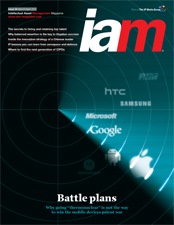
IAM Cover - Issue 52, March/April 2012The following is a heavily-edited extract from an article I wrote for IAM Magazine.  The original, entitled ‘Apple vs Android – The Struggle for IP Supremacy in the Mobile Market’ is the cover story of the current issue (no. 52, March/April 2012).

The full version is around three times as long, covering many aspects of the story – such as the history between Apple and Microsoft, and between Apple and Samsung – in much greater detail.  It also includes images and further discussion of patent themescape maps similar to those presented in Patentology’s most popular ever article, How Apple Punches Above Its Weight in Smartphone Disputes.

IAM Magazine is a subscription product, however a free trial is available upon registration.  There is also much on the website that can be accessed permanently once you have registered.  It is a great resource, and highly recommended!
 
Steve Jobs had already become a multi-millionaire by the age of 25, when Apple Computer, Inc (as it then was) went public in December 1980 on the back of having effectively launched the personal computer revolution with the Apple II. In January 1983, Apple launched the Lisa – featuring a graphical user interface (GUI) based on a ‘desktop’ metaphor – and though this machine would have limited commercial success, due to its high price-tag, Jobs was already leading the team at Apple which was working on something called the ‘Macintosh project’. Of course, the resulting product would go on, once again, to revolutionise the way humans interacted with computers.

Jobs was a child of the cold war, who grew up in the sixties and seventies and was strongly influenced by Zen Buddhism (he went on a spiritual journey to India in 1974). But he had, by all accounts, a complex personality, and he would probably have seen no irony or contradiction in his angry pronouncement to his biographer, Walter Isaacson, in 2010 that he was willing to ‘go thermonuclear war’ on Google’s Android operating system, and ‘to spend every penny of Apple’s $40 billion in the bank’, if necessary.

Opening Moves

Apple’s first-strike against Android was a complaint, filed in March 2010 in the US District Court for the District of Delaware and the US International Trade Commission (ITC), alleging infringement of 20 Apple patents – relating to the iPhone’s user interface, underlying architecture and hardware – by Taiwanese smart phone manufacturer HTC Corporation.

Since then, the face-off between Apple and its best-performing Android-based competitors has escalated. By December 2010 a further dispute with Motorola Mobility, Inc had coalesced into litigation over infringement and validity of 24 Apple patents, and 18 Motorola patents, across the ITC and the US District Courts of Delaware, the Western District of Wisconsin and the Southern District of Florida.

22 December 2011

Apple v Samsung Down Under – 2011 Redux

Apple-GalaxyThe opening gambit in the Australian arm of the global dispute between Apple and Samsung finally drew to a close earlier this month, neatly typing up a few loose ends in what must surely be the biggest Australian patent story in recent memory. The stage is now set for the main event – full trials on infringement and validity of various Apple and Samsung patents – during the course of next year.

A review of the story so far is therefore timely, as the Australian courts close down for an extended break over the holiday season, before getting back into full swing for the new year in February 2012.

THE END OF THE BEGINNING

On 9 December 2011, the High Court of Australia refused Apple's request for special leave to appeal from a decision of a Full Bench of the Federal Court denying a preliminary injunction against the launch of the Galaxy Tab 10.1. (Article: Breaking: High Court Rejects Apple Appeal Bid.)

In what turned out to be a temporary win for Apple, an injunction had originally been granted by a single judge of the Federal Court, pending a full trial in relation to Apple’s claims of patent infringement. (Article: Samsung’s ‘Eyes Wide Open’ Sinks Australian Galaxy Tab 10.1.)

Samsung’s tablet is now on sale in Australia, just barely in time for Christmas, and four months after the originally-planned launch in mid-August.


Copyright © 2014
Creative Commons License
The Patentology Blog by Dr Mark A Summerfield is licensed under a Creative Commons Attribution-NonCommercial-ShareAlike 3.0 Australia License.