Showing posts with label Innovation patent. Show all posts

28 February 2023

Zombie Patents! Can Expired Innovation Patents Still Be Examined and Certified?

ZombiesThe Australian Patent Office recently issued two decisions on the examination and certification of innovation patents owned by UK company Diogenes Limited: Diogenes Limited [2023] APO 5 concerning innovation patent no. 2020104437 (‘Diogenes 1’); and Diogenes Limited [2023] APO 8 concerning innovation patent no. 2021103809 (‘Diogenes 2’).  Both patents claim inventions relating to electronic pool wagering systems and – unsurprisingly, given this subject matter – both were found to be unpatentable under Australia’s ‘manner of manufacture’ approach to patent-eligibility.  However, it is not the substantive reasons for refusing to certify the patents that is of most interest.  What is unusual about both patents is that they had each expired before an initial examination report had even been issued.  Despite this, IP Australia proceeded with examination, issuing three reports on patent no. 2020104437, and two reports on patent no. 2021103809, before in both cases accepting requests to be heard and issuing the decisions noted above.  Just to repeat for emphasis, all of this activity occurred after the patents had expired.

The rationale for proceeding with examination is given in Diogenes 1 at paragraph [10], where the Hearing Officer observed:

It is not usual for the Commissioner to undertake actions on an expired patent. However, I note that, in order for the patentee to enforce their rights in relation to an innovation patent, it is necessary for that patent to be examined and certified. In such circumstances, and noting that the patentee could potentially bring infringement proceedings up to 6 years after expiry (assuming infringement proceedings occurred just prior to the expiry date – see subsection 120(4) of the Act), undertaking examination (and this decision) after the expiry date is appropriate.

I find this statement confusing, and suspect that the Hearing Officer may have meant to suggest that the infringement itself – rather than the ‘infringement proceedings’ – may have occurred prior to the expiry date of the patent.  In any event, we will get to the circumstances in which an expired innovation patent, that was not examined and certified within its lifetime, may nonetheless be enforceable.

Diogenes 2 was decided by a different Hearing Officer, who (at paragraph [4]) adopted the reasoning of Diogenes 1 for proceeding with examination of an expired innovation patent.

In the Diogenes cases, examination of the innovation patents was requested while they were both still alive – albeit, as we shall see, just barely!  But these decisions raise the question of whether a (former) patentee could request examination of an expired innovation patent and, in such a case, whether the expired patent could be retrospectively certified and enforced up to six years after expiry.  If so, then this might apply not only to patents that expired at the end of their maximum eight year term, but also to patents that ceased earlier than this due to non-payment of an annual renewal fee.

The upshot is that zombie innovation patents are able to rise from the dead and reach back in time to capture historical infringements!

26 May 2022

Division and Conversion – the Continuing Life of the Australian Innovation Patent

It's a convertible - geddit?!In the Patents chapter of its recently-published 2022 IP Report, IP Australia provides the usual annual filing statistics for 2021.  According to the report, there were 23,371 Australian standard patent applications filed as National Phase Entries (NPEs) from international applications under the Patent Cooperation Treaty (PCT), 9,026 standard applications filed directly in Australia, making up a record total of 32,397 new standard applications.  There were also 4,297 provisional applications filed, and 7,844 innovation patent applications ‘including … standard patents converted to innovation patents’.  On IP Australia’s figures, the top five applicants in 2021 were LG Electronics (259 applications), Huawei (255), OPPO (197), Nestle (157) and Apple (151).

All patent data is a moving target.  The patent office database is a living entity which is updated daily with new applications, and changes to existing applications, including status updates, completion of missing information, and even occasional backdating of records for reasons such as correcting errors or actioning successful applications for extensions of time to complete various actions.  It is not surprising, then, that there are some minor discrepancies between figures in the IP Report and numbers that I published back in January, when the dust was still settling on 2021.  The most notable difference is probably that I awarded the top filing spot to Huawei because, at that time, LG had only 251 filings officially recorded – an additional eight LG applications filed in December 2021 were yet to be fully processed.

A more substantial discrepancy is that I counted only 7,657 innovation patent filings in 2021.  A difference of 187 applications is hard to explain as a consequence ‘late year’ filings, given that most new innovation patent applications were filed prior to 26 August 2021, when the phase-out of the innovation patent system commenced.  The key to this difference is in the words I quoted from the Report above in italics – IP Australia’s numbers include applications that were converted from existing applications of other types, as well as newly-filed applications.

Whether conversions should be included with new filings or not really depends upon what you are trying to count.  On the one hand, converting an existing application to an innovation patent application does not add to the total number of applications in progress, because the original application is effectively replaced by the conversion.  On the other hand, the converted application is assigned a new number and a record of the original application remains in IP Australia’s database, and can be found via the AusPat online search system.  And, from IP Australia’s perspective, the ‘new’ innovation patent application has to be processed through the formalities examination, and granted as a patent, in exactly the same way as a ‘fresh’ filing.

A better approach may be to look more deeply at the circumstances in which conversions are occurring, and to try to account for the applicant behaviour in detail.  It is then possible to make an informed decision on how to account for all applications, depending upon your purposes.  Conversion of other application types to innovation patents remains relevant because, despite the phase-out of the system, it remains possible to convert any pending application filed prior to 26 August 2021.  It also continues to be possible to file new innovation patent applications as divisionals of any standard patent application with a filing date prior to 26 August 2021.

In this article I will therefore look at both division and conversion to innovation patents, and the circumstances in which these strategies have been used, as an insight into the continuing life of the Australian innovation patent during the phase-out period.  I will also endeavour to provide a ‘definitive’ count of new applications filed in 2021.

28 October 2021

Innovation Patent System ‘Ends’ not with a Whimper, but a Bang!

BombThe innovation patent has been Australia’s second tier patent right since 2001, but it is now being phased out.  Just over two months have now passed since the final day on which new, original (i.e. not derived from an existing application) innovation patents could be filed.  As of 26 August 2021, the only way to obtain an innovation patent application is by division or conversion from an application that itself has a filing date on or before 25 August 2021.  Innovation patents have a maximum term of eight years from the initial filing date, and thus after 25 August 2029, at the latest, there will be no more innovation patents.  Predictably, the number of innovation patent applications being filed grew significantly during the weeks and months leading up to the final deadline, driven in large part by applications of dubious merit originating in China and India.

So how did filing numbers end up?  And why has it taken two months for me to get around to this analysis?  Well, to answer the second question first, the huge deluge of applications – nearly 2,800 over 25 days in August, over half of which were filed in the final six days – created a backlog that IP Australia is still clearing.  As at the time of writing, there remain around 300 innovation patent applications that are yet to be processed in any way, meaning that details of who filed them, and who the applicants are (and where they are from) remain unavailable.  At this point, however, a clear picture is emerging.  Furthermore, there is some evidence that IP Australia has been prioritising the order in which the remaining applications are being processed according to the workload involved, such that almost all unprocessed applications were filed by Indian applicants.

In the final days, Australian resident applicants filed innovation patent applications in unprecedented numbers, apparently driven primarily by those who had received advice from patent attorneys about the final deadline and the implications of the phase out of the innovation patent.  Indian and Chinese applicants continued to fleece the system for cheap patent certificates, accounting for over half of the applications filed in August.  Filings originating elsewhere in the world increased only modestly, suggesting that genuine demand for innovation patents by foreign applicants remained relatively low until the end.

18 August 2021

Chinese, Indian Applicants Go Mad for Innovation Patents as System Gets Set to Close on a (Dubious) High

Soaring numbersOver 1,000 Australian innovation patent applications were filed in July – an all-time record, ahead of 768 applications in June and 692 in May.  Between 2010 and early 2020, there were typically between 100 and 200 innovation patent applications filed each month.  But with the system set to close to new applications from 26 August 2021, filings have surged over the past year, with over 600 applications every month since October 2020 (with the exception of February 2021, when ‘only’ 482 applications were filed).  China remains the most prevalent country of origin for these applications, accounting for nearly 45% of new innovation patent filings in July.  However applications received from India have grown significantly since June 2020, with Indian applicants filing a third of applications in July.  Applications by Australian applicants have increased modestly over the past couple of months, rising to 175 in July.  Applicants from other jurisdictions seem (so far) nonplussed by the imminent demise of the innovation patent system, with no apparent recent surge in filing numbers.

It is well-known that the motivation for Chinese applicants seeking Australian innovation patents – which are subject only to a formalities examination before being granted – is to obtain government incentive payments without the delay and expense associated with substantive examination.  While these subsidy schemes are supposed to be coming to an end, clearly there are still sufficient incentives available for Chinese entities to keep filing for as long as it remains possible to do so.  It is less clear why innovation patents have recently become so popular with Indian applicants, however I have noted that many of the applications appear to be filed in the names of academic or research institutes, and/or individuals or teams including people with academic titles.  I therefore suspect that being an inventor or applicant on a granted patent may have benefits for people pursuing academic or research careers in India.

In any event, it is clear that the vast majority of innovation patent applications are currently being filed by non-resident applicants for reasons that have nothing to do with any genuine desire to obtain or commercialise intellectual property rights in Australia, and few are filed by the Australia small and medium enterprises (SMEs) that the system was intended to benefit.  Surging demand for innovation patents in the lead-up to the system being closed to new applications is overwhelmingly being driven by Chinese and Indian applicants, with Australian residents showing relatively little interest in taking advantage of the final opportunity to file new innovation patent applications.

Of course, genuine users of the patent system – including Australian applicants – are continuing to file standard applications and international (PCT) applications, and these may be converted to innovation patents in the future, or form the basis for divisional innovation patent applications, where the filing date is earlier than 26 August 2021.  While these types of applications have been a minority in the past, they will necessarily become the only sources of ‘new’ innovation patents as the system is phased out over the coming eight years.

14 May 2021

IP Australia Rises to the Challenge of Surging Demand for Innovation Patents

Team challengeLast month, IP Australia issued a notification informing applicants that, due to a high volume of new filings, they may experience delays in having innovation patents granted.  Innovation patents are issued following a formalities examination only – substantive examination for novelty, innovative step, and other requirements, occurs after grant, and only upon request.  As a result the delay between filing and grant is typically relatively short, and has historically been less than four weeks.  However, with a phasing-out of the innovation patent system now looming, and Chinese applicants in particular using the system to claim government subsidies on foreign granted patents, innovation patent applications are currently being filed at over four times their ‘normal’ historical rates.  This obviously means a lot of extra work for IP Australia to process all of these additional applications.

The good news is that after letting things get a little out-of-hand over summer (when, presumably, many staff were on annual leave), IP Australia now appears to be bringing the situation back under control.  Average pendency (i.e. the delay between filing and grant) peaked at 68 days for innovation patents granted in March, before falling to 52 days in April.  In both March and April, the number of patents granted exceeded the number of new applications filed, and the number of pending applications fell from a peak of 1229 in February to 879 at the end of April.  While this is still much higher than historical levels of about 100-150 innovation patent applications pending at any given time, it is clear that IP Australia has allocated additional resources, and has ramped-up handling of new innovation patent applications to the point where it is now once again processing them faster than they are being filed. 

Up until March, it looked as though delays could continue to grow.  It now seems likely that average pendency will be back below a month by July.  This is, of course, barring any further surge in demand that outstrips processing capacity – which could certainly happen, given that the final date for filing new innovation patent applications before the phase-out begins is 25 August 2021, and a last-minute rush might be expected.  But, for now at least, it looks like IP Australia has the situation in hand.

27 February 2020

Countdown to the End of the Innovation Patent: Abolition Legislation Signed into Law

Like sands through the hourglassOn 26 February 2020, the Intellectual Property Laws Amendment (Productivity Commission Response Part 2 and Other Measures) Bill 2019 received Royal Assent (i.e. was signed into law by the Governor General of Australia), becoming Act No. 9 of 2020.  I reported passing of this Bill in the Senate, with amendments, in November last year, noting that its passage through the House of Representatives (which eventually occurred on 5 February 2020) was a mere formality.  The full text of the Bill, as passed, can be found on the Parliament of Australia website, and should soon be available as the Intellectual Property Laws Amendment (Productivity Commission Response Part 2 and Other Measures) Act 2020 on the Federal Register of Legislation.

The main feature of the Act, about which I have written a number of times over the past few years, with varying degrees of ambivalence, is the abolition of Australia’s second-tier innovation patent system.  I briefly reviewed the history of the innovation patent’s downfall when reporting passage of the Bill through the Senate, and will not rehash this here.  The key point to note, however, is that the legislation provides for an 18 month window, commencing on the date of Royal Assent, before the phase-out of the innovation patent begins.  The following timeline has therefore now been established:
  1. 26 February 2020 – Act receives Royal Assent;
  2. 26 August 2021 – no longer possible to file new innovation patent applications, other than divisional applications based on applications filed on or before 25 August 2021; and
  3. 25 August 2029 – final expiry date of all innovation patents (i.e. eight years after the last possible filing date of 25 August 2021).
The Bill originally provided a 12-month sunset period, however this was extended to 18 months by amendments in the Senate proposed by the Labor opposition, along with provisions requiring that a statutory review be undertaken to assess the impact on Australian small to medium enterprises of abolishing the innovation patent system, and make recommendations to facilitate access to standard patent protection for small business in Australia.  The review must commence within three months (i.e. by 26 May 2020), and provide a written report to the Minister for Industry, Science and Technology (currently the Hon Karen Andrews MP) within 12 months of commencement (i.e. no later than 26 May 2021).

To assist people with keeping track of the time remaining to file new innovation patents, I have added a countdown timer to the sidebar of this blog.  (You’re welcome!)  Notably, because 2020 is a leap year, and the Act received Royal Assent prior to 29 February and during daylight savings time, everyone has 25 hours more than would otherwise have been the case to file their final innovation patent applications!

While abolition of the innovation patent is, for most people, the big ticket item in the Act, it introduces a few other changes to Australia’s IP laws.  Read on for a brief summary of these.

05 November 2019

Australian Senate Condemns the Innovation Patent, but Grants an Extra Six Months on Death Row

Sad GravestoneOn 16 October 2019 the Intellectual Property Laws Amendment (Productivity Commission Response Part 2 and Other Measures) Bill 2019 was passed by the Australian Senate. Among other purposes, this bill includes long-anticipated provisions to phase out Australia’s second-tier patent right, the innovation patent – despite concerted last-ditch efforts by opponents of the move to persuade non-government senators, in particular, to vote against the legislation. This lobbying did not fall entirely upon deaf ears, with Centre Alliance Senator Rex Patrick speaking passionately on behalf of Australian companies that wanted to see the innovation patent retained and unsuccessfully moving an amendment removing the phase-out provisions from the bill.

In the end, however, the Labor opposition voted with the government, thus ensuring passage of the bill, albeit on condition that the legislation be amended to provide for a statutory review to be undertaken to assess the impact on Australian small to medium enterprises of abolishing the innovation patent system, and make recommendations to facilitate access to standard patent protection for small business in Australia. The review is required to commence within three months of the legislation coming into effect, and must be completed within 12 months.

To allow time for the review, the period before the phase-out begins is to be extended from 12 to 18 months. During this period, it will remain possible to file new innovation patent applications. Once the phase-out commences, however, new innovation patents will only be available where they are based on existing applications filed prior to the phase-out date, e.g. as divisional applications or via conversion of pending standard patent applications.

To become law, the bill must still pass through the House of Representatives. However, its passage there is certain, since the government has a majority. The House will sit for the final time in 2019 between 25 November and 5 December, and I anticipate that the bill will pass during this period, and then be sent on to the Governor General for ‘Royal Assent’ (i.e. to be signed into law) before the end of the year. On this timetable, the statutory review will have to commence no later than March 2020, and be completed no later than March 2021. The phase-out will then begin by June 2021.

10 July 2018

A Brief History of the Australian Innovation Patent

History lessonThe innovation patent is Australia’s second-tier patent right, which has existed since 2001.  It differs from a standard patent in that it has a shorter term (eight years instead of 20), has a lower inventiveness standard (‘innovative step’ rather than ‘inventive step’), has a five-claim limit, can be granted rapidly following only a formalities review, is not subject to any form of pre-grant opposition, and need not be subject to substantive examination (although it must be examined and certified before it can be enforced against any accused infringer).

In recent years, the innovation patent system has been under a cloud, with a number of forces assembling arguments and evidence in support of its abolition.  Legislation was recently drafted and published for public consultation including provisions that would, if enacted, result in a phase-out of the innovation patent.  However, at the last minute these provisions were removed prior to introduction of the legislation to the Australian Parliament.

If, as still seems most likely, the innovation patent is to be abolished in the near future, this seems to be an opportune time to review its short, but eventful, life.

Prehistory – the Rise and Fall of the Petty Patent

Before the innovation patent, Australia had a secondary patent right called the ‘petty patent’.  Petty patents were originally introduced in 1979, and they differed from standard patents in that they had a shorter term (up to six years), could include only three claims, were faster to obtain, and were not subject to a pre-grant opposition process.  However, they required exactly the same level of inventiveness as a standard patent, and could not therefore be used to protect any invention that could not otherwise be protected by a standard patent.  Unsurprisingly, petty patents came to be used primarily as a tool for strategic patent enforcement.

In 1994, the Australian Government decided to review the petty patent system, in response to recommendations made in a report to the Prime Minister's Science and Engineering Council (PMSEC), The Role of Intellectual Property in Innovation.  In July 1994, the Government referred the petty patent system to a relatively new panel, the Advisory Council on Intellectual Property (ACIP).  The resulting review of the petty patent system was (somewhat ironically, as we shall see) ACIP’s first major inquiry.

In August 1995, ACIP published its report on the Review of the Petty Patent System, in which it recommended that the petty patent be abolished and replaced with a new system in order to fill a perceived gap between registered design rights and standard patent protection.  Among a number of other differences from the petty patent system, the ‘innovation patent’ proposed by ACIP would be a true ‘second tier’ right having a lower ‘inventiveness’ requirement, and which would therefore enable innovators to obtain protection for lower-level innovations that might not otherwise qualify for standard patent protection.

10 April 2018

With Second-Tier Patent Rights in Retreat in Australia, Are They Making an ‘Advancement’ in New Zealand?

Dr Parmjeet ParmarWhile the second-tier innovation patent may be out-of-favour with the Australian government (a late stay of execution notwithstanding), there is at least one New Zealand parliamentarian who is bold enough to stand up for the rights of incremental innovators.  Dr Parmjeet Parmar is a list member for the opposition National Party in New Zealand, who has drafted and submitted a private member’s bill titled the Patents (Advancement Patents) Amendment Bill.  The bill proposes the introduction of a new second-tier patent right which has many similarities with – and a few differences from – the Australian innovation patent, and Dr Parmar suggests that it would fill a gap in the availability of intellectual property rights in New Zealand that was widened by the enactment of the Patents Act 2013.

Generally speaking, the proposed ‘advancement patent’ would – like the innovation patent – provide for a shorter-term patent right, permit fewer claims, and feature a bifurcated system of registration and optional examination and enforceability.  Some of the major differences from the innovation patent would be:
  1. terminology, i.e. ‘advancement’ rather than ‘innovation’, and ‘advancement step’ rather than ‘innovative step’;
  2. maximum term, i.e. up to ten years, rather than eight years; and
  3. lifecycle, i.e. an ‘advancement patent’ would be considered ‘provisional’ initially, and only have the status of ‘granted’ following examination/certification.
Reading Dr Parmar’s maiden speech in the New Zealand parliament, it is not hard to see where she finds her enthusiasm for innovators and innovation.  Born, raised and originally educated in India, she moved to be with her husband in New Zealand where she completed a PhD in biological sciences at the University of Auckland.  She subsequently worked in both academic and commercial science and research, before establishing a business manufacturing natural health products.  Clearly this is a level of hands-on experience with research, innovation, business and entrepreneurialism to which few – if any – of the politicians, bureaucrats and economists currently gunning for the Australian innovation patent can lay claim.

Many people will be surprised to see this new bill introduced in New Zealand at the same time that Australia is looking to abolish the innovation patent.  A common theme in the long gestation of the New Zealand Patents Act 2013 and the recent review of Australia’s IP arrangements by the Productivity Commission was the view, held particularly by certain economists, that for net importers of intellectual property and technology, such as Australia and New Zealand, intellectual property rights tend to be owned predominantly by foreign entities, and that it is therefore not in our interests to grant such rights improvidently, or too easily.

My own analysis of innovation patent data over a nine-year period showed that while the target community of Australian small and medium enterprises (SMEs) were indeed, by filing numbers alone, the dominant users of the system, too many of these were ‘self-filers’, who generally gain no value from their patents, while many of the largest individual users of the system are foreign entities that filed innovation patents for strategic reasons (e.g. Apple, Inc), or merely to take advantage of economic incentives in their own home countries (e.g. many Chinese companies).  While probably not enough to justify abolition – rather than improvement – of the innovation patent, this is not a great look, and is hardly a glowing endorsement of the domestic benefits of a second-tier patent system.

Considering these current concerns with the innovation patent, I decided to take the opportunity to reach out to Dr Parmar and ask her about her motivations for drafting her bill, and why she believes that a New Zealand ‘advancement patent’ would fare better than the Australian innovation patent.  She was kind enough to take the time out of her busy schedule to answer my emailed questions, and I am pleased to be able to present her views in her own words.

30 March 2018

A ‘Death Row Reprieve’ for Innovation Patents as IP Laws Amendment Legislation Reaches Parliament

5 minutes to midnightOn 28 March 2018, the Intellectual Property Laws Amendment (Productivity Commission Response Part 1 and Other Measures) Bill 2018 was introduced to the Australian House of Representatives.  Schedule 1 of the Bill, along with associated regulations, will implement various recommendations arising from the Productivity Commission’s inquiry into Australia’s intellectual property arrangements, namely: clarifying the circumstances in which the parallel importation of trade marked goods does not infringe a registered trade mark; expanding the scope of ‘essentially derived variety’ declarations in the Plant Breeder’s Rights Act; reducing the grace period for filing non-use applications under the Trade Marks Act; and eliminating requirements for patentees to provide certain data relating to pharmaceutical patents with an extended term.

Notably absent from the bill as introduced to parliament, however, are provisions for phasing out Australia’s second tier patent system, the innovation patent.  As recently as early March, IP Australia published its response to submissions on the proposed phase-out, rejecting continuing calls for the innovation patent system to be retained in some form, and indicating its intention to proceed with the transition process set out in the exposure draft of the legislation.  But if a week is a long time in politics, three weeks is a veritable eternity, and IP Australia has now announced that ‘the Government has decided to undertake further industry consultation targeted at better understanding the needs of innovative SMEs before the phase out of the innovation patent occurs.’

12 March 2018

Continuing Opposition to Abolition of the Innovation Patent Falls On Deaf Ears at IP Australia

Hard of hearingIP Australia has published its response to submissions made in its consultation on the Exposure Draft Intellectual Property Laws Amendment Bill 2017 and Regulations.  The period for comment on the proposed legislation closed on 4 December 2017.  The draft legislation contains measures to implement aspects of the Government’s response to the Productivity Commission’s inquiry into Australia’s intellectual property arrangements, along with amendments to strengthen plant breeder’s rights (PBR) enforcement, streamline official processes, and make technical improvements to the legislation.
While the majority of Productivity Commission recommendations addressed by the draft legislation relate to PBRs and trade marks, the most significant patent-related provisions are those implementing the abolition of the innovation patent system.  The proposed approach would see a fairly gentle transition, with applicants given a year’s notice within which innovation patents would still be granted under the current system, followed by eight years during which all existing innovation patents would gradually cease or expire, and restrictions would be imposed on new applications and the certification of innovation patent claims.

When the draft legislation was published, I argued that the proposed transition could be viewed as too gentle, considering the Productivity Commission’s relatively strong objections to the strategic use of divisional innovation patents, and the uncertainty caused by uncertified claims.  This was, however, very much a contingent view – i.e. given that the innovation patent system is to be abolished based upon the Productivity Commission’s recommendation, the abolition should be implemented in a way that most-effectively addresses the Commission’s reasons for making that recommendation. 

In fact, I would prefer to see the innovation patent system given a second chance, in an improved form.  However, since the Government has accepted the Productivity Commission’s recommendation, and the consultation was directed to its implementation, rather than being a further opportunity to canvas objections to this decision, I did not make a submission.  This did not, however, prevent a number of others from taking the opportunity to once again express their opposition to abolishing the innovation patent system.

Unsurprisingly, these repeated objections fell on deaf ears, with IP Australia focussing in its response on the few submissions that actually addressed the merits of the proposed legislation.  On this basis, it appears at this stage that – absent a last-minute reprieve at the parliamentary level – the process of abolishing the innovation patent system is likely to proceed in substantially the manner set out in the draft legislation.

29 October 2017

The Impending Extinction of the Australian Innovation Patent

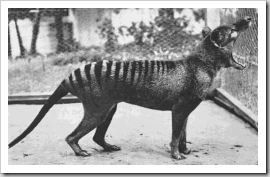
Last ThylacineThe photograph accompanying this article is of ‘Benjamin’, the last known thylacine (commonly known as the Tasmanian tiger), which died in captivity in the Hobart zoo, most likely as a result of neglect, on 7 September 1936.  Benjamin had been captured in 1933, three years after the last thylacine known to have been shot in the wild was killed by a farmer.  Indeed, a major contributor to the thylacine’s extinction was its inconvenience to farmers.  As the largest carnivorous marsupial of modern times, the thylacine was blamed for the slaughter of livestock, and between 1888 and 1909 the Tasmanian government paid £1 per head for dead adult animals and ten shillings for pups – which was a lot of money at the time.

The innovation patent is another unique Australian creature that is about to become extinct at the hand of government policy.  Unfortunately for the innovation patent, it has become a great inconvenience to economists, within IP Australia and at the Productivity Commission, who believe that the system, and in particular the low threshold for the innovative step, contributes to low value patents, which they blame for the imposition of unacceptable costs on the community.  IP Australia has now published draft legislation and rules (the Intellectual Property Laws Amendment (Productivity Commission Response Part 1 and Other Measures) Bill and Regulations 2017) including measures to implement aspects of the Government’s response to the Productivity Commission’s inquiry into Australia’s Intellectual Property arrangements.  These measures include the abolition of the innovation patent which will, if the draft legislation becomes law in its current form, go out like the thylacine, not with a bang but a whimper, dwindling slowly away over eight years after the last shot has been fired against it. 

Of course I am aware that the extinction of an entire species is a tragedy of criminal proportions, and that comparison with the mere repeal of a second-tier patent system is hyperbole of the highest order.  But I am using this rhetorical device to highlight the analogous manner in which government policy is driven in each case by a single perspective on the problem at hand.  Both the thylacine bounty and the abolition of the innovation patent are the result of governments acting on input provided by particular interest groups, i.e. farmers and economists respectively.  Just as the 19th century was a different time, when there would have been little public interest in, or opposition to, the culling of a unique native animal to protect farmers’ livelihoods (and the food supply), there is today very little interest from the broader community in challenging economists’ views on what is best for Australia’s innovation and intellectual property systems.

Economic modelling has become one of the primary drivers of so-called evidence-based policy-making, despite the fact that very few people (including most, if not all, politicians) could claim to understand the economists’ models, assumptions, or the statistical methods used to produce their ‘evidence’.  In fact, economic models rarely make reliable predictions, even when they fit past data well.  Just this past week, the deputy governor of the Reserve Bank of Australia has conceded that the Bank can only ever predict even the most basic economic indicators within a wide margin of error and that, ‘not surprisingly, forecast misses are more common than not’.  If the country’s top central bankers cannot predict headline figures like economic output and inflation with any precision, what prospects do economists have of predicting the long-term impact of different options within the Australian patent system on national innovation and productivity?

Sadly, we will never know if there was a solution better than ‘termination with extreme prejudice’ to the problems posed by either the thylacine or the innovation patent.  But, once we accept that the innovation patent must and will die, IP Australia’s current proposal seems like a soft option.  I say that if we are going to abolish the innovation patent, it should be done as swiftly and decisively as possible!

28 August 2017

Vale Innovation Patent – Australian Government Responds to Productivity Commission IP Report

Sad sackThe Australian Government has issued its response to the Productivity Commission’s final report on its Inquiry into Australia’s Intellectual Property Arrangements, indicating its support for a number of the Commission’s recommendations.  In the area of patents in particular, the Government intends to implement recommendations to further amend the law in relation to inventive step, introduce an ‘objects clause’ into the Patents Act 1990 and ‘phase out’ (i.e. abolish) Australia’s contentious second-tier right, the innovation patent.  It has also indicated its support for a proposal that ‘IP Australia should reform its patent filing processes to require applicants to identify the technical features of the invention in the set of claims’, although it is unclear at this stage exactly what form the implementation of the recommendation will take.

The Government has largely rejected recommendations of the Productivity Commission to set patent fees to promote broader intellectual property policy objectives (as opposed to the current objective of recovering the costs of running the Patent Office), and to restrict the availability of extensions of term for patents relating to pharmaceutical products.  It has, however, indicated support ‘in principle’ for the introduction of a system for transparent reporting and monitoring of settlements between originator and generic pharmaceutical companies to detect potential ‘pay for delay’ agreements, modelled on the US system.

As I will discuss further in this article, the demise of the innovation patent has been on the cards for some time, and is now all but inevitable.  Adding an objects clause to the Patents Act may be little more than window-dressing.  Much will depend on how it is worded (and the Productivity Commission’s proposal will not be popular), and then how much weight it is given by the courts (which might, I would suggest, be very little).  Further enhancing the inventive step standard, which the Productivity Commission has suggested should be based upon the European model, is not hugely controversial, in my opinion. 

As I shall endeavour to explain, however, if there is to be a fight over any of the proposed reforms it is most likely to be over the requirement to identify ‘technical features’ in patent claims.  In combination with raising the inventive step standard to the highest possible level, I believe that this recommendation reflects the Productivity Commission’s general antipathy to the idea that the patent system provides any net economic benefit to Australia, and its belief that patents should therefore be as difficult to obtain as is practicable.  But the potential consequences of a new, and unique, requirement for Australian patent claims could be far-reaching, and detrimental to Australian innovators.

18 June 2017

IP Australia’s Chief Economist on the Role of Economic Modelling, the Innovation Patent... and Perpetual Motion!

Benjamin Mitra-Kahn[Note: This is the third, and final, part of the transcript of my conversation last year with IP Australia’s Chef Economist, Benjamin Mitra-Kahn.  The first two parts were A Conversation with IP Australia’s Chief Economist and Talking ‘Data’ with IP Australia’s Chief Economist.]

The Australian innovation patent system has been under a cloud for some time, with first the (now defunct) Advisory Council on Intellectual Property (ACIP), and then the Australian Government’s Productivity Commission, calling for the system to be abolished.  The original source of evidence behind these calls was a report produced by IP Australia’s Office of the Chief Economist entitled The economic impact of innovation patents.  The report used Australian patent filing data, linked to company-level business information, to make the case that the innovation patent is not achieving the objective of stimulating innovation among Australian small and medium enterprises (SMEs).

Many patent professionals have a different perspective on this issue, albeit one that is strongly influenced by the particular cross-section of users of the innovation patent system that they encounter in their daily practice.  I recently read a ‘defence’ of the system by a New Zealand-based practitioner arguing, in essence, that innovation patents had been useful to a number of his clients, and he would be sorry if they were to be abolished.  While I believe that there is an argument to be made, based upon the data, that more weight should be given to attorney-represented SME applicants in assessing the worth of the innovation patent system, the kinds of ‘feelpinions’ expressed in that article do not, in my view, constitute a very useful contribution to the debate.

But if those at the coal face might have difficulty in seeing the forest for the trees (if you will pardon my carbon-based mixed metaphor), might it not also be the case that economists, with their penchant for aggregating and analysing data, could sometimes fail to see the trees for the forest?  Either way, it seems that a clash of cultures has arisen between those who view the individual trees as important and those who believe that the system can only be properly evaluated via an aerial view of the entire forest.  My own inclination, absent evidence to the contrary, is to presume that each of these perspectives lies at the extreme of a continuum, and that they are therefore equally likely to provide an incomplete view.

In any event, this disparity in the perspectives of IP practitioners and economists was a topic I was very keen to discuss with IP Australia’s Chief Economist, Ben Mitra-Kahn, when we spoke last year.  But before we got to that, we first covered the future of IP Government Open Data, a.k.a. the IPGOD, and the fate of patents on perpetual motion under the new ‘utility’ requirements introduced in 2013 by the Raising the Bar patent law reforms.

14 May 2017

How IP Australia Has Been Quietly Curbing Abuse of the Innovation Patent System

Stop guyUpdate, 16 May 2017: The Commissioner of Patents, Fatima Beattie, has responded to this article in the comments.

While working with the new 2017 release of the Intellectual Property Government Open Data (IPGOD) I noticed something unusual – in October 2016, IP Australia refused 101 innovation patent applications.  Adding to the mystery, in 53 of these cases the refusal was retrospective, in the sense that innovation patents had already been granted, in one case as far back as April 2015.  Not only is refusal something that can only happen to a pending application (a granted patent can, however, be revoked), but it is something that generally does not happen to an application for an innovation patent.  As at the time of this writing, there are 23,387 innovation patent records in IP Australia’s AusPat system.  Never before, nor (as yet) since, these 101 cases has an innovation patent application been refused.

The one thing that all 101 of these applications have in common is that they name a Chinese resident company or individual as applicant.  I have written on a number of previous occasions about suspected abuse of the Australian innovation patent system by Chinese applicants (see Junk Patents Dumped on Australia as Chinese Subsidies Rorted, Chinese Junk Patents Revisited: 2013 Filings Update and, most recently, Users and Abusers of the Australian Innovation Patent System).  IP Australia’s Australian Intellectual Property Report 2017 (‘IP Report’) observed that:
 
Although Australian residents remain the main users of the innovation patent system, for the first time since its inception, non-residents made up the majority of innovation patent applicants with 54 per cent of the total in 2016.
 
The increase in international applications is attributable almost exclusively to an increase of some 142 per cent in applications from Chinese residents to 871 applications. This accounts for around 93 per cent of the overall increase in non-resident applications, and represents 38 per cent of total filings.


It is my belief that the primary motivation for Chinese applicants to obtain Australian innovation patents is to secure government subsidies that are paid upon the grant of foreign patent rights.  An innovation patent is granted following a check only of certain formalities, and without substantive examination as to novelty and inventive step (or, rather, the lower standard of innovative step).  Although the resulting patent must pass examination and be certified before it can be enforced, the applicant nonetheless receives a certificate that conveys (at least to anybody who is insufficiently familiar with the workings of the Australian innovation patent system) the impression of a full patent grant .

It is clearly undesirable, to say the least, for the Australian Register of Patents to be cluttered with dubious registrations, and for these Chinese ‘junk’ patents to cloud our ability to assess how effectively the innovation patent system is serving the small-to-medium Australian enterprises for which it was primarily designed.  I therefore welcome any legitimate steps that may be taken to curb this activity.  However, the statutory basis for these ‘refusals’ is not clear to me.  It may be that the Commissioner of Patents is stepping outside the bounds of the Patents Act 1990.  If so, then it would not be the first time!

04 April 2017

Justice Stephen Burley Pulls Excess Teeth from Australia’s Innovation Patent

ToothThe innovation patent is Australia’s ‘second tier’ patent right.  It is granted without substantive examination (but must be examined and certified before it can be enforced), has a maximum term of only eight years, and requires a lower level of inventiveness than a standard patent in order to be valid.  Despite this, however, a certified innovation patent gives its owner all of the same rights and remedies against infringers – including injunctions and financial compensation – as a standard patent.  And in one respect innovation patents have appeared, since September 2011, to offer a distinct advantage over standard patents in that damages have been held to accrue not just back to the date of certification, or the date of grant, but all the way back to the original effective filing date.  In the case of divisional applications, this could be many years before the actual filing and grant dates of the innovation patent.  (For more information, see Britax Childcare Pty Ltd v Infa-Secure Pty Ltd [No 3] [2012] FCA 1019, and my earlier article Innovation Patents Reach Back in Time for Infringement.)

Innovation patents are currently under attack from a number of quarters, and it is no secret that a number of authorities would like to see the system abolished altogether.  I have repeatedly argued, however, that the main criticisms of the system could be dealt with through some judicious modifications to strike a better balance between reduced patentability standards, patent term, rights of patentees, and rights of competitors and the wider public.  (See, for example, IP Australia Has the Innovation Patent In Its Sights, Again!, Five Easy Ways to Fix the Innovation Patent System, The Productivity Commission on Patents – It’s All About ‘Value’ and ‘Quality’, and Users and Abusers of the Australian Innovation Patent System.)

The strategic use of divisional innovation patents to ‘tailor’ claims targeting a competitor’s activity, and then claim compensation back to the original filing date of the parent application, was highlighted by the Australian Government’s Productivity Commission in its final report on its Inquiry into Australia’s Intellectual Property Arrangements.  In a chapter concluding with a recommendation that the innovation patent system be abolished, it presented the following diagram illustrating the discrepancy between the period during which divisional innovation patent claims are public (i.e. when infringers may be on-notice of liability) and the period over which compensation can be claimed (Figure 8.4, p 255).
PC IP Arrangements Report Figure 8.4
However, in a decision issued on 3 April 2017 and authored by Justice Stephen Burley (with whom Justices Nicholas and Jagot expressly concurred, rather than simply issuing a joint judgment), a Full Bench of the Federal Court of Australia has overruled Britax: Coretell Pty Ltd v Australian Mud Company Pty Ltd [2017] FCAFC 54. 

Accordingly, as the law now stands compensation for infringement of a divisional innovation patent cannot be claimed back to the original date of the parent application.  The correct position, according to the Full Court, is that compensation for infringement of an innovation patent (divisional or otherwise) is available only from the date of grant – which is also the date of publication – of the innovation patent.

05 March 2017

Users and Abusers of the Australian Innovation Patent System

Up and Down In an eight year period – one full innovation patent lifecycle – between 2007 and 2015, Australian residents were overwhelmingly the biggest users of the second-tier innovation patent system, filing over 10,000 innovation patent applications.  The next most frequent filers were the Chinese, with just 1500 applications, followed by US applicants with less than 1000.  Over 90% of the Australian applicants were individuals or small-to-medium enterprises (SMEs – businesses with fewer than 200 employees), i.e. the exact people the innovation patent system was intended to benefit when it was established by the Howard Government in 2001.  Over the same period, Australian residents filed just over 23,000 standard patent applications, a very distant second to US residents who were responsible for 115,000 applications.

Yet despite the system’s success by these measures, it is an open secret that IP Australia would like to see the end of the innovation patent, and has been diligently working behind-the-scenes for some years to achieve this objective.  After first proposing – and failing to win substantive support for – raising the ‘innovative step’ threshold to the same level of inventiveness required for standard patents, IP Australia economists undertook a study of the ‘economic impact’ of the innovation patent system which was used – prior to any publication or consultation on the methodology or results – to convince the now-defunct Advisory Council on Intellectual Property (ACIP) to issue, as its final act, a recommendation that the Government consider abolishing the system.  A belated consultation on this recommendation elicited submissions from a range of stakeholders who once again overwhelmingly supported retaining the innovation patent as a second-tier right in Australia, although many favoured modifying the system to address problems that had become apparent since its introduction in 2001.  IP Australia passed the submissions received in response to its consultation paper on to the Productivity Commission, which was by then in the midst of a 12-month review of Australia’s entire IP system.  To nobody’s great surprise, the Commission recommended abolition of the innovation patent system, in both its draft report and, despite further submissions from stakeholders, in its final report

More recently, Innovation and Science Australia released its Performance Review of the Australian Innovation, Science and Research System, in which it followed the Productivity Commission in declaring that Australia grants patent protection too easily and this has allowed a proliferation of low-quality patents, and innovation patents in particular.  IP Australia was quick to highlight this particular ‘weakness’ of the IP system in a post on its blog.

Now, I do not doubt that IP Australia would dispute that it is gunning for the innovation patent.  Rather, I am sure that its position is that it is seeking to provide evidence-based input to government to enable it to make informed decisions in meeting legitimate policy objectives.  The difficulty I have with this is that, despite a veritable cacophony of dissenting views from stakeholders, with proposals to improve rather than abolish the innovation patent system, it seems that the current position of IP Australia, the Productivity Commission, and Innovation and Science Australia – all of which have the Government’s ear – is informed almost entirely by the IP Australia Economic Impact study.  It is perhaps worth noting that this study cannot be independently replicated, verified and/or its assumptions tested, because key data on which it is based – Australian Tax Office records of R&D tax concession claims by businesses, industry sector information, and business/tax registration records – are not publicly available.

There is, however, much in the Economic Impacts study itself, and in the publicly-available IPGOD data set, supporting a view that the innovation patent system has not failed so badly as to justify its abolition.  Although its fate may already be sealed, given the forces rallying against it, it is worth taking a fresh look at who is using the innovation patent system and, equally importantly, who is abusing it.

05 October 2015

‘Free Software’ Advocates Aside, Submissions to IP Australia Overwhelmingly Support Innovation Patent System

SupportAs I have previously reported, IP Australia has been conducting a consultation process on the posthumous recommendation by the Advisory Council on Intellectual Property (ACIP) that the Australian government consider abolishing the innovation patent system. 

The due date for public feedback on this proposal was 28 September 2015.  The submissions have now been published and, with the exception of a fairly obviously coordinated campaign by a handful of ‘free software’ advocates, a clear majority of stakeholders – including IP lawyers, patent attorneys, inventors, small-to-medium enterprises, and industry groups – have come out in favour of retaining the innovation patent system. 

Most, however, would also support a range of proposed reforms to the system, including raising the ‘innovative step’ standard, introducing a mandatory deadline for requesting substantive examination, and restricting the use of the name ‘patent’ to those rights that have actually been examined and certified.

17 August 2015

Five Easy Ways to Fix the Innovation Patent System

FiveAs I reported last week, IP Australia has opened a consultation on the belated recommendation by the now-defunct Australian Advisory Council on Intellectual Property (ACIP) that the government consider abolishing the innovation patent system.

The consultation, and ACIP’s recommendation, arise as a result of IP Australia’s report entitled The Economic Impact of Innovation Patents, which concluded that the innovation patent system is failing to achieve its original objective of encouraging innovation by Australian inventors and small-to-medium enterprises (SMEs).

Specifically, IP Australia is seeking ‘feedback’ on:
  1. the ACIP recommendation that the innovation patent system be abolished; and 
  2. any alternative suggestions to encourage innovation among SMEs.
I believe that the concept behind the innovation patent – providing a second-tier patent right that is easier and more cost-effective for individuals and SMEs to obtain, but which has a shorter term of protection than a standard patent – is a good one, although it has become clear that the execution of that concept has left much to be desired.  However, the fact that the system is imperfect is no reason to abandon it without some attempt at revision.

With this in mind, I would like to present five simple proposals to address many of the concerns that have arisen in relation to innovation patents.  Readers familiar with recent Australian politics will be aware that nothing gets done in this country unless it can be encapsulated in a three-word slogan.  I have therefore reduced each of my proposals to a simple three-word headline:
  1. Raise the Step;
  2. Limit the Damages;
  3. Reduce the Term;
  4. Stop the Injunctions; and
  5. Force the Examination.
Further explanation of each of these proposals, and the potential benefits, are set out in the remainder of this article.

09 August 2015

IP Australia Has the Innovation Patent In Its Sights, Again!

CrosshairIP Australia has initiated a consultation on the recommendation of the Advisory Council on Intellectual Property (ACIP), in its one-page statement issued in May 2015, that Australia’s second-tier ‘innovation patent’ system be abolished.  While the terms of the consultation naturally do not say it in so many words, it seems to me that IP Australia is gunning for the innovation patent, and would like to see ACIP’s latest recommendation implemented by the government.  The consultation paper is available from IP Australia’s web site, and submissions are requested by 28 September 2015.

ACIP had previously reported on a three-year review of the innovation patent system back in June 2014.  Its report that was largely inconclusive, and made no recommendation supporting either the retention or abolition of the innovation patent system.  However, as I explained in an earlier article, immediately following publication of an IP Australia report on The Economic Impact of Innovation Patents ACIP (or somebody purporting to speak for ACIP – see later) was miraculously struck by certainty, and issued its short-but-sweet revised recommendation that the Australian government should consider abolishing the innovation patent.

The IP Australia report resulted from analysis of the Intellectual Property Government Open Data (‘IPGOD’) dataset that has been compiled and made available to the public, free of charge.  The IPGOD (which presumably resides in IP Heaven, assuming such a place exists) contains over 100 years of data on IP rights applied for in Australia.  It includes information on all aspects of the application process, augmented by a unique set of identifiers enabling IP rights to be linked to individual firms and firm-level business information.  The analysis was conducted under the auspices of IP Australia’s Office of the Chief Economist, as part of its ongoing studies of the Economics of IP, and the report concludes that ‘the innovation patent is not fulfilling its policy goal of providing an incentive for Australian SMEs to innovate’.

Copyright © 2014
Creative Commons License
The Patentology Blog by Dr Mark A Summerfield is licensed under a Creative Commons Attribution-NonCommercial-ShareAlike 3.0 Australia License.