
Since February, the examination guidelines have been twice updated – on 16 March 2026 and 3 July 2026 – firstly in view of the High Court’s refusal of special leave, and further in view feedback from stakeholders. It is therefore reasonable, and timely, to ask: what difference, if any, have the Full Court and High Court decisions and the updates to the examination manual actually made to outcomes in the examination of CIIs in Australia?
In this short update (it is early days yet) I report preliminary and tentative evidence that outcomes are improving in examination of applications directed to CIIs. Objections based on subject matter eligibility, i.e. MoM, have declined in every full quarter since Q3 2025, when the Full Court issued its decision in Aristocrat. In Q2 2026, MoM objections were 40% below their peak in Q4 2024. This is an astonishing turnaround in just 18 months, and is strong evidence that CIIs are receiving substantially more favourable treatment at the Australian Patent Office in the wake of the Aristocrat decisions.
Methodology
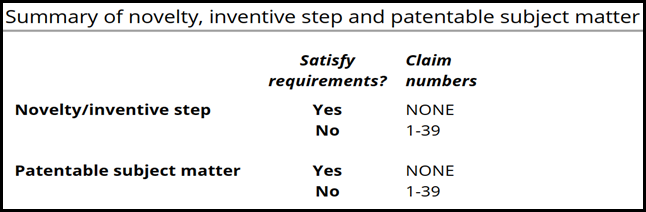
Details of examination objections are not readily available in IP Australia’s online Patent Search system. However, examination reports can be downloaded, in PDF format, from the eDossier section of the patent application details page. And, conveniently, for over a decade the examination report templates have included a summary table of substantive findings in relation to prior art and patentable subject matter, such as the example shown below.
I gathered data on recent examination outcomes using the following automated method.
- I identified all standard patent applications for which any substantive office action (either an examination report, or an acceptance) had issued between 1 January 2023 and 31 July 2026 (i.e. the most recent month for which my database was fully up-to-date at the time of the analysis).
- For each of these applications, I identified all substantive office actions that had issued, from the first examination report up to the time of the analysis.
- Where an examination report was issued, I downloaded the report PDF, and extracted the content of the summary table.
- Examination reports including MoM objections were those for which the corresponding ‘No’ entry int he summary table identifies at least one claim.
- Acceptances are treated simply as office actions for which all claims are novel, inventive and comprise patentable subject matter.
I created two data sets using this method. The first set comprises examination data for all applications having a first IPC classification within section/class G06, which covers ‘computing or calculating; counting’ and in which a majority of CIIs are classified. The second set comprises a random selection of just under 7000 applications (commensurate with the size of the first set) having a first IPC classification within any section/class other than G06. So, in effect, I am using ‘G06’ and ‘not G06’ as proxies for ‘many CIIs’ and ‘few CIIs’. There is contentious and uncontentious subject matter in both sets, but in vastly different proportions, and my hypothesis is that observable differences between the two sets are indicative of the different treatment of CIIs as compared with non-CIIs.
Subject Matter Objections in Decline
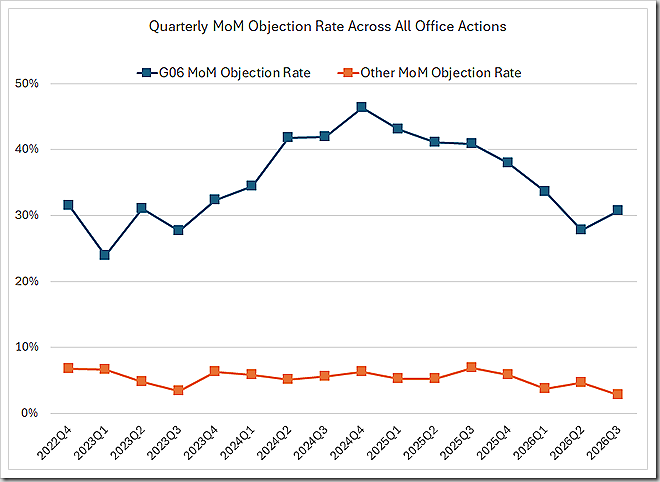
The chart below shows, on a quarterly basis, the proportion of all office actions (first and subsequent examination reports, as well as acceptances) that include a subject matter (MoM) objection, for both the G06 data set and the non-G06 (‘other’) data set. I chose a quarterly interval to smooth out a significant month-to-moth variation resulting from the relatively small (sometimes fewer than 200) number of office actions issued per month in each data set. It is apparent that while MoM objections in the ‘other’ data set have been fairly consistent at between around 4% and 7% over the period analysed, MoM objections have varied significantly between a low of 23.9% (Q1 2023) and a high of 46.3% (Q4 2024).
I do not presently have any theory as to why the G06 objection rate was lower prior to 2024, but I am considering further analysis that I could conduct to investigate this. For now I want to focus on two more recent periods:
- the 18 months from Q2 2024 to 2025 Q3, during which the G06 objection rate (notwithstanding the notable outlier in the middle) sat fairly consistently at just over 40%; and
- the nine months from Q4 2025 to Q2 2026 during which there is a clear decline of over 25% in the rate of G06 MoM objections (noting that the Q3 2026 data point is unreliable, since it is incomplete and includes only one month of data).
I criticised the October 2025 amendments to the examination guidelines for minimising the significance of the Full Court’s Aristocrat judgment, and largely maintaining the status quo. I was not the only one to do so – for example, on the IP Kat blog Dr Claire Gregg described the updates as ‘minimal’ and reported that, in response, a dedicated CII Task Force had been formed by FICPI Australia and supported by the Institute of Patent and Trade Mark Attorneys of Australia (IPTA) to propose further amendments to the Manual.
However, the data above indicates that even the minimal initial change in examination practice resulted in improved outcomes for CII applicants, with declines in MoM objection rates across Q4 2025 and Q1 2026 coming mostly prior to the High Court’s refusal of special leave, and the further amendments to the guidelines in March 2026. Following these additional developments, there was a steeper decline in Q2 2026 (although we should probably not read too much into this single data point). The effect of the most recent updates, in July 2026, remains to be seen. I am hearing, anecdotally, that the situation is continuing to improve for CIIs – but a couple of isolated experiences is hardly meaningful in comparison to the hundreds of examination reports captured in each quarter of my data set!
Patent-Eligibility Remains a Challenge for CIIs
The chart above clearly shows that, despite the post-Aristocrat decline, CIIs remain subject to MoM objections at a far higher rate than inventions in other fields of technology. The situation now is little different from where it was in 2023. To illustrate the overall impact of patent-eligibility in Australian examination, the chart below summarises the eventual outcomes for all applications in both data sets for which a MoM objection is raised in the first examination report.
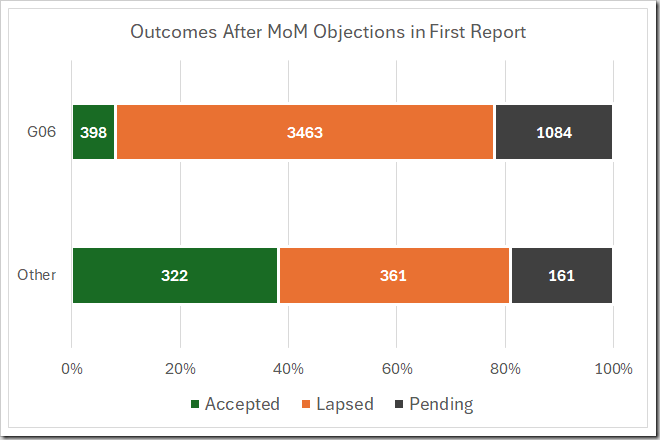
Once a first examination report has been issued, the applicant has 12 months within which to overcome any objections and achieve acceptance, otherwise the application lapses. The chart shows that in the CII data set (‘G06’), a total of 4,945 applications (out of 6,921) received MoM objections in the first report. Of these, only 398 (7.9%) went on to be accepted, while 3,463 (70%) ultimately lapsed. At the time of data extraction, 1,084 remain pending (i.e. the first examination report issued less than 12 months prior, and the application has yet to be finalised either way).
In the non-CII data set (‘other’), just 844 applications (out of 6,839) received MoM objections in the first report. Of these, 322 (38%) went on to be accepted, 361 (43%) ultimately lapsed, and 161 remain pending.
While this analysis does not look into exactly why each failed application lapsed (e.g. there may also have been prior art based objections that the applicant was unable or uninterested in overcoming) the implication of the comparison is clear: within this data set, once an application that is primarily classified in G06 has received a MoM objection, the prospects of achieving acceptance are little better than one in ten, whereas for applications otherwise classified the ratio is close to fifty-fifty. Add to this the fact that 71% of ‘G06’ applications received initial MoM objections, compared with just 12% of ‘other’ applications, it is clear that obtaining patent protection for CIIs remains challenging in Australia.
Conclusion – The Aristocrat Effect is Real, but Modest
The picture that emerges from this analysis is one of genuine, but modest, progress. The decisions of the Full Court and High Court in Aristocrat, together with the guideline amendments that followed, have produced an observable decline in the rate at which CIIs attract subject matter objections. In particular, I think we would all agree that a 40% reduction from the Q4 2024 peak is not a trivial effect. But the comparison with the ‘other’ data set puts this progress in perspective: CIIs are still objected to on MoM grounds at roughly six to ten times the rate of inventions in other fields, and once such an objection is raised, succeed in reaching acceptance at only around a fifth of the rate achieved by non-CII applications. Applicants pursuing CII protection in Australia are, on the data, meaningfully better off than they were eighteen months ago, but they remain in a substantially more difficult position than applicants in almost every other field of technology.
Whether the July 2026 guideline amendments, further feedback from stakeholders, or further bedding-down of the Aristocrat precedent through future decisions will narrow this gap further is a question that will only be answered once more quarters of data are available. For now, the appropriate conclusion is a cautious one: the Aristocrat effect is real, but it has so far softened rather than eliminated the Patent Office’s established scepticism towards computer-implemented inventions.


0 comments:
Post a Comment