
But here we are in mid-2026, and the wheels are visibly wobbling. Last month, the much-touted Brisbane Airport site was unceremoniously abandoned in favour of a council-owned site at Moreton Bay Central. Yet, despite pivoting to an empty lot at a former paper mill, it appears that neither the company nor the government has publicly walked back their foundational commitment to have the site operational by the end of 2027. Promising to build the world's first million-qubit, fault-tolerant computer from the ground up in just 18 months is, to put it mildly, an ambitious logistical – and technical – undertaking!
More importantly, I am writing about this now because we should not continue to ignore the sheer opportunity cost of this mega-project. While the government plays venture capitalist with a single, highly speculative hardware gamble, the reality is that Australian science may be reaching a breaking point.
According to the Australian Bureau of Statistics (ABS), Australia’s Gross Expenditure on R&D (GERD) was a mere 1.69% of GDP in 2023-24. This leaves us languishing far behind the OECD average, estimated at 2.93% in 2023, and significantly outpaced by peer economies that treat foundational research as critical infrastructure rather than a discretionary expense.
We are, quite literally, starving the ecosystem.
There is a profound irony at the heart of the PsiQuantum deal. The company is headquartered in Silicon Valley, but its co-founders are products of the Australian university system. They are the quintessential example of the ‘brain drain’ – talented innovators who left Australia when the domestic funding ecosystem failed to support their ambition. This leaves us spending nearly a billion dollars of taxpayer money to effectively buy back our own exported talent at a massive premium.
Yet, in doing so, we are contributing to the collapse of the very STEM pipeline required to produce the next generation of innovators. How does a government justify a near-billion-dollar bet on a speculative hardware project while simultaneously starving the foundation? The answer, as is so often the case in technology policy, lies in a deliberate semantic conflation. By using the word ‘quantum’ as a monolithic buzzword, policymakers have successfully blurred the lines between practical, deployable technologies and a long-term engineering marathon.
Let's dive in and look at the data.
The ‘Hunger Games’ of ARC Grants
While politicians eagerly don hard hats and high-vis vests for photo-ops at tech mega-projects, the researchers who actually drive domestic innovation are being quietly and systematically rejected by the nation's primary funding body.
To understand the depth of the crisis, we only need to look at the Australian Research Council (ARC). The ARC is the engine room of foundational STEM research in Australia, and its Discovery Early Career Researcher Award (DECRA) scheme is specifically designed to support the nation's most promising young talent. It represents the start of the pipeline for future prosperity.
Yet, the recent DECRA selection report for funding commencing in 2026 paints a grim picture. The overall success rate plummeted to just 13.1%, which is the lowest point since the scheme was introduced. Out of 1,532 applications, only 200 were approved.
Put simply, Australia’s premier research funding body is actively rejecting nearly 87% of our brightest early-career researchers.
So, on the one hand, the government is willing to bypass open, competitive tender processes to hand approximately A$940 million to a single, foreign-headquartered company in the hope of buying a slice of the global quantum computing market. On the other hand, it is starving its own domestic physicists, engineers, and computer scientists of the basic grant funding required to pursue sovereign ideas.
When early-career researchers face an 87% chance of failure simply trying to secure the funding to do their jobs, the resulting environment is less a functioning research ecosystem and more a fiscal Hunger Games. It should come as no surprise that, faced with such dismal prospects, Australia’s best and brightest are not just looking overseas for better opportunities; many are choosing to abandon the research sector entirely.
The Gig Economy of Science and the STEM Exodus
The downstream effect of these abysmal grant funding rates is a crisis in job security. You cannot build a sovereign quantum industry – or any advanced manufacturing sector – if the scientists and engineers required to build it cannot afford to stay in the profession.
In Australia today, academic research effectively functions as a highly-credentialed gig economy. The majority of early-to-mid-career university researchers are trapped on short-term or casual contracts strictly tied to these shrinking grant cycles. When an ARC application fails, the researcher does not just lose a project; they may lose their livelihood.
The human cost of this precarity is now showing up in the data. A recent survey conducted by the EMCR Forum (backed by the Australian Academy of Science) highlighted ‘widespread career uncertainty’, explicitly noting that the structure of research funding is driving increasing ‘attrition risks’.
More starkly, a recent analysis by peak body Science & Technology Australia (STA) warned of a ‘mass exodus’ currently underway in the sector. According to STA, nearly half of the STEM workers surveyed are looking to change jobs, and a devastating one-third plan to leave the sector altogether.
Combine this attrition with the recent, severe job cuts at Australia’s national science agency, the CSIRO, where hundreds of positions have been slashed due to funding failing to keep pace with the rising costs of research, and the government's quantum strategy begins to look entirely disconnected from reality.
We are handing a billion dollars to a Silicon Valley firm to build the ‘infrastructure of tomorrow’, while the sovereign scientific talent required to maintain, operate, and innovate upon that infrastructure is actively being forced out of the industry today.
The Bait and Switch: Sensing, Computing, and the ‘Encryption Threat’
To understand how a government justifies starving its foundational research base while dropping a billion dollars on a single, highly speculative hardware project, it helps to look at the language being used. In political press releases and mainstream media, the word ‘quantum’ has become a monolithic, magical catch-all that simultaneously means ‘stopping hackers tomorrow’, ‘finding underground minerals today’, and ‘inventing the next industrial revolution eventually’.
This semantic sleight-of-hand allows for a classic bait-and-switch. There are two primary branches of quantum technology relevant to this discussion, and they operate on entirely different timelines:
- Quantum Sensing and Timing: This technology is here now. These devices use quantum properties to measure gravity, magnetic fields, and time with unprecedented accuracy. For the defence and resources sectors, this means tangible, immediate capabilities, such as navigating submarines without GPS, or surveying underground mineral deposits with pinpoint precision.
- Quantum Computing: This is the long-term ‘holy grail’. It involves manipulating quantum states (qubits) to solve specific, highly complex mathematical problems that classical supercomputers cannot.
When defence departments and national security hawks push for urgent quantum funding, they are generally talking about the immediate tactical advantages of sensing. Yet, the Australian government took that momentum, and that funding, and spent A$940 million on computing.
The ‘Encryption Threat’ and the Scale Problem
The primary narrative used to justify treating quantum computing as an immediate national security crisis is a panic over a supposed threat to encryption – the fear that a quantum computer will soon break the public-key codes (RSA encryption) that secure our information on the global internet.
While it is mathematically true that a fully mature quantum computer running Shor's algorithm could crack RSA encryption, the timeline is constantly misrepresented by those with a vested interest in securing government capital, or lucrative public and private sector cybersecurity contracts. Achieving this requires a ‘utility-scale, fault-tolerant’ machine. Because physical qubits are inherently noisy and prone to environmental errors, you have to group massive numbers of them together to form a single, reliable ‘logical’ qubit. This is the essence of quantum error correction.
To break RSA, we do not need a machine with hundreds of physical qubits. We need one with millions.
While the physics of error correction has been validated in principle, scaling a system to millions of physical qubits operating flawlessly is a monumental engineering challenge. This is why the promise of building the world's first million-qubit, fault-tolerant computer in a brand-new facility in Moreton Bay in just 18 months strains credulity.
It also stands in stark contrast to the consensus of independent experts. Longitudinal surveys such as the one summarised in the chart below, from the Global Risk Institute's Quantum Threat Timeline Report, consistently show that top international physicists do not predict a high probability of a cryptographically relevant machine emerging for at least 15 years, with the highest likelihoods stretching out into the 20-to-30-year timeframe.
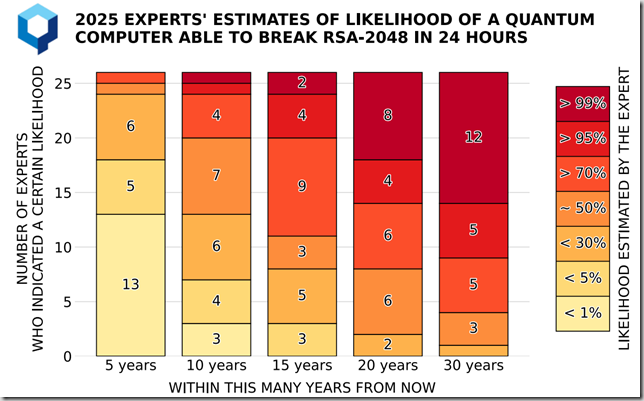
More aggressive timeline estimates often rely on highly optimistic ‘doubling times’, for the number of qubits in a single machine, which ignores the compounding physical friction of actually building these systems.
Buying the Wrong Future?
In my view, the Australian government has leveraged the very real, immediate need for quantum sensing and secure communications to justify a venture-capital-style gamble on a quantum computer that, even if successful, will not yield practical national security or commercial dividends for years.
If the goal was immediate national security, the money should have gone to sensing.
If the goal was protecting data, the money should have gone into migrating government networks to post-quantum cryptography (PQC) algorithms.
Instead, the government bought a highly speculative lottery ticket for the 2030s (or 2040s), paid for by the researchers who are being forced out of the sector today.
Conclusion: Portfolios, Not Photo-Ops
The tragedy of the PsiQuantum bet is not that the technology is unworthy of investment. It is the opportunity cost. Australia possesses a genuine, world-class quantum ecosystem built upon a quarter century of steady, foundational research. We have homegrown companies like Diraq, Silicon Quantum Computing, and Q-CTRL that have pioneered breakthroughs without needing a billion-dollar handout to locate here.
A resilient, sovereign tech strategy requires a ‘portfolio’ approach, not a single, winner-takes-all casino bet. It requires spreading capital across multiple local start-ups testing different approaches, hedging the nation's bets against unforeseen physics roadblocks. More importantly, it requires ensuring the base of the pyramid – the foundational grant system – is stable enough to keep talented Australians in the country to maintain the research and educational foundations necessary to support tech industries into the future.
Imagine what A$940 million could have achieved if deployed sensibly. It could have rescued the ARC DECRA scheme from its 87% failure rate, securing the careers of thousands of early-career physicists, engineers, and computer scientists. It could have funded a massive rollout of deployable quantum sensors for the defence and mining sectors, generating immediate economic returns. It could have provided vital seed capital to dozens of domestic start-ups.
Instead, we have an empty field in Moreton Bay and a research workforce in open revolt.
Until policymakers stop treating quantum physics as a political photo-op and start treating foundational STEM funding as critical national infrastructure, the Australian brain drain will only accelerate. You cannot buy the future if you refuse to fund the people required to build it.
Before You Go…
Thank you for reading this article to the end – I hope you enjoyed it, and found it useful. Almost every article I post here takes a few hours of my time to research and write, and I have never felt the need to ask for anything in return.
But now – for the first, and perhaps only, time – I am asking for a favour. If you are a patent attorney, examiner, or other professional who is experienced in reading and interpreting patent claims, I could really use your help with my PhD research. My project involves applying artificial intelligence to analyse patent claim scope systematically, with the goal of better understanding how different legal and regulatory choices influence the boundaries of patent protection. But I need data to train my models, and that is where you can potentially assist me. If every qualified person who reads this request could spare just a couple of hours over the next few weeks, I could gather all the data I need.
The task itself is straightforward and web-based – I am asking participants to compare pairs of patent claims and evaluate their relative scope, using an online application that I have designed and implemented over the past few months. No special knowledge is required beyond the ability to read and understand patent claims in technical fields with which you are familiar. You might even find it to be fun!
There is more information on the project website, at claimscopeproject.net. In particular, you can read:
- a detailed description of the study, its goals and benefits; and
- instructions for the use of the online claim comparison application.
Thank you for considering this request!
Mark Summerfield


0 comments:
Post a Comment