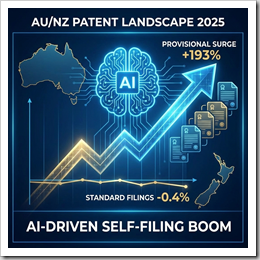
The Australian and New Zealand patent filing landscape in 2025 was marked by the continuation of established market trends alongside a striking new development that has potentially significant implications for both the patent system and the patent attorney profession. Total standard patent applications filed in Australia decreased marginally by 0.4% to 30,327, representing the third consecutive year of modest decline following a pandemic-era peak. New Zealand complete applications fell more substantially, by 4.4% to 5,538. However, these figures were eclipsed by a dramatic surge in provisional patent filings driven by what appears to be widespread use of generative AI tools by self-represented applicants, a phenomenon that resulted in a near-tripling of self-filed provisional applications.
Market share dynamics continued to evolve in ways that present ongoing challenges for firms within the IPH Limited group. Independent firms collectively surpassed the 50% filing share threshold for the first time, accounting for 51.7% of Australian patent filings, while IPH's share declined further to 32.7%, down from 35.0% in 2024. Meanwhile, QANTM IP firms maintained relatively stable positioning at 15.6% filing share under private equity ownership. This continuing divergence reinforces the conclusion that ownership structure alone cannot explain firm performance, with factors including geographic market exposure, client demographics, and strategic positioning all playing significant roles.
Analysis of the 2025 data reveals a market navigating multiple concurrent trends: declining US-originating applications (down 5.1%), growing Chinese filings (up 13.5%), and the emergence of AI as both a potential disruptor and, paradoxically, a possible source of future work for patent attorneys.
Let’s dive in and look at the data.
Standard Patent Filings in Australia
The following chart shows the number of complete (i.e. non-provisional) patent applications filed each year in Australia between 2014 and 2025, in total, and broken down by filing route – direct filings, and filings via the Patent Cooperation Treaty (PCT) system. The total number of standard patent applications filed in Australia during 2025 was 30,327, representing a slight decrease of 0.4% compared to 2024, following larger declines of 2.3% and 3.3% in 2023 and 2024 respectively.
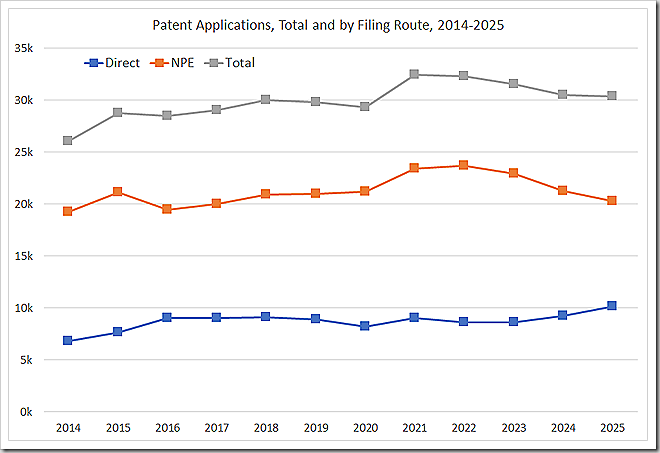
The data show a continuation of the recent trend of increasing direct filings – up by 9.2% – and decreasing filings via PCT national phase entry – down by 4.6%. While data from the World Intellectual Property Organization (WIPO) indicates that there was a decline in international (PCT) applications in 2023, which could have impacted Australian filings in 2025, the longer-term trend in PCT filings is that they have essentially plateaued since 2020 following many years of growth. If subsequent Australian national phase filings followed the same pattern we would expect to see the numbers holding steady, rather than declining. But with direct filings increasing as nation phase filings fall, it seems that there may be some ongoing shift in the preferred route chosen by applicants wishing to file patent applications in Australia.
Provisional Filings and the Impact of AI
The chart below shows the number of provisional application filings in Australia between 2014 and 2025, in total, and broken down by agent – those for which applicants were represented by an identifiable registered patent attorney or firm, and those for which the applicant was self-represented, or where the identifiable filing agent was a non-attorney third party. The numbers for 2025 are … well … interesting!
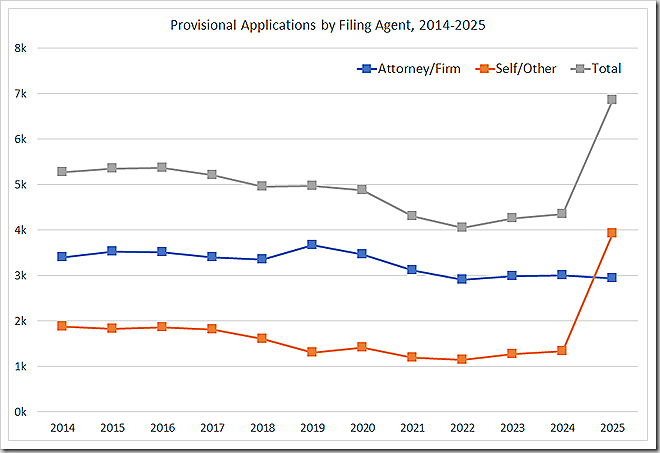
The massive increase, of 193%, in largely self-filed provisional was already evident last year, and I have previously speculated (not that I think much speculation is required) that this is due to applicants believing that AI can draft patent applications for them. They are wrong – as many of those who choose to proceed further with these applications will eventually discover – but that has not prevented them from going down this dubious path.
Most of the self-represented applicants are private individuals, and I see no point in identifying them. I will note, however, that the single largest filer of Australian provisional applications in 2025 was the self-represented company Nuwey Pty Ltd, which was registered on 12 December 2025, and filed 158 provisional applications during the remaining weeks of the year, all supposedly the work of a single (human) inventor!
The leading attorney-represented provisional applicants for 2025 were dominated (as always) by universities and other public research institutions, along with the usual corporate suspects: NewSouth Innovations (60); University of Sydney (45); CSIRO (43); University of Queensland (41); ResMed Pty Ltd (37) (the Singaporean arm, ResMed Asia Pte Ltd also filed 17 applications); University of Melbourne (36); Breville Pty Ltd (25); University of Adelaide (21); Macquarie University (20) and RMIT University (18).
As I noted in my previous analysis, the overwhelming majority of the additional self-represented applications in 2025 were filed by new users of the patent system. These are, presumably, individuals and companies (operated by individuals) who are, and probably always were, unwilling to pay for the services of a patent professional. There has been little change in the number of applications filed with the assistance of a patent attorney – a slight decline, but well within the variation over the past few years – suggesting that AI is not currently taking work from the profession but, rather, is being used by people who have no intention of engaging with the profession anyway. This is, potentially, a problem for the system, but it is not (yet) a problem for the patent attorney profession. It is definitely, however, something that we need to keep an eye on.
Australian and New Zealand Filings
Looking at filing activity across both jurisdictions in 2025, shown in the bar chart below, the total number of patent applications (standard plus provisional) filed in Australia was 37,210, representing an increase of 6.8% from the previous year, and driven by the surge in self-filed provisional applications. In New Zealand, 6,283 applications were filed, up 1.2% from 2024 – also the result of a significant increase, from 416 to 745, in the number of provisional applications filed.
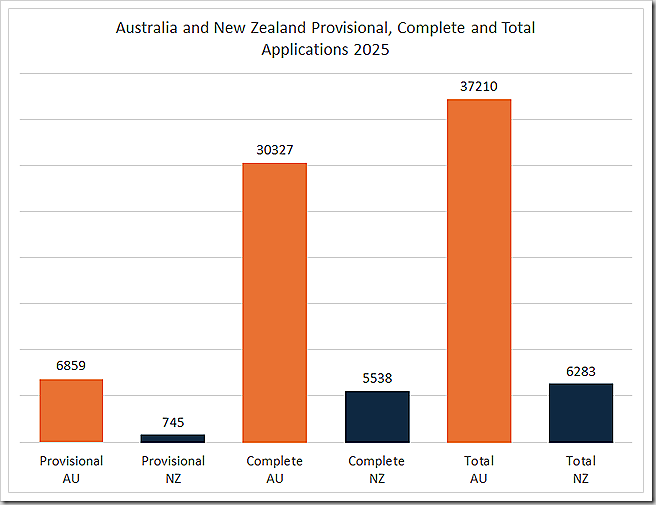
On the other hand, New Zealand complete (i.e. non-provisional) patent applications fell by 4.4% to 5,538 (compared with the 0.4% decline in Australia).
The relative scale of patent filing activity between the two jurisdictions has once again remained relatively stable, with the number of complete applications filed in New Zealand being just under 20% of Australia, while the relative number of provisional filings in New Zealand has increased slightly, to a little over 10%.
Leading Firms – Total Filings
The following charts of patent filings by the leading attorney firms across Australia and New Zealand show that the overall composition of top filing firms remains largely unchanged, with just a few shifts in relative positions. Second and third places have swapped relative to the previous year, with FB Rice edging ahead of Davies Collison Cave. Further down the list, Madderns has risen by two places, out-filing both James & Wells and RnB IP in 2025. JMSD IP (a.k.a. Jones Maxwell Smith & Davis), formed from a merger of Foundry IP and Davis IP in March 2025 has replaced Foundry IP in the rankings (for the purposes of this data, I have attributed all prior filings by both Foundry IP and Davis IP to JMSD IP). Laminar IP replaces IP Gateway in 18th position, although the final places on my truncated list are always closely contested, and IP Gateway only just missed the cut this year.
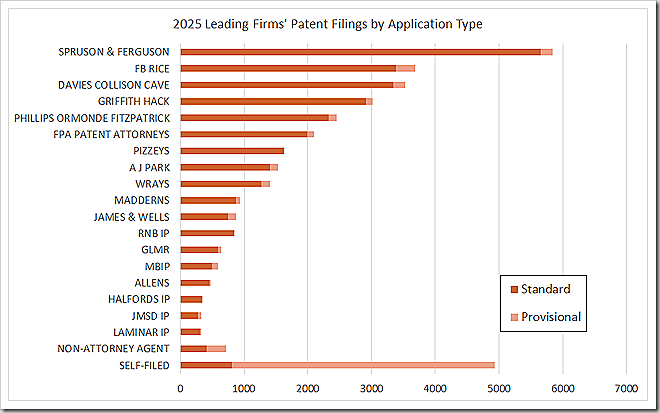
The above chart shows the total number of filings categorised by application type, i.e. standard versus provisional applications. There have been increases in both standard and provisional applications filed without the assistance of a patent attorney with – as has already been observed – by far the largest growth in self-filed provisional applications.
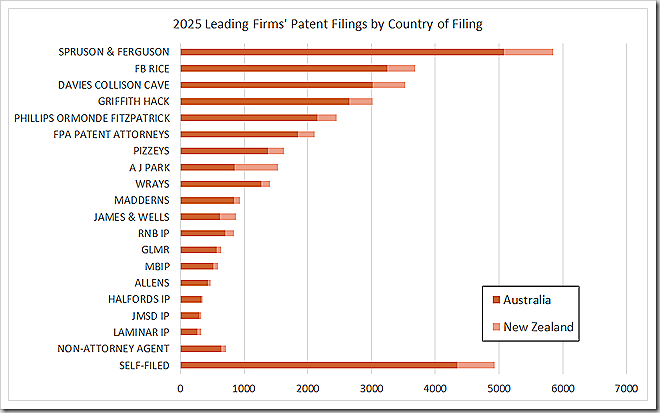
The chart below shows the same total filings, but now categorised by country of filing – Australia versus New Zealand (noting, for those unfamiliar with our system, that there is a single trans-Tasman registration regime that permits attorneys to practice in both jurisdictions). As in previous years, the largest New Zealand-based firm, A J Park, filed the highest proportion of New Zealand applications among the leading firms. There was, as in Australia, an increase in non-attorney-assisted filings in New Zealand, although not to the same extent.
Firm Gains and Losses in Patent Filings
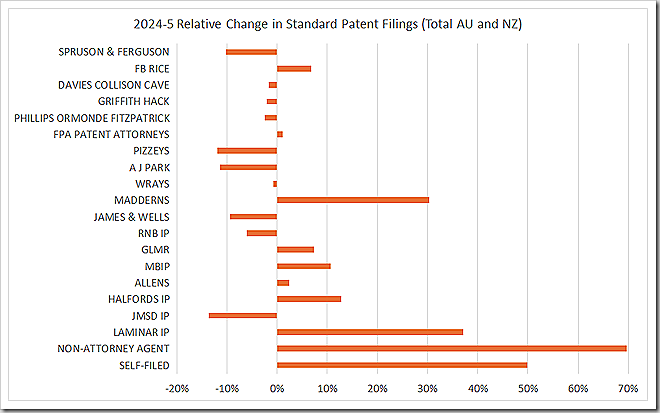
The chart below shows relative changes in filings of complete (i.e. non-provisional) patent applications by the leading firms, across both Australia and New Zealand. Firms held within the publicly-listed IPH group recorded notable declines: Spruson & Ferguson (-10.1%), Griffith Hack (-2.1%), Pizzeys (-11.9%), and A J Park (-11.4%). Firms in the QANTM IP group – now held by private equity – fared better, with Davies Collison Cave down marginally by 1.6%, while FPA Patent Attorneys recorded a 1.2% increase.
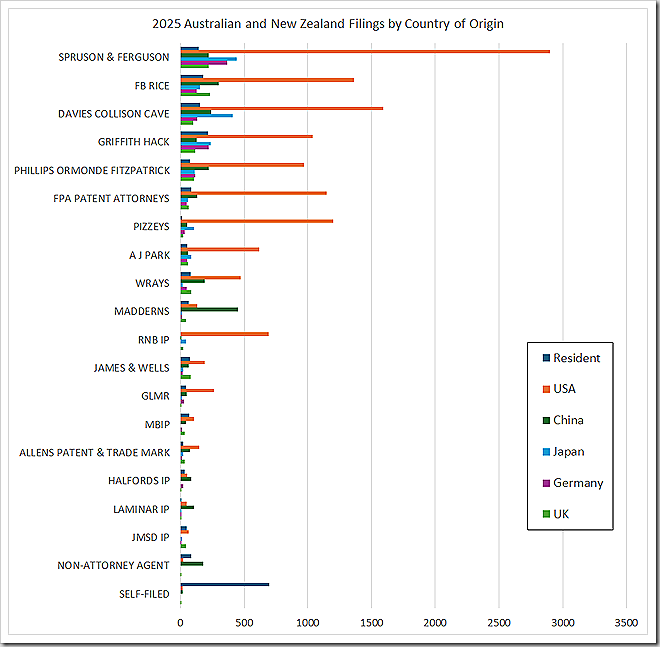
Once again, a significant factor in the declining numbers of some firms was exposure to the US market. Total filings by US-based applicants fell once again in 2025, by 5.1%, following on from a reduction of 5.7% in 2024. As the chart below shows, firms with high US exposure relative to their overall filings (i.e. over 50%) include Spruson & Ferguson, FPA Patent Attorneys, Pizzeys, and RnB IP, of which only FPA Patent Attorneys maintained its filing numbers in 2025. On the other hand, the strongest growth market is China, with applications of Chinese origin increasing by 13.5% in 2025. The firm that has best capitalised on this growth is Madderns, which handles more Chinese filings than any other firm (including all of its larger competitors). Madderns, notably, currently has two partners, one associate and two trainee patent attorneys who, according to their web site, speak Mandarin as a secondary language.
Filing Shares of Group and Independent Firms
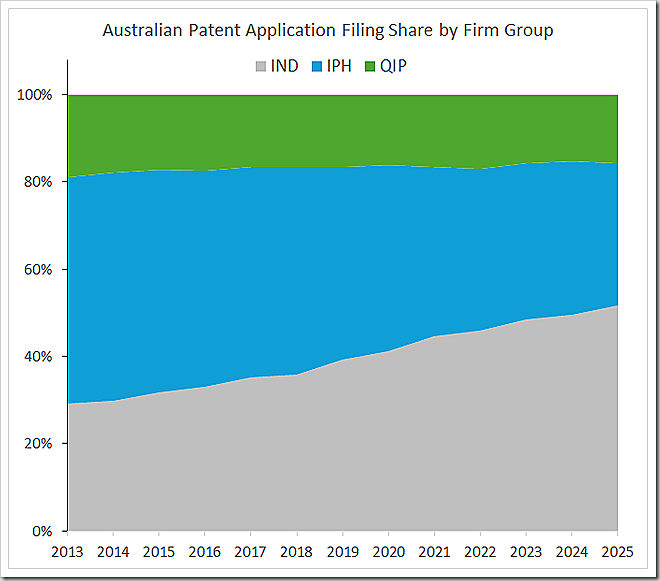
The chart below, of total filing share across attorney firm groupings, shows a continuation of established trends. Independent firms once again collectively increased their share of Australian patent filings, and accounted for more than half of all filings, at 51.7%. Firms in the privately-owned QANTM IP group maintained share, being responsible for 15.6% of filings (up marginally from 15.4% in the previous year). Meanwhile, the IPH group – comprising Spruson & Ferguson, Griffith Hack, Pizzeys and A J Park – has experienced a further decline in collective share to 32.7%, compared with 35.0% in 2024.
The following chart provides a breakdown of the distribution of filing share among independent firms. FB Rice remains the largest with 10.0% of total filings (up from 9.2% in 2024), followed by Phillips Ormonde Fitzpatrick at 6.9% (down from 7.0%). Wrays increased its share slightly, to 3.9% (up from 3.8%), while smaller independent firms including Madderns, James & Wells, RnB IP, MBIP and GLMR collectively account for around 10% of total filings.
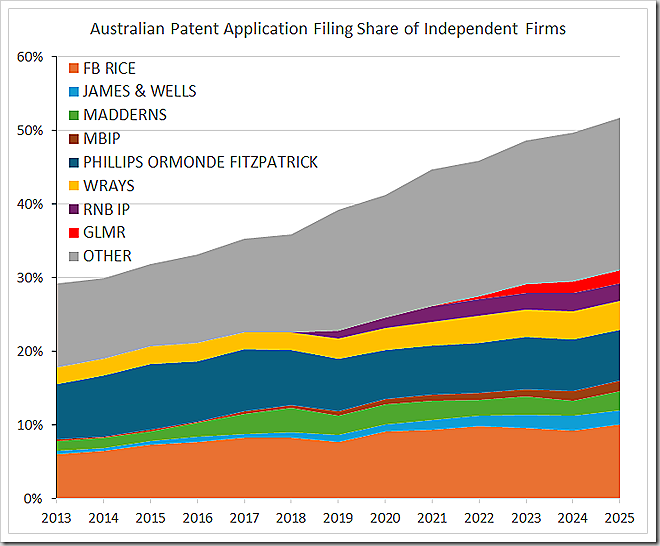
The numerous other small independent practices continue to increase their collective presence, now accounting for 20.7% of all Australian patent filings, up from 20.5% in 2024.
Conclusion – AI is (as Elsewhere) the Big Story of 2025
Most of the trends apparent in the above charts are continuations of previously-observed developments – declining filings from the US, rising filings from China, and a steady leakage of filing share from the listed IPH group of firms to independent firms. On this last point, it remains notable that merely being a member of an ownership group, publicly listed or otherwise, is not necessarily a driver of this trend, since firms in the QANTM IP group have consistently maintained filing share under both public and private ownership. The drivers of agency work away from IPH firms, and towards independent firms, are not clear to me, and I would not venture to speculate.
But (of course) the big story is AI, which appears to be behind a massive increase in self-filed applications – particularly provisionals – in 2025. In some ways this is unsurprising, and I expect other patent offices are seeing similar behaviours (although, unfortunately, the lack of public information about unpublished applications in other jurisdictions means that this is no more than an educated guess).
But what particularly strikes me as interesting is that the increase in self-filed applications has not been accompanied by any apparent decrease in the number of attorney-filed applications. That is to say, while AI is being used by applicants to prepare applications – and possibly to generate prospective ‘inventions’ in the first place – it is not being used to replace patent attorneys. The overwhelming majority of applicants who are using AI have never engaged an attorney in the past, and presumably would not have engaged an attorney in 2025 even in the absence of AI.
It is even possible that AI-assisted provisional applications may lead to additional work for patent attorneys in the coming years. I am hearing, anecdotally, of attorneys fielding enquiries from applicants requiring assistance when it comes to the next steps of navigating national, and international, non-provisional filing and examination processes. Whether these applicants will make ‘good’ clients, or whether they will arrive with more problems than they can afford to have an attorney solve for them, remains to be seen. I will, however, be looking at the filing data closely as this year progresses to try to identify the proportion of self-filed applications that proceed beyond the provisional stage.


0 comments:
Post a Comment