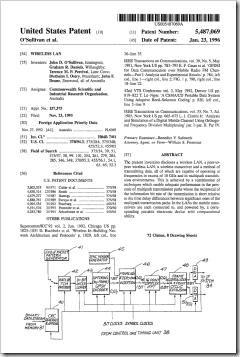
 In all of the debate over the past week around the CSIRO wireless LAN patent, there has been very little information – and much misinformation – about what the patent actually covers.
Various vague assertions have been bandied about, such as that the patent describes nothing much more than a few techniques that were well-known at the time (the priority date of the patent is 27 November 1992).
And some commenters on the various articles have complained that none of the authors have actually gone into any technical detail about the patent.
There is a good reason for this – it is not simple to explain in detail the technical and legal scope of a patent. While patent attorneys actually do this all the time, in order to advise clients on various matters, we tend to charge significant sums for the service, because it takes great expertise and many hours to do it right.
The part of a patent that actually defines the extent of the monopoly is the section at the end containing a series of numbered statements, called ‘claims’. If you do something which is actually within the entirety of the language of at least one claim, then you infringe the patent. However, if you do something which is described in the patent specification, but which is not the entire subject matter of a claim, then you do not infringe. Ideally, this would all be very clear-cut. In practice, with the best will (and the best patent drafting) in the world, language is an imprecise and sometimes ambiguous tool!
Most patents describe many things that are not new. However, granted patents (hopefully) describe and claim some combination of things which is new and inventive.
So in this article we will – at no charge, with no obligation, and with the strong disclaimer that this is not legal advice and cannot be relied upon for any purpose – take a look at what the CSIRO WLAN patent is actually all about.

 I am sometimes asked – as I am sure most patent attorneys are – whether it is possible to patent a recipe. This provides a sufficient connection to the subject matter of this blog to allow me, as a special ‘Easter report’, to post my recipe for hot cross buns, which is surely not patentable. But first, for those who are actually interested, I shall explain how recipes are treated under the patent laws.
 As has been widely reported in recent days, Australia’s CSIRO has settled outstanding patent claims against US telecommunications companies including AT&T, Verizon and T-Mobile for around $220 million. The case against these companies has been ongoing for almost two years, although litigation involving the patent in question, which relates to technology underlying all commonly-deployed wireless local area networking (WLAN) systems and components, has a far longer history than this.
  When IP Australia released its Consultation Paper setting out details of proposed fee changes, it simultaneously revealed plans to expand online services, with some fees to be reduced when transactions are conducted online rather than via traditional payment channels (see


